Summary
- Real Energy Independence: By pairing solar panels with an electric vehicle, it allows you to create your own free fuel at home. This means your EV is truly zero-emissions. You’ll also be protected from volatile petrol and diesel prices.
- The Smart Charger Advantage: To charge efficiently, you need a smart EV charger (like Zappi). They monitor your home’s energy in real-time and only send surplus solar power into your car battery.
- Annual Savings: The average Irish driver can save over €1,600 per year on fuel compared to a petrol car by switching to solar-powered charging. They can also avail of SEAI grants of up to €1,800 for solar and €300 for the charger.
- All-in-One Solution: Homeowners can install a combined system of panels, a smart charger and a battery, for the most efficiency. The battery allows you to store solar energy during the day and charge your car for free overnight.
For homeowners in Ireland, the last few years have seen a “perfect storm” of rising energy costs and a surge in electric vehicle (EV) adoption. If you’re one of the thousands making the switch to an EV, you’re already saving a fortune on petrol or diesel.
But one question is on every new and potential EV owner’s mind: “Can I power my new EV with my own solar panels?”
The short answer is: Yes, absolutely. And it’s one of the single best financial and environmental moves you can make. It’s the dream scenario: you create your own clean electricity on your roof and use it to run your car for free. It’s the ultimate way to achieve true energy independence.
However, you can’t just plug your car into a standard socket and hope for the best. To do it properly, you need the right technology.
This guide will break down everything you need to know about pairing solar panels with an EV charger in Ireland, from the tech involved to the costs and incredible savings.
Why Charge Your EV with Solar?
Pairing solar panels with an electric car isn’t just a gimmick; it’s a perfect synergy. The two technologies solve each other’s problems.
- “Free” Fuel, Forever: This is the most obvious benefit. The sun’s energy is free. Once your panels are installed, every kilometre you drive on solar-generated electricity is a kilometre you didn’t pay for. With grid electricity prices remaining volatile, this protects you from future price hikes.
- Become Genuinely Zero-Emissions: An EV is only as clean as the electricity that powers it. If you’re charging from the grid at night (which is often powered by gas), you still have a carbon footprint. Charging directly from your own solar panels makes your EV truly zero-emissions.
- Maximise Your Solar Investment (ROI): The SEAI’s “Clean Export Guarantee” is a great step forward, but you are paid a much lower rate for exporting your excess solar power than the rate you pay to buy it. The most-savvy homeowners use every last kilowatt they generate. Using that surplus electricity to charge your 60kWh car battery is far more valuable than exporting it for a few cents.
- Energy Independence: There is no better feeling than watching your meter and knowing you’re not importing from the grid. You’re generating, storing, and using your own power for your home, your hot water, and your car.
How Does Charging an EV with Solar Actually Work?
This is where the technology gets clever.
When your solar panels are generating electricity, your home’s appliances (fridge, TV, etc.) will use it first. If you’re generating more power than your house needs, this “surplus” or “excess” electricity has to go somewhere.
Without an EV, it would just be exported back to the grid.
But you can’t just plug your car in. A standard EV charger doesn’t know where the electricity is coming from. It will just pull 7.4kW of power from whatever source is available and if your panels are only producing 2kW, the charger will pull the other 5.4kW straight from the grid, costing you money.
This is where the single most important piece of the puzzle comes in. To charge your car only with solar, you need a Smart EV Charger.
A Smart EV Charger (sometimes called an “eco-friendly” or “solar-aware” charger) is the “brain” of the operation. It communicates with your solar panel system and your home’s main electricity meter.
Here’s how it works:
- A “CT Clamp” is Installed: A small device called a Current Transformer (CT) clamp is attached to your main electricity cable. This clamp’s job is to monitor your whole house. It can see in real-time if you are importing power from the grid or exporting surplus solar power to the grid.
- The Smart Charger Reads the Data: The clamp sends this information to the smart charger. The charger now knows exactly how much spare, free solar electricity is available at any given second.
- You Choose Your “Eco-Mode”: This is the magic. You select a “solar-only” or “eco” mode.
The Magic of “Eco-Mode” (Solar-Only Charging)
When you set your smart charger to its eco-mode, it will behave in one of two ways:
- 1. “Solar-Only” Mode: This is for the purist. The charger will wait until it detects a minimum amount of surplus solar (usually 1.4kW) before it even begins to charge the car. If a big cloud covers the sun and your surplus drops, the charger will pause the charging session. When the sun returns, it resumes. Your car will only ever receive 100% free, solar-generated electricity.
- 2. “Eco-Boost” Mode: This is a blended mode. It will use all available solar power and then “top up” from the grid to a consistent level (e.g., 3.6kW). This is useful if you need to charge but still want to maximise your free energy and charge faster than the sun alone will allow.
Of course, all smart chargers also have a “Boost” or “Fast” mode. This setting makes it act like a normal charger, pulling the full 7.4kW (from solar and grid) to charge your car as fast as possible, regardless of cost.
What Do I Need for the Perfect Solar EV Charging Setup?
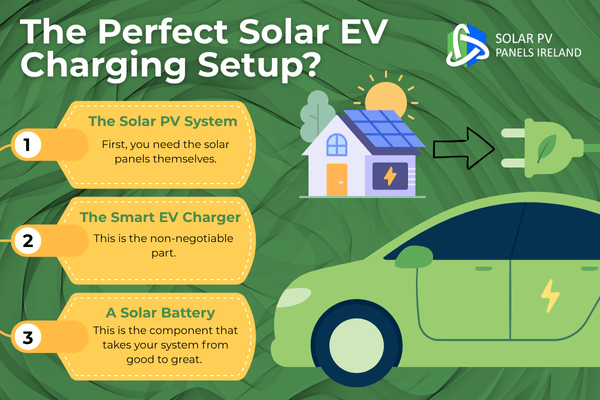
To get this system up and running, you need three key components.
1. The Solar PV System (The Engine)
First, you need the solar panels themselves. A common question we get is, “How many panels do I need to charge my car?”
Let’s break down the maths for a typical Irish homeowner:
- A standard EV gets about 5-6 km per kWh of electricity.
- The average Irish driver travels about 17,000 km per year.
- This means the average EV needs ~2,800 – 3,400 kWh of electricity per year to run.
Now, let’s look at a solar panel system:
- A modest 6kWp solar system (around 14-16 high-efficiency panels) in Ireland will generate, on average, 5,100 – 5,400 kWh per year.
As you can see, a standard-sized solar PV system generates more than enough electricity over the year to cover the entire annual mileage of your car. The challenge is simply getting that power into the car, which is where the smart charger comes in.
2. The Smart EV Charger (The Brain)
This is the non-negotiable part. As mentioned, this is the device that monitors your solar output and diverts the surplus to the car. Brands like Zappi are market leaders in this and are specifically designed for this “solar-aware” charging.
3. A Solar Battery (The “Optional but Powerful” Extra)
This is the component that takes your system from good to great. Most people are at work during the day when the sun is shining and solar generation is at its peak. They are at home in the evening and overnight, when the car needs to be charged.
- Without a battery: You can only charge your car with solar when it’s sunny and the car is physically plugged in at home.
- With a battery: Your panels generate free electricity all day and store it in your 5-10kWh home battery. You come home at 7 PM, plug in your EV, and your smart charger pulls that free, stored solar energy from your home battery and puts it into your car battery.
This is the ultimate setup: you charge your car overnight, for free, using the energy you captured 8 hours earlier.
Let’s Talk Numbers: Irish Costs, Grants & Savings
This combination of tech is a significant investment, but the payback is faster than ever.
The Savings
- Petrol/Diesel: The average Irish driver (17,000 km) in a petrol car (5.5 L/100km) at €1.80/L is spending €1,683 per year on fuel.
- Grid Electricity: That same driver in an EV (17,000 km) charging only on the grid at a 35c/kWh average rate is spending €1,071 per year on electricity. (This is still a good saving!)
- Solar Power: That same driver charging only from their solar panels is spending €0 per year on electricity.
Your annual saving on “fuel” is over €1,600 compared to a petrol car, and over €1,000 compared to grid-charging your EV.
The Grants
The Irish government actively supports this move through the SEAI.
- SEAI Solar PV Grant: You can receive up to €2,100 towards the cost of your solar panels and a battery (or €2,400 for panels alone, though this is changing in 2025). This makes the initial investment much lower.
- SEAI Home EV Charger Grant: You can claim a separate grant of €300 towards the cost and installation of your smart EV home charger.
These two grants are separate and can be combined, knocking a significant amount off the total installation cost.
The Solar PV Panels Ireland “All-in-One” Solution
Here’s a common problem: you get a solar company to install your panels, and then you have to find a separate electrician or EV charger company to install the charger. The two teams might not communicate, and you’re left trying to figure out if the systems are compatible.
This is where we come in.
At Solar PV Panels Ireland, we are experts in the entire home energy ecosystem. We don’t just install solar panels, and we don’t just install EV chargers. We design and fully install them together.
Our expert team will handle your entire project from start to finish:
- Free Survey: We design the perfect solar PV system for your roof.
- Battery Storage: We’ll size a battery (if you want one) to meet your home’s needs.
- Smart EV Charger: We will supply and install a top-tier smart EV charger at the same time.
- One Installation: Our team does it all in one go, ensuring your panels, inverter, battery, and charger are all communicating perfectly from day one.
- Grant Handling: We’ll guide you through the SEAI grant applications for both your solar and your EV charger.
You get one point of contact, one seamless installation, and the peace of mind that your system is designed to work as one.
The Final Verdict: Is It Worth It?
Without a doubt, yes. Charging your EV with your own solar panels is the single most powerful way to take control of your energy costs. It future-proofs your home, slashes your bills, and turns your car into a truly zero-emissions vehicle.
You’ve already made the smart move by choosing an EV. Now, take the final step and run it on free, clean energy that you generate yourself.