Summary
- Normal Generation: Every year, a well-installed 1kWp solar system in Ireland generally produces between 900 and 1,100 kWh of clean electricity. A standard 8-panel (3.2kWp) system can cover roughly 65–75% of an average family’s energy needs.
- Light Over Heat: Solar panels convert light, not heat, into power. Ireland’s mild climate actually helps maintain panel efficiency. Modern tech allows solar panels to capture 20–40% of their peak power even on very cloudy days.
- Seasonal Changes: Energy generation will be highest between May and September. It makes up about 75% of your annual total. Adding a battery allows you to store excess daytime energy for use during dark winter evenings.
- Smart Savings: You save the most by using your solar power directly. Any excess you don’t use is automatically sold back to the grid through the Clean Export Guarantee (CEG). This will earn you credits on your bill.
If you’re thinking about making the switch to green energy and cutting those hefty electricity bills, you need a straight answer: How much electricity does a solar panel actually produce here in Ireland?
The short, honest answer is that it’s impossible to give you a single, neat figure without knowing the specifics of your roof. But don’t worry, we can give you some seriously solid estimates.
On average, a well-installed 1-kilowatt-peak (kWp) solar PV system in Ireland will churn out anywhere between 900 kWh and 1,100 kWh of clean electricity per year.
That’s a brilliant starting point, but to really understand the potential savings for your home, we need to dive into the technical bits, the seasonal shifts, and the simple fact that our mild, temperate climate is actually better for solar than you might think. Get comfortable, because we’re going to walk you through everything you need to know about harnessing the power of the Irish sun.
The Numbers Game: Understanding PV Output in Ireland
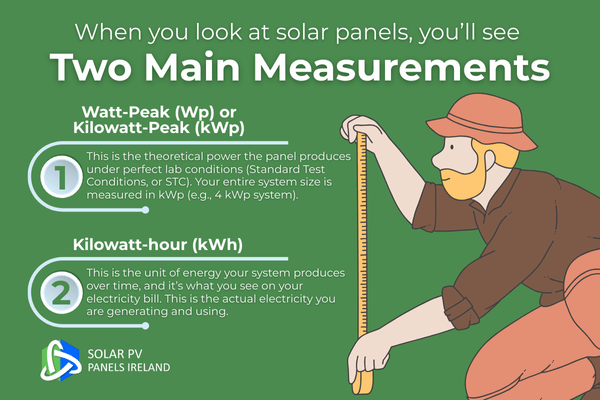
Before we talk about your roof, let’s quickly clear up the jargon. When you look at solar panels, you’ll see two main measurements:
- Watt-Peak (Wp) or Kilowatt-Peak (kWp): This is the theoretical power the panel produces under perfect lab conditions (Standard Test Conditions, or STC). Your entire system size is measured in kWp (e.g., 4 kWp system).
- Kilowatt-hour (kWh): This is the unit of energy your system produces over time, and it’s what you see on your electricity bill. This is the actual electricity you are generating and using.
What Does a Single Panel Produce?
Let’s look at a modern, high-efficiency panel, typically rated around 400 Watts (0.4 kWp). Under average Irish conditions, one of these panels can produce roughly 730 kWh to over 1,022 kWh per year, depending entirely on its location and orientation. On an average day, you’re looking at about 1.75 kWh to 2 kWh from that single panel.
Typical Output for an Average Irish Home
The average Irish household consumes about 4,200 kWh of electricity annually. Very few people install a solar system aiming to cover 100% of this, as it often means generating excess power in the summer that is then sold cheaply. Instead, most people aim for optimal self-consumption, using the majority of what they generate.
Here are some typical system sizes and what you can realistically expect them to generate in a calendar year, assuming a good, south-facing installation:
| Home Size/Energy Use | System Size (kWp) | Approximate Number of Panels (400W) | Estimated Annual Generation (kWh) | Coverage of Average Usage |
|---|---|---|---|---|
| Small / Low Usage | 2.5 kWp | 6–7 | 2,250 – 2,750 | ~50–60% |
| Average Family Home | 3.2 kWp | 8 | 2,800 – 3,200 | ~65–75% |
| Larger Home / EV Charger | 4.9 kWp | 12 | 4,200 – 4,800 | ~90–100% |
| High Usage / Electric Heating | 6.0 kWp+ | 15+ | 5,400+ | 100% + |
As you can see, a standard 8-panel, 3.2 kWp system, which is very common, will produce enough energy to cover well over two-thirds of the electricity bill for a typical family. That’s a massive saving! It means that for 7-9 months of the year, you’ll barely be touching the grid, apart from perhaps overnight for the odd few bits.
Cracking the Code: The Key Factors Influencing Solar Generation in Ireland
While the estimates above are handy, the real-world output of your panels is complex and influenced by seven core factors. Understanding these will help you set realistic expectations and, more importantly, ensure your system is designed for maximum efficiency.

1. Orientation and Tilt: Getting the Angle Right
This is arguably the most crucial factor after system size.
Tilt (Angle): The ideal tilt angle for maximum annual production in Ireland is typically between 30 and 35 degrees. This angle is calculated to balance the low winter sun and the high summer sun. Thankfully, most pitched roofs in Ireland naturally fall within this optimal range, making installation straightforward.
Orientation (Direction): In the Northern Hemisphere, a true south-facing roof is the gold standard. This orientation provides the maximum yield over the course of the year. If your roof faces South-East or South-West, that’s absolutely fine, your output will only be about 5-10% lower. Even East- or West-facing roofs can still achieve 80-90% of the optimal output, making them fantastic options, especially if you use more power in the morning (East) or evening (West). North-facing roofs, however, are generally avoided as the production drops off too much to be cost-effective.
2. Ireland’s Climate: Sunshine vs. Diffused Light
Here’s the massive misconception: you don’t need direct, blazing hot sun for solar PV panels to work.
Cloudy Days Still Produce: On a typical Irish overcast day, modern monocrystalline solar panels are highly effective at capturing diffused light. While output is obviously lower than on a bright, sunny afternoon, panels can still generate 20% to 40% of their peak power even when it looks like rain. This reliable, consistent generation, day in, day out, is what makes solar panels a brilliant long-term investment here.
It’s Not Heat, It’s Light: Solar panels convert light (photons) into electricity, not heat. In fact, excessive heat is actually detrimental! Panels lose a little efficiency when they get roasting hot, so Ireland’s mild, temperate climate is actually a hidden bonus, keeping panel temperatures down and their efficiency up.
3. Shading and Obstructions: The Efficiency Killers
- Shading, even partial shading from something as small as a chimney or a nearby tree branch, can significantly reduce the output of an entire string of panels. Imagine a garden hose, if you squeeze it anywhere along its length, the flow is reduced for the whole hose. Traditional solar panels wired in series often work the same way.
- The Modern Solution: This is where smart technology comes in. High-quality systems use Micro-Inverters or Power Optimisers. These clever devices sit behind each individual panel and manage the generation separately. If one panel is shaded, the others keep churning out electricity at full capacity, minimising loss and maximising your overall yield. This is a critical factor when choosing an installer.
4. Panel Quality and Degradation
Not all panels are created equal. Investing in high-quality panels ensures better long-term performance.
- Degradation: All solar panels naturally lose a tiny bit of output over time. This is called degradation. Good panels are typically guaranteed to still produce 80-85% of their original output after 25 years. This gradual decline is factored into any reputable return-on-investment calculation.
- Efficiency: Most top-tier panels used in Ireland have an efficiency rating between 20% and 23%. Higher efficiency means more electricity generated from a smaller area of the roof. If you have limited roof space, high-efficiency panels are a necessity.
5. Inverter Quality and Design
The inverter is the brains of your operation. It converts the Direct Current (DC) electricity produced by the panels into the Alternating Current (AC) used in your home. A quality inverter will maximise this conversion, ensuring minimal losses.
6. Maintenance and Cleanliness
While Ireland’s frequent rainfall often keeps panels reasonably clean, a build-up of dirt, dust, or bird droppings can occasionally impact performance. Thankfully, solar systems are very low maintenance. A quick, gentle clean every now and then, or simply letting the rain do its thing, is usually all that’s required.
Seasonal Swings: When Do Your Panels Work Hardest?

It’s crucial to understand that solar production is anything but constant. The vast majority of your annual electricity generation, up to 75%, will happen between May and September, thanks to long summer days and better angles of sunlight.
To give you an idea of the seasonal difference for a typical 4 kWp system:
| Season | Daily Output Estimate (kWh) | Monthly Output Estimate (kWh) |
|---|---|---|
| Summer (June-Aug) | 12 – 18 kWh per day | 360 – 540 kWh |
| Spring/Autumn (Mar-May, Sept-Oct) | 6 – 12 kWh per day | 180 – 360 kWh |
| Winter (Nov-Feb) | 2 – 5 kWh per day | 60 – 150 kWh |
The Winter Challenge and the Battery Solution
The winter dip is the biggest sticking point for most homeowners. You need power when the sun is low (in the morning and evening), but that’s precisely when your panels are producing the least.
This is why solar battery storage has become so popular in Ireland.
- The Power of Night-Time: Batteries also allow you to charge them overnight using cheaper off-peak electricity rates, effectively turning your battery into a large, cheap energy storage solution for use during the expensive day-time peak hours.
- How Batteries Help: On a sunny winter day, your panels might produce 4 kWh. Without a battery, any power you don’t use immediately is exported to the grid. With a battery, you can store that precious 4 kWh, ready to power your TV, kettle, and lights when it gets dark at 5 pm, drastically improving your self-consumption rate and reducing your reliance on expensive peak-time grid electricity.
Maximising Your Savings: Self-Consumption and Microgeneration
The amount of money you save isn’t just about how much electricity your panels produce; it’s about what you do with it.
The Self-Consumption Sweet Spot
Every kWh your solar panels generate and you use instantly in your home is a unit you don’t have to buy from the energy company at rates that can be north of 30c per kWh. This is called self-consumption, and it’s where the real savings are made.
Top Tip: Get into the habit of running high-draw appliances (washing machines, dishwashers, electric showers, hot water immersion heating) during the middle of the day when your solar production is at its peak. Modern inverters and smart controls can even automate this for you.
Microgeneration: Getting Paid for Your Exports
Since 2022, the Irish government has mandated Microgeneration Support, meaning utility companies must pay you for any excess electricity you export back to the national grid. This is a game-changer.
Export tariffs, or Clean Export Guarantees (CEG), vary by provider but are typically around 19 to 25 cents per kWh.
While this export rate is usually lower than the rate you pay to buy electricity, it means that power you generate but can’t use (for instance, on a sunny afternoon when you’re out of the house) isn’t wasted. Instead, it earns you a credit on your bill, further reducing your annual energy costs.
Is Solar Worth It in Ireland? Yes!
To circle back to our original question: How much electricity does a solar panel produce in Ireland?
- In sheer volume: Plenty. A standard 4 kWp system produces enough electricity to cover the bulk of a typical household’s annual demand (around 3,600 – 4,400 kWh).
- In financial terms: It’s excellent. By switching from expensive grid power (30c+/kWh) to free solar power, you drastically cut your bills. Even with Ireland’s unpredictable weather, most modern, well-installed systems enjoy a solid return on investment, with payback periods typically ranging from 4 to 7 years, thanks to rising energy costs and available government grants.
- In environmental terms: Priceless. You’re reducing your carbon footprint, insulating yourself against energy price hikes, and contributing to Ireland’s move toward energy independence.
Ireland is a great location for solar PV. The light is consistent, the mild temperatures are perfect for panel efficiency, and the technology is better than ever.
Ready to stop wondering and start generating? Get in touch with the experts at Solar PV Panels Ireland today and discover the true power of solar for your home. We’ll calculate your exact production estimates, handle the grants, and fit a system that will keep those bills low for decades to come.