Summary
- Boosts BER Significantly: Installing Solar PV panels is one of the best ways to jump up the BER scale. It does this by reducing your homes energy requirement.
- Increased Property Value: Improving your BER rating shows great efficiency but high-rated homes also have much higher market prices and can sometimes offer access to lower-interest “Green Mortgages.”
- Huge Bill Reductions: By generating your own clean electricity, you can eliminate daytime energy costs. You can also earn money back by selling surplus power to the grid through the Clean Export Guarantee (CEG).
- Supported By Grants : Large SEAI grants are available to help offset the cost of the installation. This makes the transition to an energy-independent home more affordable than ever.
Are you an Irish homeowner feeling the chill of rising energy bills? Are you looking for ways to make your home warmer, more affordable to run, and more valuable? If so, you’ve almost certainly heard about the Building Energy Rating, or BER.
That A-to-G letter on your BER certificate has become one of the most important metrics in Irish property. It’s not just a label; it’s a direct reflection of your home’s efficiency, comfort, and running costs. A low rating (like an F or G) means your home is leaking heat and money. A high rating (like an A or B) means you have an efficient, comfortable, and highly desirable property.
The big question for many is: how do I improve my rating?
You can add insulation, upgrade windows, or install a new boiler. These are all valid steps. But one of the most powerful, effective, and future-proof upgrades you can make is installing solar photovoltaic (PV) panels.
This article will explore exactly what a BER rating is, why it’s so crucial, and how installing Solar PV Panels is perfect for the job of dramatically boosting your home’s score and increasing your property’s value.
What is a BER Rating and Why Does it Matter?
Before we dive into the solution, let’s make sure we understand the challenge. What exactly is a BER certificate, and why should you care?
Decoding Your BER Certificate
A Building Energy Rating (BER) is an official rating of your home’s energy efficiency. It’s managed by the Sustainable Energy Authority of Ireland (SEAI) and is a legal requirement if you are selling or renting a property.
Think of it like the energy label on your fridge or washing machine, but for your entire house. The scale runs from A1 (best) down to G (worst).
- A-rated homes are the most energy-efficient. They are well-insulated, airtight, and often feature advanced heating systems and renewable technology. They have the lowest energy bills.
- G-rated homes are the least energy-efficient. They are typically poorly insulated, draughty, and have old, inefficient heating systems. They cost a fortune to heat and are uncomfortable to live in.
A BER certificate is valid for 10 years and must be carried out by a registered SEAI BER Assessor. This assessor inspects your home’s insulation, windows, doors, heating systems, hot water, ventilation and any renewable energy sources to calculate your final score.
The “Why”: More Than Just a Letter on a Page
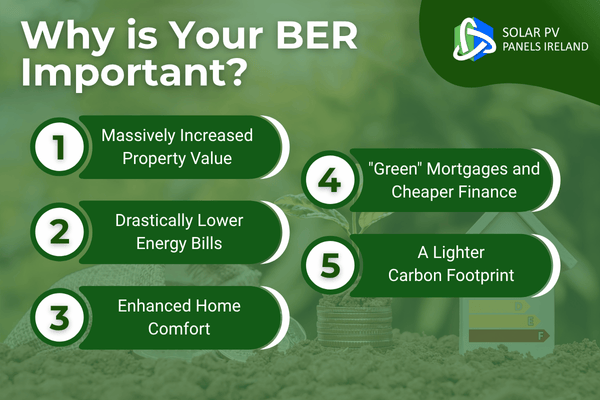
A decade ago, a BER rating might have been seen as just another piece of paperwork. Today, it’s a critical factor for any savvy homeowner. Here’s why it matters so much:
- Massively Increased Property Value: This is the big one. Irish buyers are now highly educated about BER ratings. Properties with higher BER ratings, tend to to command higher sale prices. Moving from a G-rating to an A-rating could add tens of thousands of euros to your home’s value. Buyers see an A-rating and know they are buying a high-quality, low-running-cost home.
- Drastically Lower Energy Bills: This is the benefit you feel every month. A more energy-efficient home requires less fuel (oil, gas, or electricity) to keep it warm. An A-rated home can cost 80-90% less to heat than an equivalent G-rated home. In an era of volatile energy prices.
- Enhanced Home Comfort: A good BER rating isn’t just about money; it’s about comfort. A-rated homes are warmer in winter and cooler in summer. They are free from the cold draughts, damp spots, and condensation that plague inefficient properties.
- Access to “Green” Mortgages and Cheaper Finance: Many Irish banks now offer “green mortgages” or better interest rates for customers who are buying or renovating a home to a B-rating or higher. A better BER can literally make your mortgage cheaper.
- A Lighter Carbon Footprint: For the environmentally conscious homeowner, improving your BER is one of the single biggest things you can do to reduce your personal carbon footprint. An efficient home uses less fossil fuel, which means fewer CO2 emissions.
The BER Calculation: A Quick Look Under the Hood
To understand how solar panels improve your BER, you first need to understand how the rating is calculated.
Your BER Assessor doesn’t just guess. They input all the data about your home, insulation levels, window types, boiler efficiency, etc., into something called the Dwelling Energy Assessment Procedure (DEAP).
This calculates your home’s Primary Energy Requirement. This is a measure of the total energy needed to run your home for a year. Crucially, this includes the energy used at the power station to generate your electricity. Because of energy loss during generation and transmission, for every 1 unit of electricity you use from the grid, the DEAP counts it as roughly 2 units of primary energy.
Your home’s final BER grade is based on this primary energy score. To improve your rating, you must reduce your home’s Primary Energy Requirement.
You can do this in two ways:
- Reduce Demand: Use less energy. This is what insulation, airtightness, and new windows do. They reduce the amount of heat your home needs.
- Generate Your Own (Clean) Energy: This is where solar PV comes in.
Solar PV Panels: The BER-Booster
This brings us to the hero of the story. While insulation is essential (and you should absolutely have it), installing solar PV panels is one of the most significant single “leaps” you can make to your BER score.
How Solar PV Directly Impacts the DEAP Calculation
Remember how the DEAP penalises you for using grid electricity? Well, it massively rewards you for generating your own.
When you install a solar PV system from Solar PV Panels Ireland, you are placing a mini power-plant on your own roof. Every single kilowatt-hour (kWh) of clean electricity your panels generate is a kWh you don’t have to import from the grid.
The DEAP sees this on-site generation and subtracts it from your home’s total energy demand. This has a dramatic and immediate impact on your Primary Energy Requirement, slashing the final number and propelling your home up the BER scale.
It’s not uncommon for a solar PV installation to improve a home’s rating by a full grade or more (e.g., from a C to a B, or a B to an A) all on its own. It directly addresses the “Primary Energy” part of the calculation in a way few other technologies can.
Solar PV vs. Other Upgrades
Think of your BER improvement journey like this:
- Insulation & Windows (The Fabric): These are reductive upgrades. They stop heat from leaving. This is your home’s defensive line. It’s vital, but you can only insulate a wall once.
- Solar PV (The Generator): This is an additive upgrade. It adds clean energy into your home’s energy equation. It’s your home’s offensive line, actively winning you points on the BER scorecard.
For many homes sitting on a C or D rating, the “fabric” might already be quite good. It could cost thousands to gain a few extra points from specialist insulation. A solar PV system, by contrast, can be a more cost-effective upgrade that tips you over the line into a coveted B or A rating.
The Ripple Effect: Beyond the BER Score
The impact of a solar PV system goes far beyond the letter on your certificate. It creates a positive ripple effect that transforms your home and your finances.
- Slash Your Bills: This is the most immediate win. By using the free electricity you generate, your daytime energy costs can drop to zero.
- Get Paid for Your Power: Thanks to the Clean Export Guarantee (CEG) scheme, any surplus electricity you generate and don’t use is automatically sold back to the grid. You get paid for your contribution!
- Future-Proof Your Home: Solar PV is the foundation of a modern, smart home. It’s the perfect partner for:
- Electric Vehicles (EVs): Imagine charging your car with free sunshine from your roof.
- Battery Storage: Add a battery to your solar system to store your daytime energy and use it at night, becoming almost fully independent from the grid.
- Heat Pumps: Air-source heat pumps are incredibly efficient, but they run on electricity. Powering your heat pump with your own solar panels is the ultimate combination for a low-cost, A-rated home.
The Process: From Consultation to A-Rating
So, how do you get started? A proper BER improvement plan is a journey, but it’s a straightforward one.
Step 1: Get Your Baseline – The Initial BER Assessment
First, you need to know where you stand. Before starting any work, we strongly recommend getting a professional, independent assessment from a registered SEAI assessor.
For a thorough and reliable report, we recommend Greenwise Energy. Their team of expert assessors will give you a detailed report showing exactly where you stand and what your home’s potential is. This baseline report is your starting map.
Step 2: The Solar PV Panels Ireland Consultation
This is where we come in. Once you have your BER report, Solar PV Panels Ireland will analyse your report, discuss your goals (Are you aiming for an A2? A B1?), and assess your roof’s orientation and size.
We will then design a bespoke solar PV system, complete with optional battery storage, that is perfectly sized to meet your ambitions and your budget. We’ll show you the projected energy savings and the expected impact on your BER.
Step 3: Flawless, Professional Installation Our teams of SEAI-registered installers will handle the entire installation. It’s a clean, fast and safe process, usually completed in just a day or two. We only use the highest-quality Tier 1 panels and components, ensuring your system performs flawlessly for decades.
Step 4: The Final BER Assessment (The Reward!) After our installation is complete, you’ll have your BER assessor return. They will conduct a new assessment, factoring in your brand-new solar PV system. This is the exciting part, witnessing your BER rating jump, often by several grades and receiving that coveted A or B certificate.
Don’t Forget the SEAI Grants
The good news gets even better. The SEAI offers significant grants to help homeowners invest in their home’s energy future. There are grants available for solar PV, insulation, heat pumps and more.
As an approved SEAI installer, Solar PV Panels Ireland can guide you through the entire grant application process. We’ll help you understand what you’re eligible for and ensure all the paperwork is handled correctly, making your journey to an A-rating even more affordable.
Your Journey to an A-Rated Home Starts Today
Improving your home’s BER rating is no longer a luxury, it’s one of the wisest financial and environmental decisions an Irish homeowner can make. It’s a direct investment in your property’s value, your personal comfort and your financial security.
While many upgrades offer small, incremental gains, installing a solar PV system is a game-changer. It fundamentally changes your home’s relationship with energy, turning it from a passive consumer into a smart, active producer.
Ready to transform your home’s energy future?
Contact Solar PV Panels Ireland today for a free, no-obligation consultation. Let’s analyse your home and design the perfect solar system to get you on the path to an A-rating.
And don’t forget to book your initial assessment with the experts at Greenwise Energy to find out exactly where your journey begins. A warmer, cheaper and more valuable home is closer than you think.