
Summary
- Fast Return on Investment: These days, most Irish homeowners see a full payback on their solar panel investment in just 5 to 7 years. This of course is followed by decades of free electricity.
- Works in Irish Weather: Solar panels don’t need direct sunshine to work, they actually thrive on daylight. Ireland’s cool, bright climate is perfect for keeping panels working efficiently and making sure they don’t overheat.
- Three Ways to Save & Earn: You save money by using your own power, reduce upfront costs with SEAI grants and you earn a passive income by selling excess energy back to the grid (CEG).
- Future-Proof Your Home: Solar PV improves your BER rating, increases your property’s market value and also protects your household from future energy price hikes.
Sky-high electricity bills, climate change concerns, and a desire for energy independence, these are the top reasons Irish homeowners are looking to the sky for a solution. The answer, increasingly, is solar PV. But in a country famous for its unpredictable weather, the number one question we hear at Solar PV Panels Ireland is: “Are solar panels really worth it in Ireland?”
The short answer is a resounding yes.
Thanks to massive improvements in technology, significant government grants, and persistently high energy prices, a home solar PV system is no longer a “nice-to-have.” For most Irish homeowners, it’s one of the best financial investments you can make, with average payback periods shrinking to just 5 to 7 years.
After that payback period? You’re generating free, green electricity for decades to come.
This article will break down the real costs, the tangible savings, and, most importantly, show you how to calculate your own payback period to see if solar is the right move for your home.
The Biggest Myth: “It’s Not Sunny Enough in Ireland!”
Let’s clear this up immediately. Solar Photovoltaic (PV) panels don’t need direct, blazing sunshine to work; they need daylight.
Modern panels are incredibly efficient and generate significant amounts of electricity even on the cloudy, overcast days we’re all too familiar with. While a clear July day will produce more power than a dark December afternoon, the system generates electricity all year round.
Ireland’s long summer days and cool temperatures are actually ideal. Unlike in very hot climates, where high heat can reduce panel efficiency, our mild weather allows the panels to operate at or near their peak performance.
The Three Streams of Income: How Solar Panels Save and Earn You Money
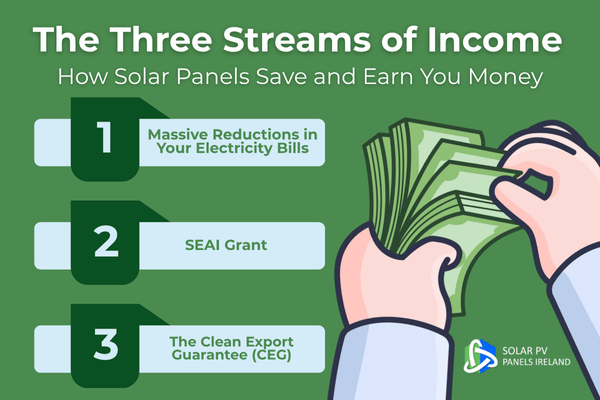
Investing in solar PV isn’t just a cost; it’s a financial asset that provides a return in three distinct ways.
1. Massive Reductions in Your Electricity Bills
This is the most significant benefit. Every kilowatt-hour (kWh) of electricity your panels produce is a kWh you don’t have to buy from the grid. This is called “self-consumption.”
With average Irish electricity prices hovering around 36c per kWh in 2025, every unit you self-consume is a direct, 36-cent saving. By shifting energy-heavy tasks, like the washing machine, dishwasher, or immersion, to the middle of the day, you can maximise these savings.
2. The SEAI Grant: A Government-Funded Price Cut
The Sustainable Energy Authority of Ireland (SEAI) provides a generous grant to make the initial investment much more affordable. As of 2025, homeowners can receive:
- €700 per kWp for the first 2kWp
- €200 per kWp for the next 2kWp
- A maximum grant of €1,800 (for systems of 4kWp or larger)
To be eligible, your home must have been built and occupied before the 31st of December, 2020. At Solar PV Panels Ireland, we are fully-registered SEAI installers and handle all the grant paperwork for you, ensuring a seamless process.
3. The Clean Export Guarantee (CEG): Selling Your Surplus Power
Your panels will often produce more electricity than you can use, especially in the middle of summer. Thanks to the Clean Export Guarantee (CEG) scheme, this surplus power is not wasted.
Your smart meter automatically tracks how much electricity you export to the grid, and your electricity supplier must pay you for it. Rates vary by supplier but typically range from 18c to 25c per kWh. This creates a new, passive income stream that appears as a credit on your electricity bill, further accelerating your payback period.
The Initial Investment: What Do Solar Panels Cost in Ireland in 2025?
This is the “how long is a piece of string” question, as the final cost depends on system size, panel quality, roof complexity, and whether you include a battery.
However, we can provide a very clear ballpark. Following the government’s smart decision to reduce the VAT on solar panel installations to 0%, prices have become more stable and affordable than ever.
For a typical 3-bed semi-detached home, after the €1,800 SEAI grant is deducted, you can expect a fully installed, high-quality solar PV system to cost between €6,000 and €8,000.
| System Size (Typical) | Average Cost (Before Grant) | SEAI Grant | Average Net Cost (After Grant) |
| 8 Panels (~3.5 kWp) | €7,600 – €8,600 | €1,700 | €5,900 – €6,900 |
| 10 Panels (~4.4 kWp) | €8,000 – €9,500 | €1,800 | €6,200 – €7,700 |
| 12 Panels (~5.3 kWp) | €8,800 – €10,300 | €1,800 | €7,000 – €8,500 |
These are 2025 estimates. For a precise, fixed quote for your home, you will need a technical survey.
How to Calculate Your Solar Panel Payback Period: A Step-by-Step Example
Now, let’s get to the most important calculation. The payback period is the time it takes for your annual savings to cover your initial investment.
Payback Period (in Years) = Net System Cost / Total Annual Savings
Let’s use a real-world example: The Forde Family in their 3-bed semi-detached home.
- Their Home: Built in 1998.
- Annual Electricity Bill: €2,200 per year (using ~6,100 kWh @ €0.36/kWh).
- The System: They choose a 10-panel (4.4 kWp) system.
- Installer: Solar PV Panels Ireland.
Step 1: Calculate the Net Initial Cost
This is the total price minus the government grant.
- Total System Cost: €8,000
- SEAI Grant (4.4 kWp): – €1,800 (the maximum)
- Net Initial Cost: €6,200
Step 2: Calculate Total Annual Savings
This is a combination of Bill Savings (self-consumption) and Export Payments (CEG).
- Bill Savings (Self-Consumption):
A well-designed 4.4 kWp system in Ireland will generate around 3,700 – 4,000 kWh per year. Let’s be conservative and say 3,800 kWh.
A typical household with no battery will use about 50% of this power directly (this is “self-consumption”). A home with a battery can use 70-80%+.
- Annual Generation: 3,800 kWh
- Self-Consumption (50%): 1,900 kWh
- Value of this power (1,900 kWh x €0.36/kWh): €684 saved on bills
- B. Export Payments (CEG):
The other 50% of the power (1,900 kWh) is exported to the grid. We’ll use a conservative export rate of €0.20/kWh.
- Annual Export: 1,900 kWh
- Export Payment (1,900 kWh x €0.20/kWh): €380 earned from exports
- Total Annual Savings:
- Bill Savings (€684) + Export Earnings (€380) = €1,064 per year
Step 3: Calculate the Payback Period
Now we divide the net cost by the total annual savings.
- Net Initial Cost: €6,200
- Total Annual Savings: €1,064
- Payback Period: €6,200 / €1,064 = 5.8 years
In just under 6 years, the Fordes’ system has completely paid for itself.
The Secret Weapon: The Solar Battery
In the example above, the payback was 5.8 years without a battery. But what if they added one?
A solar battery (or hybrid system) stores your surplus solar energy during the day instead of exporting it all. It then releases that free, stored electricity in the evening when your panels aren’t producing, and your home’s usage is high (lights, TV, cooking).
- Benefit: This pushes your “self-consumption” rate from 50% up to 80% or more.
- Cost: A battery will add €3,000 – €4,000 to the initial cost.
- Impact: While it increases the initial cost, it dramatically increases your annual savings by allowing you to use your own 36c/kWh electricity instead of exporting it for 20c/kWh.
For many households, especially those who are out at work during the day, a battery is a financial “no-brainer” that can secure your investment against future energy price hikes.
Beyond the Payback: The Long-Term Benefits
The payback period is only the beginning of the story. A high-quality solar panel system has a performance warranty of 25-30 years.
After 5.8 years, the Fordes in our example will be getting €1,064+ per year (tax-free) for the next 20+ years. As electricity prices rise, those savings will only get bigger.
The other long-term benefits are just as compelling:
- Improves Your BER Rating: Installing solar panels is one of the most effective ways to improve your home’s Building Energy Rating (BER). A better BER is crucial for grant eligibility for other upgrades (like heat pumps) and massively increases your property’s value.
- Increases Property Value: A home with a high BER and, crucially, rock-bottom electricity bills is far more attractive to buyers. It’s a proven selling point that adds tangible value to your property.
- Protects Against Inflation: You are future-proofing your home against the volatile energy market. When the news reports another 20% price hike, your savings simply get 20% bigger. You are no longer just a consumer; you are a producer.
- Reduces Your Carbon Footprint: Finally, you will be doing your part. A typical domestic system will save over 1.5 tonnes of CO2 from entering the atmosphere every single year.
So, Are Solar Panels Worth It in Ireland?
For almost every Irish homeowner with a suitable roof, the answer is an undeniable yes.
The investment is no longer a leap of faith. It is a straightforward financial calculation. With a 0% VAT rate, a maximum grant of €1,800, and a payback period as low as 5-7 years, the question is shifting from “Are solar panels worth it?” to “Can I afford to not install them?”
Ready to Calculate Your Exact Payback Period?
The examples above are a fantastic guide, but every home is unique. The only way to get a precise, fixed-price quote and an accurate savings projection is to have a specialist assess your specific roof, orientation, and energy usage.
At Solar PV Panels Ireland, we make this process simple. Our team of experts provides a free, no-obligation home survey. We’ll design the perfect system for your budget and energy needs, show you exactly what it will cost, and give you a calculation of your personal payback period.