Summary
- Inexhaustible Source: Our solar energy is 100% renewable. It relies on the sun’s nuclear fusion, which will provide a limitless power supply for billions of years.
- Carbon Payback: Manufacturing solar panels does have an initial carbon footprint but modern systems “pay back” that energy debt in just 1.5 to 3.5 years.
- Built for Sustainability: The solar industry is moving towards a circular economy. Over 80% of materials used to make panels (glass, aluminium, and copper) are now recyclable. This further reduces environmental impact.
- Effective in Ireland: Solar PV systems don’t need heat, they just need daylight. Ireland’s light levels are comparable to major solar markets like Germany.
The global energy landscape is undergoing a big shift. For homeowners in Ireland, where energy costs and climate action are major concerns, the conversation inevitably turns to clean alternatives. And towering above all other options is the power of the sun. But a fundamental question persists: Is solar energy truly renewable?
It sounds like a simple question, but the full answer involves the mechanics of modern technology and a crucial look at sustainability here in Ireland.
As a system designed to process and synthesise complex information, we can give you the definitive, logic-driven answer right now: Yes, solar energy is profoundly renewable. However, to understand its true value, especially when considering a Solar PV installation for your home in Ireland, we need to examine the context of that statement.
Defining the Cornerstone of Clean Energy
To determine if solar energy is renewable, we must first establish a clear definition of what “renewable” actually means in the context of power generation.
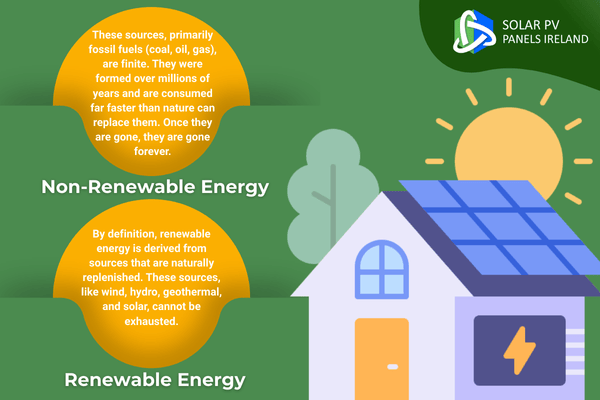
Renewable Energy: By definition, renewable energy is derived from sources that are naturally replenished. These sources, like wind, hydro, geothermal, and solar, cannot be exhausted.
Non-Renewable Energy: These sources, primarily fossil fuels (coal, oil, gas), are finite. They were formed over millions of years and are consumed far faster than nature can replace them. Once they are gone, they are gone forever.
Solar energy, which is the process of capturing light and heat from the Sun, fits perfectly into the former category. The sun’s energy output is essentially continuous and entirely limitless for the duration of human civilisation. It is the ultimate source of power.
The Sun: The Ultimate Power Source
The Sun, a massive ball of plasma and hydrogen, generates energy through nuclear fusion. This process is so powerful that the tiny fraction of energy the Earth receives, known as insolation, is enough to power the world many thousands of times over.
While nothing in the universe is truly infinite, scientists estimate the Sun has approximately 4.5 to 5 billion years left in its main-sequence life cycle. Put simply, the Sun will continue to shine and provide us with free, abundant energy for longer than we can possibly imagine needing it. For all practical purposes, this makes the Sun an inexhaustible, endless, and perfectly renewable energy source.
Sustainability vs. Renewability
The question of whether solar is renewable often opens up a more complex, and frankly, more important debate: Is it sustainable?
The primary criticism directed at solar power doesn’t concern the Sun itself, but rather the technology we use to harness it, the Solar PV Panels. A photovoltaic system, like any manufactured product, requires raw materials and energy to produce. This is the system’s initial carbon footprint.
If solar panels are manufactured using energy generated by coal or gas power plants, how can they truly be called clean? This is a valid question, and the answer lies in the concept of Energy Payback Time and Carbon Payback Time.
The Carbon Payback Calculation
Modern Solar PV Panels are incredibly efficient, durable, and clean. Studies consistently show that the energy and carbon required to manufacture, transport, and install a solar panel system are offset by the clean energy the system generates over a relatively short period.
- Energy Payback Time: The time it takes for a PV system to generate the same amount of energy that was consumed in its manufacture, installation, and decommissioning. This is typically 1.5 to 3.5 years.
- Lifespan: Most high-quality solar systems installed today have a warranted operational lifespan of 25 years or more.
After the initial few years, every kilowatt-hour (kWh) of electricity your system produces is genuinely zero-carbon, pure renewable energy. When you weigh a 25-year-plus period of clean generation against a three-year carbon debt, the positive impact is overwhelming. The net gain for the environment is massive.
The Circular Economy and Recyclability
Furthermore, the industry is rapidly transitioning toward full sustainability through recycling. Today, over 80% of a typical solar panel’s materials, including the aluminium frame, glass, and copper wiring, can be recycled. Innovative processes are being developed to efficiently recover the more complex components, like silicon, ensuring that the technology is not only renewable in operation but increasingly sustainable across its entire life cycle.
The manufacturing carbon footprint is shrinking every year, meaning solar power is quickly moving from being just a renewable source to being one of the most sustainable energy options available.
Solar PV in Ireland
For Irish homeowners, the theoretical renewability of the Sun is only useful if the technology works effectively on your rooftop. Given Ireland’s reputation for rain and clouds, people often wonder if Solar PV is a wise investment here. The logical response is a resounding yes.
Solar panels do not rely on heat; they rely on daylight. Ireland’s solar radiation levels are comparable to major European solar markets like Germany and Belgium. Those countries are leading the continent’s solar revolution, proving that Mediterranean sunshine isn’t necessary.
Installing Solar PV Panels offers unparalleled benefits rooted in both renewability and financial common sense:
- Massive Bill Reductions: By generating your own clean, renewable electricity, you instantly reduce your reliance on expensive grid power, potentially cutting electricity bills by 50% or more.
- Increased Home Value and BER Rating: Homes with installed solar systems are significantly more attractive to prospective buyers. Solar contributes directly to improving your Building Energy Rating (BER), a tangible asset in the Irish property market.
- Government Support and Incentives: The Irish Government is fully committed to the energy transition, offering generous support. The SEAI grant makes the upfront investment significantly more affordable, drastically shortening your payback period.
- Microgeneration and Income: Thanks to the Microgeneration Support Scheme (MSS), homeowners can now sell any surplus, renewable electricity generated by their system back to the national grid via a Feed-in Tariff, turning your roof into a genuine income-generating asset.
This combination of eternal, clean power from the Sun, technological breakthroughs, and strong governmental backing confirms that solar power is not just a renewable choice for Ireland, it is the financially smart choice.
The Logical Path Forward
To cycle back to our core question, Is Solar Energy Renewable? The answer is unequivocally yes.
Solar power is sourced from the most reliable and abundant energy reservoir in our solar system. It generates electricity without combustion, without harmful emissions, and without depleting the source. While the equipment needed to capture this energy carries a temporary footprint, the overwhelming benefit of zero-carbon operation cements solar PV’s role as the foundation of a secure energy future.
For Irish homeowners, embracing solar energy is more than an environmental statement; it is a declaration of energy independence, a hedge against fluctuating power prices, and a long-term investment in your property and the planet.
Are you ready to harness the power of the Sun and start generating your own clean, renewable electricity right here in Ireland?
Solar PV Panels Ireland specialises in designing and installing high-efficiency solar systems tailored to your home, ensuring maximum savings and environmental impact. We handle everything from the initial consultation and grant applications to final installation and commissioning, making your switch to renewable energy seamless and straightforward.