Summary
- Energy Consumption: Your ideal system size depends primarily on your annual electricity usage (kWh), which you can find on your utility bills.
- Roof Suitability: Factors like orientation (South is best), pitch, and available space determine how many panels can actually fit and function efficiently.
- General Estimates: A typical 3-bed semi-detached home usually needs about 10 panels (4 kWp), while larger homes may require 12–14+ panels.
- Eco-Friendly Retirement: When panels eventually reach the end of their life, they are 95% recyclable, including the glass, metal frames, and silicon. This makes them a truly sustainable long-term investment.
Summary
- Impressive Lifespan: Modern high-quality solar panels are built to perform efficiently for 40 to 50 years. This far outlasts their standard 25-year performance warranties.
- Slow Degradation: Technology has advanced so that panels now lose only about 0.5% to 0.7% of their efficiency per year. This means they still operate at roughly 82% capacity after 25 years.
- Minimal Maintenance for Longevity: Simple steps like cleaning your panels every six months and ensuring no trees shade the array can help maximise your system’s lifespan and energy output.
- Eco-Friendly Retirement: When panels eventually reach the end of their life, they are 95% recyclable, including the glass, metal frames, and silicon. This makes them a truly sustainable long-term investment.
The Ultimate Guide for Irish Homeowners
In an age where electricity costs are a constant worry and the urgency to embrace sustainable living is growing, many Irish homeowners are turning to solar energy. The question on everyone’s mind is simple yet crucial: “How many solar panels do I need for my home?” While a quick search might give you a general figure, the truth is that the answer is far more complex and personal than a single number. It’s not a one-size-fits-all solution; it’s a detailed calculation based on your unique circumstances.
This comprehensive guide will demystify the process, breaking down the key factors that influence your ideal solar panel system size. We’ll explore general estimates for typical Irish homes, walk you through a simplified calculation, and show you why partnering with a professional, SEAI-registered company like Solar PV Panels Ireland is the most effective way to determine the perfect system for your needs.
The Most Important Factor: Your Energy Consumption
Before you can even begin to think about panels, you must first understand your own energy habits. This is the single most important variable in the entire equation. The number of panels you need is directly linked to how much electricity your household uses on a daily or annual basis.
Most electricity bills provide your energy usage in kilowatt-hours (kWh). You can look at your most recent bill or, even better, review your bills over a full year to get a comprehensive understanding of your consumption patterns throughout the seasons.
General Guidelines:
- A typical three-bedroom Irish home might use an average of 20 kWh per day, which translates to roughly 7,300 kWh per year.
- Larger, four-bedroom homes with more occupants or energy-intensive appliances will naturally have higher consumption, potentially exceeding this average.
- Smaller, two-bedroom terraced houses, particularly those with a focus on energy efficiency, may have significantly lower usage.
Your goal is to install a solar panel system that can generate enough electricity to meet a significant portion, if not all, of this demand. The more energy you use, the more panels you will likely need to offset that usage.
Understanding Your Roof’s Role
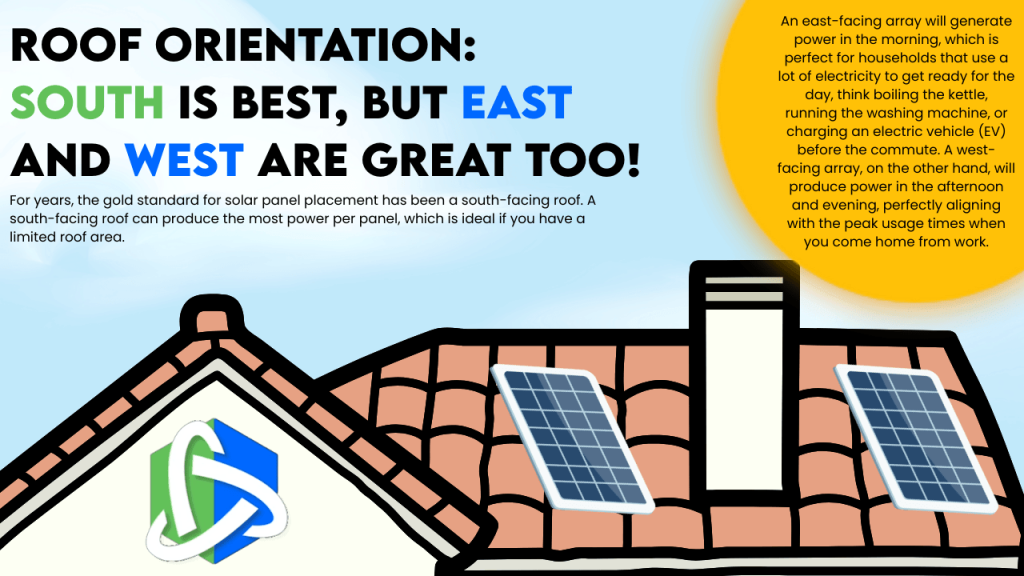
The second major factor is your roof. The size, shape, and direction of your roof are fundamental in determining how many panels can be installed and how much energy they will produce.
- Space and Obstructions: The total available space on your roof is a limiting factor. The presence of skylights, chimneys, or even dormer windows can reduce the usable area. A professional survey will map out your roof and identify the ideal placement for each panel to ensure maximum sunlight exposure.
- Orientation: In the Northern Hemisphere, south-facing roofs receive the most direct sunlight throughout the day. This makes them the most efficient for solar panel installation. West- and east-facing roofs can also be effective, particularly for homes that use more energy in the mornings or evenings, as they will capture sunlight during those specific times. North-facing roofs are generally not suitable for solar panels as they receive very little direct sunlight.
- Pitch/Slope: The angle of your roof also plays a role. A pitch between 30 and 40 degrees is considered optimal for capturing maximum sunlight in Ireland. However, modern solar technology is highly effective across a range of angles.
The Power of the Panels Themselves: Wattage and Efficiency
Not all solar panels are created equal. The two key metrics to understand are wattage and efficiency.
- Wattage (or Power Rating): This is the amount of power a solar panel can produce under standard test conditions. Panels today typically have a wattage of 400 watts (W) or higher. A 430-watt panel is common, while high-end panels can reach 550 watts. A higher wattage means each individual panel produces more electricity, meaning you might need fewer of them to achieve your desired energy output.
- Efficiency: This refers to the panel’s ability to convert sunlight into usable electricity. A panel with 20% efficiency converts 20% of the sunlight it receives into power. Higher efficiency panels are generally more expensive but can be a great option for roofs with limited space, as they generate more energy per square metre.
The “What Ifs”: Future-Proofing Your System
When planning your solar installation, it’s crucial to consider not just your current energy needs, but your future ones. Are you thinking about purchasing an electric vehicle (EV) in the next few years? Do you plan to install an air-source heat pump? Both of these technologies significantly increase your household’s electricity demand.
A great solar system is one that can grow with you. By accounting for these future needs now, you can install a slightly larger system that will save you money and hassle down the line. Installing an EV charger at the same time as your solar panels can be a smart, forward-thinking investment.
General Estimates for Irish Households
While a precise number requires a professional consultation, here are some helpful estimates based on typical Irish homes and energy usage. Remember, these are rough guidelines and not definitive answers.
Small Homes (e.g., a 2-bed terraced house): For households with low energy consumption (around 2,000 to 3,000 kWh per year), an 8-panel array might be sufficient. This could be a system size of around 3 kWp (kilowatt-peak).
- Average Homes (e.g., a 3-bed semi-detached house): A typical three-bedroom home often needs a system of around 10 panels. This would be a 4 kWp system and is a common size for many families looking to significantly reduce their electricity bills.
- Large Homes (e.g., a 4-bed detached house): A larger home with higher energy usage (e.g., 6,000 kWh per year or more) might need 12 panels or more. A 5 kWp or even 6 kWp system with up to 14 panels would be a more suitable size to meet higher demands.
The Simplified Calculation: A Quick Snapshot
For a basic, back-of-the-envelope calculation, you can use a simplified formula. This is by no means a substitute for a professional assessment but can give you a rough idea.
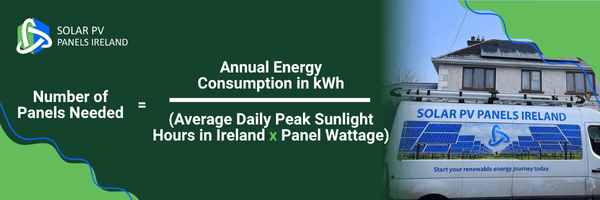
Let’s use an example: a three-bedroom house with an average daily usage of 20 kWh.
- Daily Usage: 20 kWh
- Average Peak Sunlight Hours in Ireland: Approximately 2.5 hours
- Panel Wattage: Let’s assume a 430-watt panel (0.43 kW)
Calculation
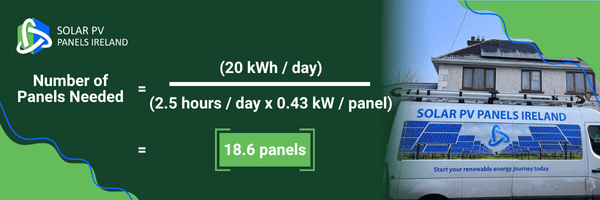
As you can see, this simplified calculation suggests a much higher number of panels than the common estimates. This is because real-world factors like cloud cover, temperature, and specific system design make a significant difference. It highlights precisely why a professional site survey is absolutely essential.
Why You Need a Professional: The Solar PV Panels Ireland Advantage
While the numbers and calculations are a good starting point, the most reliable and effective way to determine your perfect solar system size is to get a professional assessment. This is where a company like Solar PV Panels Ireland excels.
They don’t just give you a number; they provide a comprehensive solution from start to finish. Their process is designed to ensure you get the most out of your investment:
- Site Survey: A qualified team will conduct a thorough on-site survey. They will meticulously check your roof’s orientation, pitch, dimensions, and identify any potential shading issues. This data is used to create a precise, tailored system design.
- Planning and Design: Based on the survey and your specific energy needs, they will design a system that is perfectly sized for your home. They will recommend the optimal number of panels, the right type of solar inverter, and can even include solar batteries for energy storage or an EV charger.
- SEAI-Registered for Grants: As an SEAI-registered company, Solar PV Panels Ireland enables you to avail of valuable grants, such as the SEAI Solar PV grant for homeowners, which can significantly reduce the upfront cost of your installation. They can also assist with the TAMS 3 Solar Grant for agricultural projects.
- Professional Installation: The company’s qualified crew handles the entire installation process, ensuring everything is done safely and efficiently to the highest standards.
- Ongoing Support: Their commitment doesn’t end with the installation. They provide comprehensive support, ensuring your system performs optimally for its 25+ year lifespan.
The Return on Investment: Benefits Beyond the Panels
The benefits of going solar with a professional company like Solar PV Panels Ireland extend far beyond the number of panels you install.
- Significant Cost Savings: A well-sized solar system can reduce your electricity bills by up to 60% annually. This is a massive saving that adds up to thousands of Euros over the life of the system.
- Rapid Payback Period: The average payback period for a solar PV system in Ireland is typically between 5 to 7 years. After that, the electricity you generate is essentially free, providing a return on your investment for decades to come.
- Sell Back to the Grid: Thanks to the Microgeneration Support Scheme, you can sell any excess electricity you don’t use back to the grid. This creates an additional revenue stream, turning your home into a small power station.
- Environmental Impact: By generating your own clean, renewable energy, you significantly reduce your carbon footprint and reliance on fossil fuels. It’s a powerful step towards a more sustainable future for yourself and for Ireland.
- Increased Property Value: Homes with solar panel installations are becoming increasingly attractive to potential buyers, adding to your property’s value.
Where Does This Leave Us
So, how many solar panels do you need? While general estimates can provide a starting point, the most accurate and reliable answer is one that comes from a professional, on-site assessment. It’s a number that is perfectly tailored to your unique energy needs, your home’s specific characteristics, and your future goals.
By choosing an experienced and SEAI-registered company like Solar PV Panels Ireland, you’re not just buying solar panels; you’re investing in a comprehensive solution that guarantees efficiency, safety, and long-term financial and environmental benefits.
Don’t leave this crucial decision to guesswork. Contact Solar PV Panels Ireland today for a free, no-obligation quote and take the first step toward a brighter, more sustainable future for your home.