Summary
- Roof Orientation: South-facing is the gold standard for max power, but East/West arrays are excellent for matching morning and evening energy usage.
- Shading Factors: Obstacles like tall trees, chimneys, or neighbouring buildings can reduce output, though modern “optimisers” can help mitigate partial shade.
- Electrical Readiness: Your consumer unit (fuse board) must be modern and safe; older systems may require a minor upgrade to handle the solar load.
- Grant Eligibility: Most owner-occupied Irish homes built and occupied before 2021 qualify for SEAI grants, which significantly lower installation costs.
Summary
- Impressive Lifespan: Modern high-quality solar panels are built to perform efficiently for 40 to 50 years. This far outlasts their standard 25-year performance warranties.
- Slow Degradation: Technology has advanced so that panels now lose only about 0.5% to 0.7% of their efficiency per year. This means they still operate at roughly 82% capacity after 25 years.
- Minimal Maintenance for Longevity: Simple steps like cleaning your panels every six months and ensuring no trees shade the array can help maximise your system’s lifespan and energy output.
- Eco-Friendly Retirement: When panels eventually reach the end of their life, they are 95% recyclable, including the glass, metal frames, and silicon. This makes them a truly sustainable long-term investment.
Comprehensive Guide for Irish Homeowners
Thinking about joining the solar revolution? You’re not alone. Solar energy is becoming increasingly popular in Ireland, with more and more homeowners looking to reduce their electricity bills, decrease their carbon footprint, and take advantage of the generous grants and support schemes available. But before you get too excited about the prospect of free electricity from the sun, you might be asking yourself one of the most important questions: “Is my house even suitable for solar panels?”
The short answer is: probably. Solar PV Panels Ireland, a leading provider of solar energy solutions across the country, has found that most houses are indeed suitable. The longer, more detailed answer is what this article is all about. We’ll walk you through all the key factors, from your roof’s characteristics to your current electrical system, to help you understand if your home is a good candidate for a solar PV installation.
Your roof is the star of the show when it comes to solar panel suitability. It’s where the panels will live and where the magic of converting sunlight into electricity happens. Here’s what Solar PV Panels Ireland looks for during a site assessment:
a) Roof Type and Condition
The good news is that solar panels can be fitted on almost any type of pitched or flat roof in Ireland. The most common types, like flat concrete tiles and natural slate, are perfectly suitable. A key consideration, however, is the condition of your roof. Solar panels are built to last for decades, and you want to ensure the structure they’re mounted on is equally durable. If your roof is old or in need of repair, it’s wise to address this before installation. Think of it as a long-term investment; fixing the roof now will save you from a costly and complex process of removing and re-installing the panels later.
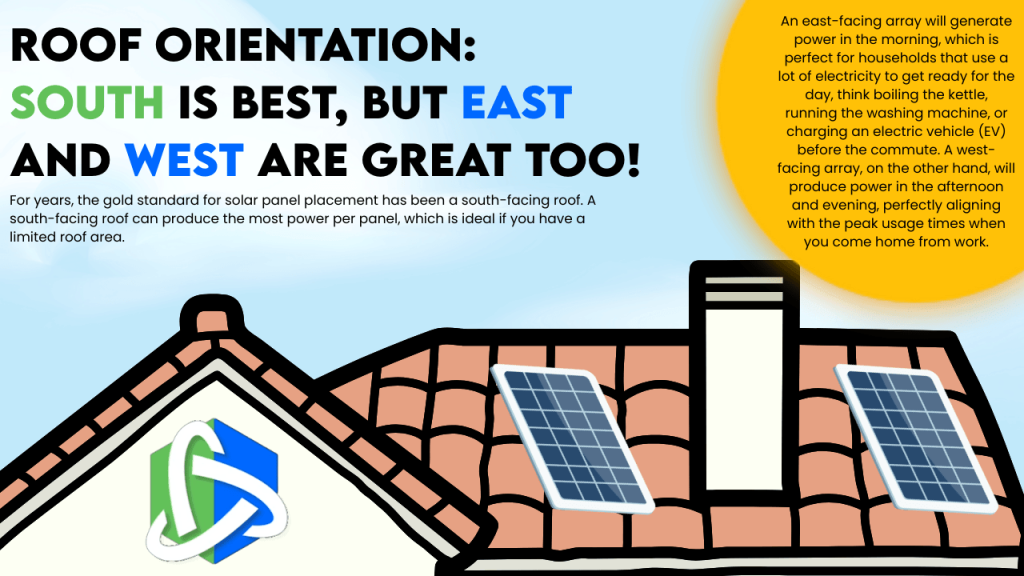
b) Roof Orientation: South is Best, but East and West are Great Too
For years, the gold standard for solar panel placement has been a south-facing roof. This is because in the Northern Hemisphere, a south-facing roof receives the most direct sunlight throughout the day, maximising energy generation. A south-facing roof can produce the most power per panel, which is ideal if you have a limited roof area.
However, the world of solar has evolved, and now, east and west-facing roofs are excellent options as well. In fact, for many modern households, they might even be a better fit. An east-facing array will generate power in the morning, which is perfect for households that use a lot of electricity to get ready for the day, think boiling the kettle, running the washing machine, or charging an electric vehicle (EV) before the commute. A west-facing array, on the other hand, will produce power in the afternoon and evening, perfectly aligning with the peak usage times when you come home from work. This can reduce or even eliminate the need to draw from the grid during the most expensive hours.
Solar PV Panels Ireland’s experts can design a system that takes advantage of both east and west-facing roof slopes, creating a split array. This can be a highly effective strategy to spread your electricity generation throughout the day, potentially matching your household’s energy consumption more closely and reducing your bills even further.
c) Roof Pitch: The Angle Matters
The pitch, or angle, of your roof also plays a role in solar panel efficiency. A pitch of 30 to 40 degrees is generally considered optimal for an Irish climate. However, modern solar panel technology is so efficient that panels on roofs with a flatter or steeper pitch will still generate a significant amount of electricity. Even flat roofs are a viable option, as panels can be mounted on frames that are tilted to the ideal angle. The key is to work with an experienced installer like Solar PV Panels Ireland, who can design a custom system that is optimised for your specific roof’s pitch and orientation.
2. Shading: The Silent Power Thief
Shading is one of the biggest potential issues for solar panel performance. Even a small amount of shade on a single panel can significantly reduce the output of the entire system. This is why a thorough site inspection is crucial. A Solar PV Panels Ireland professional will look for sources of shade from:
- Neighbouring buildings: A tall building next door can cast a significant shadow over your roof at certain times of the day.
- Trees: Overhanging trees, especially deciduous ones, can cause problems in the summer when the sun is at its highest and the leaves are thick.
- Chimneys and dormer windows: These are fixed objects on your own roof that can create shade at different times of the day.
While constant, heavy shade can make a system unviable, it’s important to remember that not all shading is a dealbreaker. For intermittent or partial shading, Solar PV Panels Ireland uses advanced technology to mitigate the issue. For example, they can install optimisers on individual panels. These devices ensure that if one panel is shaded, it doesn’t bring down the performance of the others in its row, allowing the rest of the system to operate at maximum efficiency.
3. Your Electrical System: The Hidden Requirement
The electrical system in your house is a critical but often overlooked aspect of solar panel suitability. A solar PV system connects directly to your home’s main fuse board. During a site inspection, a qualified electrician from Solar PV Panels Ireland will check the condition and capacity of your electrical system to ensure it can safely handle the new load and meet modern safety standards.
- Older Fuse Boards: If you have an older fuse board with ceramic fuses, it may need to be upgraded to a modern consumer unit with circuit breakers. This is a standard safety measure and a relatively minor cost in the grand scheme of the installation.
- Earthing and Bonding: The electrician will also check the main earth and bonding of the house to ensure the system complies with current regulations.
It is important to note that a house with an older electrical system is not unsuitable for solar panels; it simply means a minor upgrade may be required to make the installation safe and compliant.
4. Hot Water Setup: Heating Water with Sunlight
If you have a hot water tank with an existing immersion element, your house is perfectly suited for a solar immersion diverter. This clever device diverts any surplus electricity from your solar panels to heat your water tank. This means you can use the free, clean energy you’re generating to heat your water, significantly reducing or even eliminating your immersion heating bills.
While solar immersion diverters are a fantastic way to maximise your savings, modern smart meters and their tariffs are also becoming a popular and highly effective option. A smart meter allows you to sell your excess electricity back to the grid under Ireland’s Microgeneration Support Scheme, providing a new stream of income from your solar panels. Solar PV Panels Ireland can help you determine the best option for your household and hot water needs.
5. Grant Eligibility: Making it More Affordable
The Irish government, through the Sustainable Energy Authority of Ireland (SEAI), offers generous grants to encourage homeowners to switch to solar energy. Solar PV Panels Ireland is an SEAI registered company, which means they can help you navigate the grant application process and ensure you meet the eligibility criteria.
Generally, your house is eligible for an SEAI grant if it is:
- An owner-occupied home.
- Built and occupied before 2021.
- Connected to the grid.
- Has not previously received an SEAI grant for a solar PV system.
The grant can significantly reduce the upfront cost of your solar PV system, making the average payback period of 5 to 7 years even shorter. A well-sized system can reduce your electricity bills by up to 60% annually, so the savings combined with the grant make it a highly profitable and proven renewable energy solution in Ireland.
6. The Benefits: Why the Suitability Check is Worth It
Determining your home’s suitability for solar panels is the first step towards a greener, more cost-effective future. As we’ve seen, it’s not just about having a roof; it’s about making sure the entire system works for you. By getting a professional assessment from a company like Solar PV Panels Ireland, you can unlock a host of benefits:
- Financial Savings: Drastically reduce your electricity bills and start generating your own power. With the Microgeneration Support Scheme, you can even earn money by selling excess energy back to the grid.
- Environmental Impact: Reduce your carbon footprint and contribute to a more sustainable energy system in Ireland.
- Energy Independence: Become less reliant on fossil fuels and the fluctuating costs of the energy market.
- Increased Property Value: A modern, high-quality solar PV system is a major selling point and can increase the value of your home.
- Long-Term Investment: Solar panels are designed to last for 25 years or more, providing a long-term, stable return on your investment.
Is Your House Suitable? The Next Step
In most cases, the answer to “Is my house suitable for solar panels?” is a resounding “yes.” While every home is unique, and factors like roof orientation, shading, and your current electrical system need to be considered, these are rarely insurmountable obstacles. With the right design and technology, Solar PV Panels Ireland can customise a system that works for your specific circumstances.
The key is to move from asking the question to getting a professional, no-obligation site assessment. A qualified expert from Solar PV Panels Ireland will visit your home, evaluate all the factors discussed above, and provide you with a detailed plan and a quote. This is the only way to get a definitive answer tailored to your unique situation.
Solar PV Panels Ireland designs, plans, installs, and supports renewable energy installations across many counties in Ireland, including Longford, Meath, Roscommon, Galway, Offaly, Laois, Sligo, Westmeath, Kildare, Mayo and Dublin. They have the expertise to make your solar dreams a reality. Don’t wait, take the first step towards energy independence and a brighter future. Contact Solar PV Panels Ireland today to schedule your free consultation.