
Summary
- Ambitious Targets: Ireland is hoping to cut emissions by 51% by 2030. The goal is to reach 8GW of solar capacity, including 2.5GW from rooftop installations on homes and businesses.
- Quick Deployment: Unlike large wind projects, solar PV is “shovel-ready.” Home and commercial installations can be completed in a few days or weeks, making them the quickest way to add clean energy to the country.
- Grid Partnership: Solar systems perfectly add to wind energy by providing peak power during daylight hours.
- Consumer Benefits: Government grants, 0% VAT and Clean Export Guarantee (CEG) payments allow homeowners to save money while playing a direct role in helping the country reach their goals.
The clock is ticking. By the year 2030, Ireland has committed to one of the most ambitious climate transformations in Europe: cutting our national greenhouse gas emissions by a legally binding 51%. This isn’t just a political goal; it’s a national mission that will fundamentally change how we live, travel, and, most importantly, how we power our homes and businesses.
The engine room of this entire plan is our electricity grid. To slash national emissions, we must almost entirely decarbonise the way we generate power. That’s where Solar PV steps in.
Once considered a niche or ‘future’ technology, solar photovoltaic (PV) panels have become a central pillar of the Government’s 2030 Climate Action Plan Goals. Far from being a luxury, installing solar panels is now a direct and essential contribution to national energy independence and environmental security.
The Non-Negotiable Targets – 80% Renewable, 8 GW Solar
Ireland’s ultimate climate challenge lies in transitioning our electricity system from one heavily reliant on imported fossil fuels to one dominated by clean, domestic power.
The headline goal is clear: to generate up to 80% of our electricity from renewable sources by 2030.
This target is a big leap. Today, we stand at around 40% renewable electricity. To bridge that gap, we need monumental investment across all clean energy sectors, but the most striking ambition belongs to solar.
The Climate Action Plan dictates a massive ramp-up in Solar PV capacity to 8 Gigawatts (8 GW) by 2030. For context, just a few years ago, this figure was viewed as unachievable. It requires us to build the energy equivalent of a large conventional power station, purely from the sun, every single year between now and the deadline.
This 8 GW is split between two main types of installation:
- Utility-Scale Solar Farms: Large ground-mounted arrays connected directly to the high-voltage national grid.
- Non-Utility (Distributed) Solar: Rooftop installations on homes, farms, schools, and commercial buildings. Crucially, the plan calls for 2.5 GW of this capacity to come from these distributed, small-scale sources.
If you have a roof, you can have a role in hitting this target, which is roughly equivalent to installing half a million domestic solar panels Ireland-wide.
Solar PV – The Swift Solution for Decarbonising the Grid
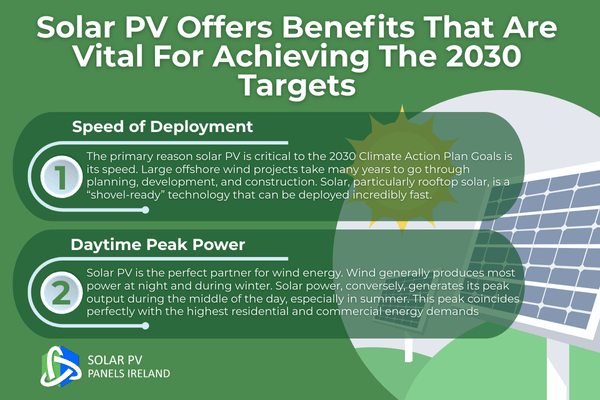
While wind power is the backbone of Ireland’s renewable energy system, solar PV offers unique benefits that are vital for achieving the 2030 targets quickly and efficiently:
Solar panels are most efficient at converting sunlight to electricity when they are cool. As their temperature rises, their efficiency slightly decreases. The relatively mild, temperate climate of Ireland, with average temperatures rarely soaring above 20°C, is a significant advantage. It allows the solar panels to operate at or near their optimal efficiency throughout the year, preventing the power losses associated with extreme heat.
1. Speed of Deployment (The Race Against Time)
The primary reason solar PV is critical to the 2030 Climate Action Plan Goals is its speed. Large offshore wind projects take many years to go through planning, development, and construction. Solar, particularly rooftop solar, is a “shovel-ready” technology that can be deployed incredibly fast.
A single home installation takes a day or two. A commercial rooftop can be completed in weeks. This ability to deploy megawatts of clean power today, without years of planning battles, makes it the fastest way to add new, zero-carbon capacity to the grid and reduce reliance on fossil fuels.
2. Daytime Peak Power
Solar PV is the perfect partner for wind energy. Wind generally produces the most power at night and during winter. Solar power, conversely, generates its peak output during the middle of the day, especially in summer. This peak coincides perfectly with the highest residential and commercial energy demands (when kettles, washing machines, and office air conditioning units are running).
By flooding the grid with clean solar electricity during the day, we reduce the need to fire up expensive, polluting gas power plants, which is the single most effective step we can take to achieve substantial emissions reduction in the electricity sector.
Empowering the People – The Microgeneration Revolution
The push for solar is about more than just numbers on a grid; it’s about empowering every citizen and business to become a local power producer, creating a system known as distributed generation.
For homeowners and businesses, the government has put forward powerful incentives to make this happen, turning a climate responsibility into a sound financial investment:
- SEAI Grants and Zero VAT: Generous SEAI grants significantly reduce the upfront cost of residential solar PV systems. Furthermore, the removal of VAT on domestic installations makes the decision even more attractive, ensuring that climate action is affordable for more families.
- The Clean Export Guarantee (CEG) Tariff: This is the game-changer. For the first time, homeowners are guaranteed a payment for any excess electricity they export back into the national grid. This turns your solar system from a simple cost-saver into a revenue generator, effectively making every home with panels a small, independent power station supporting the national grid.
- Energy Security and Independence: Global events have highlighted the risk of relying on imported fossil fuels. Every home that installs Solar PV systems in Ireland is helping the country achieve greater energy independence, insulating us from volatile international energy prices while simultaneously strengthening our national grid.
This movement has already resulted in significant progress, with Ireland recently hitting the major 1 GW rooftop solar milestone. This achievement, driven by individual action, proves that the public is ready to embrace its role in the transition.
The Economic and Environmental Co-Benefits
Meeting the 8 GW target delivers far more than just reduced emissions. The massive investment required in this sector creates significant positive ripple effects across the Irish economy, leading to both financial and environmental rewards.
Economic Benefits
If Ireland meets its 2030 targets, the solar industry could contribute over €2.3 billion in Gross Value Added (GVA) to the Irish economy between now and 2030. More importantly for local communities, the sector is projected to create jobs nationwide in manufacturing, installation, maintenance, and related services. This means that embracing solar PV is a powerful engine for green job creation and regional economic growth, securing a sustainable future for Irish workers.
Environmental and Societal Impact
- Air Quality: By displacing fossil fuel generation, solar power reduces the pollutants that lead to smog and respiratory illnesses, directly improving public health.
- Decentralisation: Distributed generation (rooftop solar) reduces the burden on the national transmission infrastructure. Power is generated right where it is consumed, leading to fewer network losses and greater local grid resilience.
- Future-Proofing: Solar PV systems are often installed alongside battery storage, turning intermittent sunlight into reliable, dispatch-able power. This technology is vital for preparing the grid for the higher demands of electric vehicles and heat pumps, two other key pillars of the Climate Action Plan.
Your Part in the 2030 Vision
Ireland’s 2030 climate challenge is formidable, but achieving it is possible. The goal of cutting emissions by 51% and achieving 80% renewable electricity hinges on a massive deployment of solar technology.
Solar PV is not just an energy solution; it’s a national delivery mechanism for climate action. It offers the speed, the capacity, and the community involvement necessary to meet the ambitious 8 GW solar target.
Every single solar panel installed in Ireland, whether on a large solar farm or your own roof, is a tangible step toward a cleaner, more secure future. By investing in solar panels now, you are not only taking control of your household or business energy costs, but you are also actively participating in one of the most important national infrastructure projects of the decade. The future of Irish energy is bright, and it’s powered by the sun. Get in touch with Solar PV Panels Ireland today!