Summary
- Utility-Scale Clean Energy: Unlike residential setups, solar farms are very large installations, usually 50+ acres. They are designed to generate massive amounts of clean electricity to power thousands of homes and businesses through the national grid.
- National Energy Security: Solar farms are very important to Ireland’s energy independence goals. They will help to reduce reliance on expensive imported fossil fuels. This should then stabilise long-term electricity prices for everyone.
- Lucrative Land Opportunities: For Irish farmers and landowners, solar farms offer a secure and long-term income stream.
- Eco-Friendly: These sites support biodiversity by allowing for “agrivoltaic” use. This is where wildflowers, beehives or grazing sheep etc share the land with solar panels. This makes them a win for both the environment and agriculture.
The Irish landscape is changing. Among the rolling green fields and towns, a new feature is becoming increasingly common: the solar farm. These large-scale arrays of gleaming photovoltaic panels are more than just a sign of the times; they are a critical component of Ireland’s journey towards a cleaner, more sustainable and energy-independent future.
But what exactly is a solar farm? How does it work? And what role does it play in Ireland’s renewable energy goals? This comprehensive guide will answer all your questions, from the basic technology to the practical steps of building one.
Defining the Solar Farm
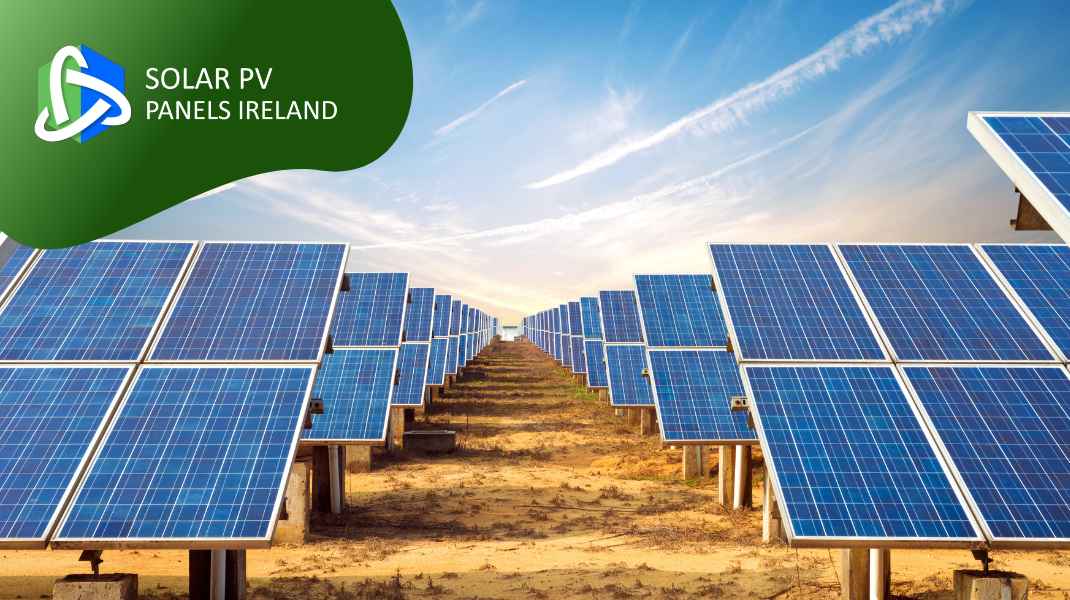
At its simplest, a solar farm, also known as a solar park or a photovoltaic power plant, is a large-scale installation of solar photovoltaic (PV) panels that absorb energy from the sun, convert it into electricity, and feed that electricity directly into the national grid.
Unlike residential or commercial rooftop solar, which typically serves the needs of a single building, a solar farm operates at a utility-scale. Its sole purpose is to generate the maximum amount of clean electricity possible for distribution to thousands of homes and businesses.
These installations are most often ground-mounted, with panels fixed onto metal frames or, in more advanced systems, onto solar trackers that follow the sun’s path across the sky to maximise energy capture.
How Do Solar Farms Work? A Step-by-Step Guide
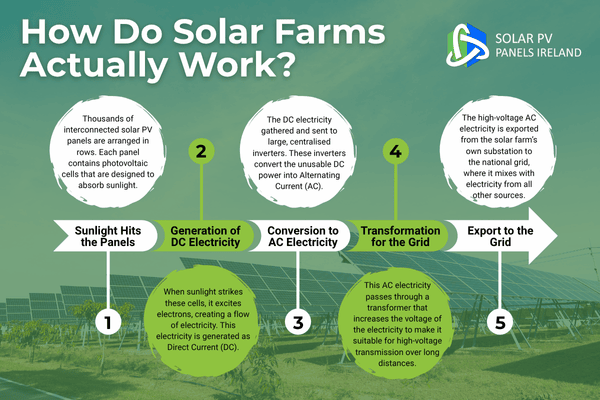
The technology behind a solar farm is beautifully simple in principle, but a marvel of modern engineering in practice. The process works in five key stages:
- Sunlight Hits the Panels: Thousands of interconnected solar PV panels are arranged in rows. Each panel contains photovoltaic cells (usually made from silicon) that are designed to absorb sunlight.
- Generation of DC Electricity: When sunlight strikes these cells, it excites electrons, creating a flow of electricity. This electricity is generated as Direct Current (DC).
- Conversion to AC Electricity: The DC electricity from all the panels is gathered and sent to large, centralised inverters. These inverters are the “brains” of the operation, converting the unusable DC power into Alternating Current (AC). AC is the standard form of electricity used by the national grid and all our appliances.
- Transformation for the Grid: This AC electricity then passes through a transformer. The transformer increases the voltage of the electricity to make it suitable for high-voltage transmission over long distances.
- Export to the Grid: Finally, the high-voltage AC electricity is exported from the solar farm’s own substation to the national grid, where it mixes with electricity from all other sources (wind, gas, etc.) and is distributed by the grid to consumers across Ireland.
The Key Components of a Solar Farm
A solar farm is more than just panels. A successful installation relies on several critical components working in harmony:
- Solar PV Panels: The “engine” of the farm, responsible for capturing sunlight.
- Mounting Systems: The scaffolding that holds the panels. This can be a fixed-tilt system, which is simple and cost-effective, or a tracking system, which increases output by 15-25%.
- Inverters: The essential devices that convert DC to AC electricity.
- Transformers & Switchgear: The equipment needed to step up the voltage and safely connect to the grid.
- Grid Connection: The physical cables and equipment that link the solar farm to the national grid.
- Monitoring & Control Systems: A SCADA (Supervisory Control and Data Acquisition) system allows operators to monitor performance, detect faults, and control the farm remotely.
- Land: Of course, the most basic requirement is a large, suitable area of land.
Why Solar Farms are Essential for Ireland
The rise of solar farms in Ireland is driven by a powerful combination of environmental, economic, and strategic benefits.
Environmental Benefits
- Zero-Emission Energy: Solar farms produce 100% clean electricity. They don’t burn fossil fuels, release greenhouse gases, or cause air pollution.
- Fighting Climate Change: Every kilowatt-hour generated by a solar farm is a kilowatt-hour not generated by a fossil fuel plant. This makes them a frontline tool in helping Ireland meet its 2030 and 2050 climate targets.
- Land Co-existence: Solar farms can be designed to enhance biodiversity. By allowing wildflowers to grow between rows and installing beehives or sheep to graze, they can become dual-purpose “agrivoltaic” sites.
Economic Benefits
- Energy Independence: Ireland has historically relied heavily on imported fossil fuels, leaving us vulnerable to global price shocks. Solar farms produce energy locally, enhancing our energy security.
- Stable Electricity Prices: The sun is a free, inexhaustible fuel source. Once a solar farm is built, its running costs are very low, which helps to stabilise long-term electricity prices for consumers.
- Job Creation: The planning, construction, and maintenance of these large-scale projects create hundreds of skilled jobs across Ireland.
- New Income for Landowners: For farmers and landowners, leasing land for a solar farm provides a secure, long-term, and predictable income stream that is not dependent on weather or market volatility.
How Do You Start a Solar Farm in Ireland?
While the idea of building your own solar farm might seem daunting, it has become a viable and attractive option for many Irish landowners. The most common route is to lease a portion of your land to a solar developer, but it’s crucial to understand the requirements.
Key Land Requirements
Not all land is suitable for a solar farm. Developers and installers like Solar PV Panels Ireland look for several key features:
- Size: Utility-scale projects are large. The minimum viable size is typically around 50 acres (20 hectares), which could power several thousand homes.
- Land Condition: The land should be relatively flat (with a slope of less than 10 degrees) and stable. It should not be in a high-risk flood zone.
- Sunlight & Shading: The site must have excellent, unshaded access to sunlight. South-facing land is ideal. Large trees, hills, or buildings that cast shadows can be a major issue.
- Proximity to the Grid: This is perhaps the most critical factor. The land must be close to a suitable grid connection point (a substation or overhead line) with available capacity. The cost of connecting to the grid can make or break a project.
- Access: The site needs good road access for the heavy machinery and components required during construction.
The 6-Step Process for a Solar Farm
- Research & Feasibility: The first step is a professional assessment to see if your land is viable. This involves desktop analysis of grid maps, sunlight levels, and planning constraints.
- Initial Assessment: An installer will visit the site to confirm its suitability and begin discussions with EirGrid or ESB Networks about a potential grid connection.
- Lease Agreement: If you are leasing your land, you will negotiate an “Option Agreement” with a developer. This gives them the exclusive right to develop a project on your land for a set period.
- Planning Permission: This is a major hurdle. The developer will spend significant time and money preparing a detailed planning application, including environmental impact assessments, to submit to the local county council.
- Grid Connection Offer: Simultaneously, the developer will formally apply for a grid connection, a complex and often lengthy process. Securing a “Granted” status in a RESS (Renewable Electricity Support Scheme) auction is often vital here.
- Construction & Operation: Once planning and grid are secured, construction can begin. This typically takes 6-12 months. After commissioning, the farm begins generating electricity and income, and will operate for 25-30 years.
How Solar PV Panels Ireland Can Build Your Solar Farm
While the process is complex, the good news is that you don’t have to do it alone. Solar PV Panels Ireland is your expert partner for large-scale solar projects. We have the expertise, industry connections, and technical know-how to manage every single stage of your solar farm’s lifecycle.
We specialise in turning suitable land into a powerful source of clean energy and a reliable asset for landowners and investors.
Whether you are a landowner with 50+ acres exploring a new income stream, a business looking to develop a large-scale ground-mount project, or an investor wanting to enter the Irish renewables market, Solar PV Panels Ireland is the partner you can trust.
The Future is Bright
Solar farms are no longer a niche concept; they are a cornerstone of Ireland’s energy strategy. They represent a win-win-win: a win for the environment, a win for the economy, and a win for the landowners who host them.
As technology improves and costs continue to fall, solar power will only play a larger role in our lives. These fields of “harvested sunshine” are a powerful, visible symbol of our transition to a cleaner, brighter future.