Summary
- The Two-Way Connection: Smart meters measure both the electricity you take from the grid (Import) and the surplus solar energy you send back (Export).
- Accurate Payments: You will need a smart meter for the Clean Export Guarantee (CEG). It records the exact export data, ensuring you get paid for every unit of energy you sell back to the grid.
- ESB Rollout: ESB Networks is replacing older meters all over the country. If you don’t have one, your solar installer will submit an NC6 form to prioritise your home for a free smart meter upgrade.
- Maximise Your ROI: With a smart meter, you’ll be able to switch to “Time-of-Use” tariffs. This will allow you to move any heavy appliance use to cheaper times like night or midday when your panels are most productive.
If you’ve been looking into installing Solar PV Panels in Ireland, you’ve probably spent time researching grants, panel efficiency, and inverter technology. But there’s one essential component that is often overlooked, the humble electricity meter.
It might sound dull, but trust us: the meter on the side of your house is the unsung hero of your solar system. It is the crucial piece of kit that determines how much you save and, more importantly, how much you get paid for the excess electricity you generate.
This is your simple guide to understanding the world of Smart Meters in Ireland, covering everything from the nationwide Smart Meter rollout to the Clean Export Guarantee (CEG) and how you can maximise your savings.
From Analogue Dials to Digital Data: The Two-Way Meter
Before solar panels became commonplace, the traditional electricity meter was a simple, one-way device. Its sole job was to measure the electricity you imported from the national grid into your home. Think of it like a car odometer, it only ever went up.
Now, with microgeneration technologies like Solar PV, things are two-way. Your home doesn’t just pull power from the grid; it also pushes surplus power back out.
This is where a dedicated smart meter, comes in.
The Problem with Old Meters
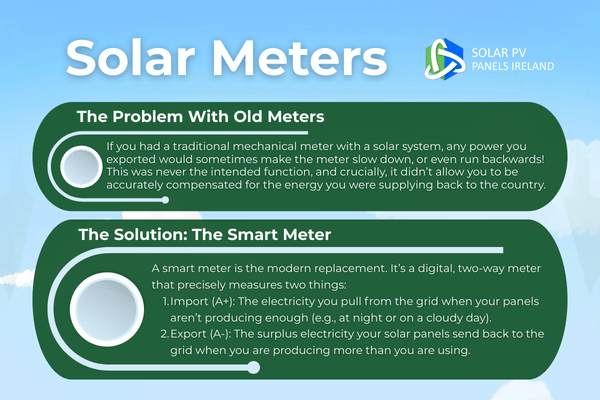
If you had a traditional mechanical meter with a solar system, any power you exported would sometimes make the meter slow down, or even run backwards! This was never the intended function, and crucially, it didn’t allow you to be accurately compensated for the energy you were supplying back to the country. It was an inefficient system that undervalued your solar investment.
The Solution: The Smart Meter
A smart meter is the modern replacement. It’s a digital, two-way meter that precisely measures two things:
- Import (A+): The electricity you pull from the grid when your panels aren’t producing enough (e.g., at night).
- Export (A-): The surplus electricity your solar panels send back to the grid when you are producing more than you are using.
This two-way measurement is absolutely essential for the entire Microgeneration Support Scheme to work, and it is the key to unlocking true financial rewards from your solar system.
The Smart Meter Rollout: Connecting Your Solar to the Grid
The great news for Irish solar homeowners is that ESB Networks is currently running a massive, nationwide Smart Meter rollout programme. The goal is to replace millions of older meters with new, high-tech smart meters. Over four out of five homes already have one.
If you don’t have a smart meter yet, don’t worry. Your decision to install Solar PV is a fantastic prompt to get one installed quickly.
The Solar Connection Process
The path from solar panel installation to a fully functional, paid-for-export system usually follows these key steps:
- Installation: Your SEAI-registered installer (like Solar PV Panels Ireland) fits your panels, inverter, and all the necessary electrical components.
- The Paperwork (NC6 Form): Your installer will then submit a technical connection notification form, known as the NC6 (or NC7 for larger systems), to ESB Networks on your behalf. This officially registers your solar system on the national grid. This is a crucial step that you shouldn’t have to worry about, a professional installer handles it all.
- Smart Meter Installation: Once ESB Networks processes your NC6 form, if you don’t already have one, they will prioritise the installation of a smart meter in your home, usually within four months. This installation is generally free of charge.
- CEG Activation: The smart meter begins automatically measuring your export data and sharing it securely with your chosen electricity supplier.
Crucially, if you are eligible for a smart meter and refuse the upgrade, you will not be able to participate in the full, accurate payment scheme for your exported power. The smart meter is the technological bridge between your home generation and the national grid’s payment structure.
Getting Paid for Your Sunshine: The Clean Export Guarantee (CEG)
The biggest advantage of having a smart meter paired with your Solar PV system is accessing the Clean Export Guarantee (CEG).
The CEG is the government-backed tariff that ensures every eligible domestic and business microgenerator in Ireland is compensated for the surplus renewable electricity they exporting power back to the grid.
In simple terms, you are selling your extra sunshine, and your meter is counting every single unit.
Metered Export vs. Deemed Export
This is where the smart meter truly makes a difference:
| Feature | Smart Meter (Metered Export) | Traditional Meter (Deemed Export) |
| Accuracy | High. Measures exact energy exported every 30 minutes. | Low. Uses an estimation formula based on the size of your system. |
| Payment | Based on the actual Kilowatt-hours (kWh) you send back. | Based on a calculated volume (a ‘deemed’ amount). |
| Eligibility | Required to claim metered CEG payment. | Only available if you are not yet eligible for a smart meter or are awaiting installation. If you refuse a smart meter, you are ineligible. |
For most solar homeowners, aiming for the metered export payment via a smart meter is the best way to maximise returns, as it ensures you get credit for every last unit you produce and export.
Choosing Your CEG Supplier
Unlike the old Feed-in Tariff (FiT) models in some countries, the CEG is competitive. While all electricity suppliers in Ireland are required to offer a CEG tariff, they are free to set their own rate (€/kWh).
This means that your choice of electricity supplier is no longer just about the unit rate for importing power; it’s also about securing the best Feed-in Tariff for your exports. Suppliers across the market currently offer varied rates, sometimes in excess of 20c per kWh.
When you switch supplier, you need to ensure they offer an attractive CEG rate to make the most of your investment. Payments usually appear as a credit on your regular electricity bill, essentially helping to offset the cost of the electricity you still need to import.
Smart Meter Readings: Understanding Your Data
The physical smart meter itself may look a little more complex than the old spinning dial, but reading your data is straightforward, especially if you know the codes.
When you press the button on the front of your new smart meter, it cycles through different registers (readings). Here are the two most important ones for solar owners:
- A+: This is your Import Reading. It represents the total energy you have taken from the grid. Your bill is calculated primarily on this number.
- A-: This is your Export Reading. This is the cumulative total of the energy you have sent back to the grid. This is the figure your supplier uses to calculate your CEG payment credit.
Time-of-Use Tariffs
One major benefit of the smart meter is the ability to use Time-of-Use (ToU) Tariffs. Your import reading (A+) is often broken down into three different time periods:
- Peak: Usually 5 pm to 7 pm (most expensive).
- Day: 8 am to 11 pm (excluding peak).
- Night: 11 pm to 8 am (cheapest).
With this data, you can adjust your household habits to maximise savings, for instance, running the washing machine during the day when your solar panels are powering it for free, or overnight on the cheap night rate.
Empowering Your Solar Investment
The meter is no longer just a boring box on the wall; it’s the intelligence hub of your solar system. For homes and businesses across Ireland, the ESB Networks smart meter rollout and the accompanying Clean Export Guarantee have entirely transformed the financial case for installing Solar PV.
A properly registered system with a smart meter ensures you benefit from three key savings streams:
- Consumption Saving: Using your own free solar power instead of importing expensive grid power.
- Time-of-Use Saving: Shifting grid usage to the cheaper night rate.
- CEG Payment: Getting paid for every surplus unit you feed back into the national grid.
If you’re ready to stop guessing and start accurately measuring and earning from your clean energy, the first step is a seamless installation.
Contact the experts at Solar PV Panels Ireland today. We handle the entire process, from your SEAI grant application and panel installation right through to the official NC6 registration with ESB Networks, ensuring your new smart meter is working optimally to deliver maximum returns from your guide to solar meters investment.