Author: Joe Reilly

  • What is a Solar Farm & How Do They Work in Ireland?

    What is a Solar Farm & How Do They Work in Ireland?

    The Irish landscape is changing. Among the rolling green fields and towns, a new feature is becoming increasingly common: the solar farm. These large-scale arrays of gleaming photovoltaic panels are more than just a sign of the times; they are a critical component of Ireland’s journey towards a cleaner, more sustainable and energy-independent future.

    But what exactly is a solar farm? How does it work? And what role does it play in Ireland’s renewable energy goals? This comprehensive guide will answer all your questions, from the basic technology to the practical steps of building one.

    Defining the Solar Farm

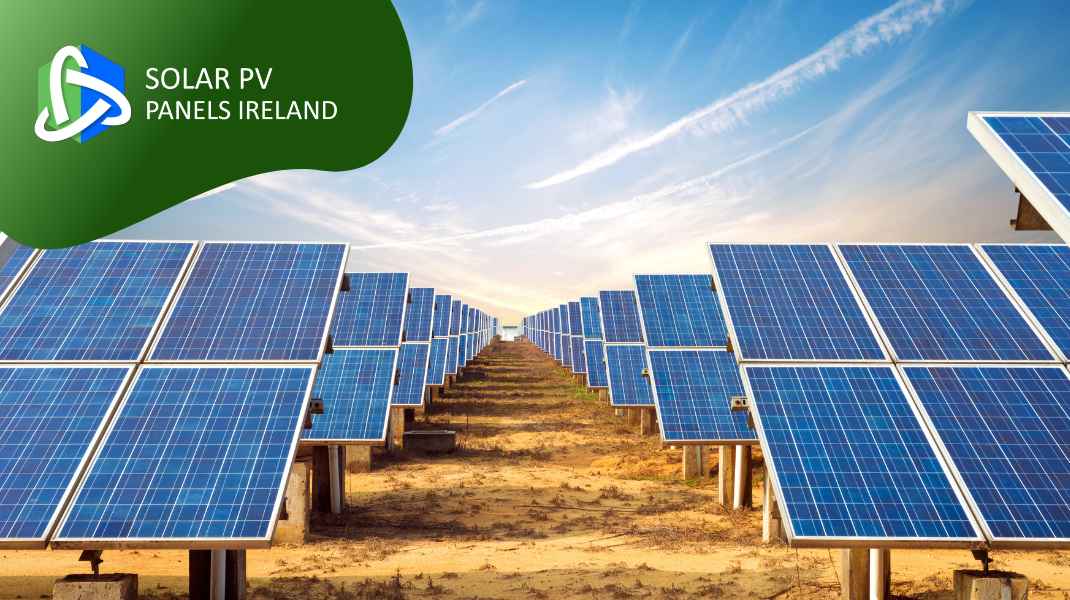
    At its simplest, a solar farm, also known as a solar park or a photovoltaic power plant, is a large-scale installation of solar photovoltaic (PV) panels that absorb energy from the sun, convert it into electricity, and feed that electricity directly into the national grid.

    Unlike residential or commercial rooftop solar, which typically serves the needs of a single building, a solar farm operates at a utility-scale. Its sole purpose is to generate the maximum amount of clean electricity possible for distribution to thousands of homes and businesses.

    These installations are most often ground-mounted, with panels fixed onto metal frames or, in more advanced systems, onto solar trackers that follow the sun’s path across the sky to maximise energy capture.

    How Do Solar Farms Work? A Step-by-Step Guide

    How Do Solar Farms Work?

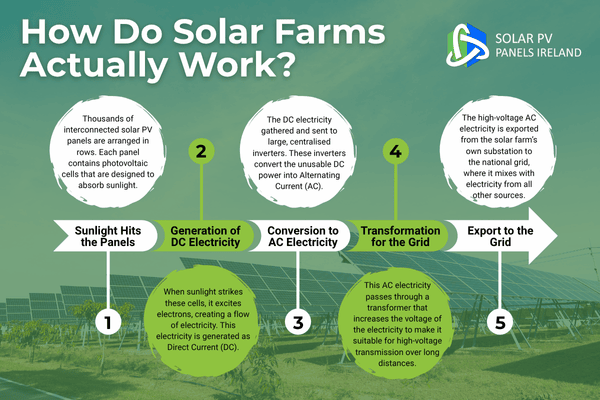
    The technology behind a solar farm is beautifully simple in principle, but a marvel of modern engineering in practice. The process works in five key stages:

    1. Sunlight Hits the Panels: Thousands of interconnected solar PV panels are arranged in rows. Each panel contains photovoltaic cells (usually made from silicon) that are designed to absorb sunlight.
    2. Generation of DC Electricity: When sunlight strikes these cells, it excites electrons, creating a flow of electricity. This electricity is generated as Direct Current (DC).
    3. Conversion to AC Electricity: The DC electricity from all the panels is gathered and sent to large, centralised inverters. These inverters are the “brains” of the operation, converting the unusable DC power into Alternating Current (AC). AC is the standard form of electricity used by the national grid and all our appliances.
    4. Transformation for the Grid: This AC electricity then passes through a transformer. The transformer increases the voltage of the electricity to make it suitable for high-voltage transmission over long distances.
    5. Export to the Grid: Finally, the high-voltage AC electricity is exported from the solar farm’s own substation to the national grid, where it mixes with electricity from all other sources (wind, gas, etc.) and is distributed by the grid to consumers across Ireland.

    The Key Components of a Solar Farm

    A solar farm is more than just panels. A successful installation relies on several critical components working in harmony:

    • Solar PV Panels: The “engine” of the farm, responsible for capturing sunlight.
    • Mounting Systems: The scaffolding that holds the panels. This can be a fixed-tilt system, which is simple and cost-effective, or a tracking system, which increases output by 15-25%.
    • Inverters: The essential devices that convert DC to AC electricity.
    • Transformers & Switchgear: The equipment needed to step up the voltage and safely connect to the grid.
    • Grid Connection: The physical cables and equipment that link the solar farm to the national grid.
    • Monitoring & Control Systems: A SCADA (Supervisory Control and Data Acquisition) system allows operators to monitor performance, detect faults, and control the farm remotely.
    • Land: Of course, the most basic requirement is a large, suitable area of land.

    Why Solar Farms are Essential for Ireland

    The rise of solar farms in Ireland is driven by a powerful combination of environmental, economic, and strategic benefits.

    Environmental Benefits

    • Zero-Emission Energy: Solar farms produce 100% clean electricity. They don’t burn fossil fuels, release greenhouse gases, or cause air pollution.
    • Fighting Climate Change: Every kilowatt-hour generated by a solar farm is a kilowatt-hour not generated by a fossil fuel plant. This makes them a frontline tool in helping Ireland meet its 2030 and 2050 climate targets.
    • Land Co-existence: Solar farms can be designed to enhance biodiversity. By allowing wildflowers to grow between rows and installing beehives or sheep to graze, they can become dual-purpose “agrivoltaic” sites.

    Economic Benefits

    • Energy Independence: Ireland has historically relied heavily on imported fossil fuels, leaving us vulnerable to global price shocks. Solar farms produce energy locally, enhancing our energy security.
    • Stable Electricity Prices: The sun is a free, inexhaustible fuel source. Once a solar farm is built, its running costs are very low, which helps to stabilise long-term electricity prices for consumers.
    • Job Creation: The planning, construction, and maintenance of these large-scale projects create hundreds of skilled jobs across Ireland.
    • New Income for Landowners: For farmers and landowners, leasing land for a solar farm provides a secure, long-term, and predictable income stream that is not dependent on weather or market volatility.

    How Do You Start a Solar Farm in Ireland?

    While the idea of building your own solar farm might seem daunting, it has become a viable and attractive option for many Irish landowners. The most common route is to lease a portion of your land to a solar developer, but it’s crucial to understand the requirements.

    Key Land Requirements

    Not all land is suitable for a solar farm. Developers and installers like Solar PV Panels Ireland look for several key features:

    • Size: Utility-scale projects are large. The minimum viable size is typically around 50 acres (20 hectares), which could power several thousand homes.
    • Land Condition: The land should be relatively flat (with a slope of less than 10 degrees) and stable. It should not be in a high-risk flood zone.
    • Sunlight & Shading: The site must have excellent, unshaded access to sunlight. South-facing land is ideal. Large trees, hills, or buildings that cast shadows can be a major issue.
    • Proximity to the Grid: This is perhaps the most critical factor. The land must be close to a suitable grid connection point (a substation or overhead line) with available capacity. The cost of connecting to the grid can make or break a project.
    • Access: The site needs good road access for the heavy machinery and components required during construction.

    The 6-Step Process for a Solar Farm

    1. Research & Feasibility: The first step is a professional assessment to see if your land is viable. This involves desktop analysis of grid maps, sunlight levels, and planning constraints.
    2. Initial Assessment: An installer will visit the site to confirm its suitability and begin discussions with EirGrid or ESB Networks about a potential grid connection.
    3. Lease Agreement: If you are leasing your land, you will negotiate an “Option Agreement” with a developer. This gives them the exclusive right to develop a project on your land for a set period.
    4. Planning Permission: This is a major hurdle. The developer will spend significant time and money preparing a detailed planning application, including environmental impact assessments, to submit to the local county council.
    5. Grid Connection Offer: Simultaneously, the developer will formally apply for a grid connection, a complex and often lengthy process. Securing a “Granted” status in a RESS (Renewable Electricity Support Scheme) auction is often vital here.
    6. Construction & Operation: Once planning and grid are secured, construction can begin. This typically takes 6-12 months. After commissioning, the farm begins generating electricity and income, and will operate for 25-30 years.

    How Solar PV Panels Ireland Can Build Your Solar Farm

    While the process is complex, the good news is that you don’t have to do it alone. Solar PV Panels Ireland is your expert partner for large-scale solar projects. We have the expertise, industry connections, and technical know-how to manage every single stage of your solar farm’s lifecycle.

    We specialise in turning suitable land into a powerful source of clean energy and a reliable asset for landowners and investors.

    Whether you are a landowner with 50+ acres exploring a new income stream, a business looking to develop a large-scale ground-mount project, or an investor wanting to enter the Irish renewables market, Solar PV Panels Ireland is the partner you can trust.

    The Future is Bright

    Solar farms are no longer a niche concept; they are a cornerstone of Ireland’s energy strategy. They represent a win-win-win: a win for the environment, a win for the economy, and a win for the landowners who host them.

    As technology improves and costs continue to fall, solar power will only play a larger role in our lives. These fields of “harvested sunshine” are a powerful, visible symbol of our transition to a cleaner, brighter future.

  • 10 Solar Panel Myths You Should Know About in Ireland

    10 Solar Panel Myths You Should Know About in Ireland

    Solar energy is rapidly gaining attention as a sustainable and cost-effective power solution across the globe and Ireland is no exception. With a growing emphasis on renewable resources and energy independence, many Irish homeowners and businesses are considering making the switch to solar panels. However, like any emerging technology, solar power is often surrounded by a cloud of misconceptions and myths that can deter potential customers. These myths, ranging from concerns about Ireland’s famously cloudy weather to installation costs, can obscure the genuine benefits and advancements in solar technology.

    This article aims to shine a light on the truth, debunking 10 common solar panel myths specifically relevant to the Irish solar panel industry. By understanding the realities of solar power in Ireland, you can make an informed decision about embracing this clean, green energy source.

    Myth 1: Solar Panels Are Only Effective in Sunny Climates

    One of the most persistent myths in Ireland is that solar panels are ineffective due to the country’s reputation for cloudy and rainy weather. The truth is, solar panels generate electricity from daylight, not just direct sunlight. While direct sun yields the highest output, even on overcast days, solar panels continue to produce energy. Modern solar technology is highly efficient and designed to capture diffused sunlight, making them remarkably effective even under cloudy Irish skies. In fact, cooler temperatures, common in Ireland, can even enhance the efficiency of solar panels, as excessive heat can reduce their performance. Therefore, Ireland’s climate is far from unsuitable for solar power, it’s ideal for it.

    Myth 2: Solar Panels Are Too Expensive to Install

    The upfront cost of installing solar panels is a significant concern for many, leading to the misconception that it’s an unaffordable luxury. While there is an initial investment, the cost of solar panel technology has dramatically decreased over the past decade due to advancements, mass production, and increased market competition. Furthermore, the Irish government and agencies like the Sustainable Energy Authority of Ireland (SEAI) offer substantial grants and incentives to make solar power more accessible. For residential customers, grants up to €2,100 can significantly offset installation costs. These grants, combined with long-term savings on electricity bills and the potential to earn income by selling excess energy back to the grid (through schemes like the Clean Export Guarantee – CEG), make solar panels a financially sound investment with attractive payback potential.

    Myth 3: Solar Panels Require Constant Maintenance

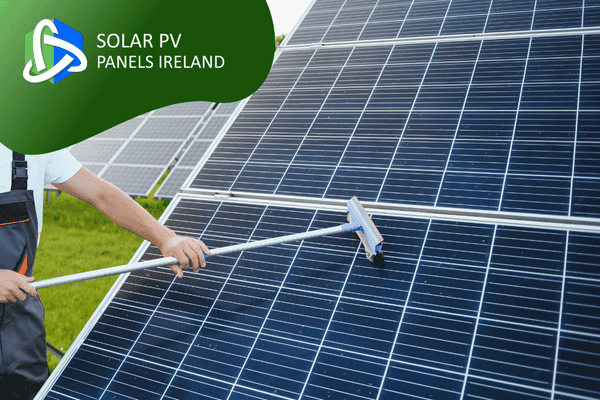
    Contrary to popular belief, solar panels are remarkably low-maintenance. They are designed to be durable and withstand harsh weather conditions, including strong winds and heavy rain, which naturally help to keep them clean. Typically, solar panels only require routine inspections every few years and occasional cleaning, particularly if dirt, leaves, or bird droppings accumulate and obscure the panels. Most reputable installers offer long warranties, often 25 years or more, guaranteeing their performance and durability. This minimal maintenance requirement makes solar panels a hassle-free addition to any property, allowing owners to enjoy consistent energy generation without constant upkeep.

    Myth 4: Solar Panels Can’t Power Homes at Night

    This myth stems from the obvious fact that solar panels don’t produce electricity when the sun isn’t shining. However, it overlooks the advancements in energy storage solutions and grid connectivity. Homes with solar panels in Ireland can either store excess energy generated during the day in battery storage systems for use at night. Alternatively, grid-tied systems allow homeowners to draw electricity from the national grid when their panels aren’t producing enough and export surplus electricity back to the grid when production is high. This ensures a continuous and reliable power supply, bridging the gap between daytime generation and nighttime consumption.

    Myth 5: Solar Panels Are Unattractive and Distracting

    The image of bulky, obtrusive solar panels is largely outdated. Modern solar panel designs are increasingly sleek, aesthetic, and can be seamlessly integrated into various architectural styles. Manufacturers now offer panels with low profiles, different colours, and even roof-integrated options that blend harmoniously with the existing roofline, making them barely noticeable. Many contemporary homes are designed with solar aesthetics in mind, transforming panels from a functional addition into a desirable architectural feature that enhances the property’s modern appeal.

    Myth 6: Solar Panels Are Harmful to the Environment

    This myth is a complete contradiction to the very essence of solar energy. Solar panels are a cornerstone of clean and sustainable energy. They produce electricity without generating greenhouse gases, harmful emissions or polluting air and water during operation. While the manufacturing process of solar panels does have an environmental footprint, ongoing advancements are making production increasingly sustainable, and the long-term environmental benefits vastly outweigh this initial impact. Furthermore, many components of solar panels, such as silicon and aluminium, are recyclable, contributing to a circular economy. Choosing solar power significantly reduces reliance on fossil fuels, directly contributing to a cleaner, healthier planet.

    Myth 7: Solar Panels Are Only for Off-Grid Living

    While solar panels are indeed vital for off-grid living, their primary application in Ireland and many developed countries is to supplement traditional grid power. Most solar panel installations in Ireland are grid-tied systems. This means they remain connected to the national electricity grid, using solar power as the primary source and drawing from the grid when needed (e.g., at night or during peak demand). This hybrid approach offers the best of both worlds: energy independence and reduced electricity bills, coupled with the security of a continuous power supply. It also allows homeowners to benefit from schemes that pay them for excess electricity exported to the grid.

    Myth 8: Solar Panels Decrease Property Values

    This myth is entirely untrue, in fact, the opposite is true. Installing solar panels typically increases property value. As energy costs rise and environmental consciousness grows, homes equipped with solar panels become highly attractive to potential buyers. They offer the promise of significantly lower energy bills, a reduced carbon footprint, and a modern, sustainable lifestyle. A property with an installed solar system is often viewed as a forward-thinking investment, providing immediate and long-term financial benefits that appeal strongly to a lot of individuals.

    Myth 9: Solar Panels Are Inefficient in Cold Climates

    This myth is similar to the “only effective in sunny climates” myth but focuses on temperature. As previously mentioned, solar panels can actually perform better in cold, sunny conditions. The efficiency of a solar panel can decrease with excessively high temperatures, as heat can reduce the electrical conductivity of the silicon. Therefore, cooler temperatures in Ireland can contribute to optimal electrical performance, provided there is sufficient daylight. Snow cover can temporarily block sunlight but panels are generally installed at an angle that allows snow to slide off and their dark surface can also help melt snow.

    Myth 10: Solar Panels Have a Short Lifespan

    Solar panels are built to last. The industry standard warranty for solar panel performance is typically 25 years, guaranteeing that the panels will still produce a significant percentage of their original power output (often 80-90%) after this period. Many systems continue to function effectively and produce electricity well beyond their warranty period, sometimes for 30 years or even more with proper care. The components are robust, designed to withstand decades of exposure to various weather conditions, making solar panels a long-term investment that provides energy benefits for a substantial portion of a home’s lifespan.

    The landscape of energy production in Ireland is evolving and solar power is playing an increasingly vital role. By dispelling these common myths, it becomes clear that solar panels are a viable, cost-effective and environmentally friendly energy solution for Irish homes and businesses. With supportive government policies, technological advancements and a growing understanding of their benefits, the future of solar energy in Ireland is bright. It’s time to look past the misconceptions and embrace the power of the sun for a sustainable future.

  • The Benefits & Advantages of Solar Panels

    The Benefits & Advantages of Solar Panels

    As more people become conscious of the environment and rising energy costs, solar panels have become a popular choice for powering homes and businesses. Not only do they reduce reliance on traditional energy sources, but they also offer numerous benefits for those looking to make a sustainable change. Here’s why solar panels are a smart investment, especially in Ireland.

    Solar panels are devices that turn sunlight into electricity, helping to power homes and businesses with clean, renewable energy. They work by capturing sunlight and converting it into usable electricity through special cells called photovoltaic (PV) cells.

    More and more people across Ireland are choosing solar panels to reduce their electricity bills and lower their carbon footprint. With government grants available, it’s now easier and more affordable than ever to make the switch.

    At Solar PV Panels Ireland, we supply and install high-quality solar panels designed for Irish weather. Even on cloudy days, they generate power to keep your home or business running efficiently.

    1. Save Money on Electricity Bills

    Save Money on Electricity Bills

    One of the biggest reasons people turn to solar panels is to save money. Once installed, solar panels reduce your dependence on the grid, meaning you’ll rely less on your energy supplier. Over time, this can lead to significant savings on your electricity bills. If your system generates more power than you use, you can even sell the surplus energy back to the grid!

    2. Increase the Value of Your Home

    Value of Your Home

    Homes with solar panels are often more attractive to buyers, as they offer lower energy costs and are seen as more eco-friendly. This means solar panels can increase your property’s value, making them a great investment if you’re planning to sell your home in the future. 

    3. Environmentally Friendly

    Environmentally Friendly

    Solar energy is clean and renewable. By installing solar panels, you’re reducing your carbon footprint and helping to combat climate change. In Ireland, where we are working towards a greener future, using solar power contributes to national sustainability goals and supports the shift away from fossil fuels.

    4. Energy Independence

    Energy Independence

    With solar panels, you’re less dependent on energy suppliers and vulnerable to rising energy prices. By generating your own electricity, you’re taking control of your energy needs. This added independence can bring peace of mind, especially when energy prices fluctuate.

    5. Government Grants and Incentives

    solar grants

    In Ireland, there are several grants and incentives available for those who choose to install solar panels. The government’s support for renewable energy makes it easier and more affordable to go solar. With the right funding, you can get started without a huge upfront cost.

    6. Low Maintenance and Long Lifespan

    Low Maintenance

    Solar panels are incredibly low-maintenance, requiring only occasional cleaning and inspection. With proper care, they can last 25 years or more. Over their long lifespan, you’ll enjoy years of reliable, cost-effective energy.

    7. Helps Ireland Meet Renewable Energy Targets

    Energy Targets

    As a country, Ireland is committed to reducing its carbon emissions and increasing the use of renewable energy. By installing solar panels, you’re not only benefiting yourself but also helping Ireland reach its climate goals. It’s a simple way to contribute to a cleaner, greener future for everyone.

    8. Sustainable and Future-Proof

    Sustainable

    Solar energy is abundant, and the technology continues to improve. With advances in energy storage solutions, like home batteries, you can even store excess energy to use during the night or on cloudy days, ensuring a reliable source of power year-round.

    Going Forward

    Solar panels provide an excellent way to save money, increase the value of your home, and reduce your environmental impact. In Ireland, with the right grants and incentives, there’s never been a better time to invest in solar energy.

    At Solar PV Panels Ireland, we’re here to help you take advantage of all the benefits solar panels have to offer. Reach out today to learn more about how you can start generating clean, affordable energy for your home or business!

  • Is Solar Energy Renewable?

    Is Solar Energy Renewable?

    The global energy landscape is undergoing a big shift. For homeowners in Ireland, where energy costs and climate action are major concerns, the conversation inevitably turns to clean alternatives. And towering above all other options is the power of the sun. But a fundamental question persists: Is solar energy truly renewable?

    It sounds like a simple question, but the full answer involves the mechanics of modern technology and a crucial look at sustainability here in Ireland.

    As a system designed to process and synthesise complex information, we can give you the definitive, logic-driven answer right now: Yes, solar energy is profoundly renewable. However, to understand its true value, especially when considering a Solar PV installation for your home in Ireland, we need to examine the context of that statement.

    Defining the Cornerstone of Clean Energy

    Cornerstone of Clean Energy

    To determine if solar energy is renewable, we must first establish a clear definition of what “renewable” actually means in the context of power generation.

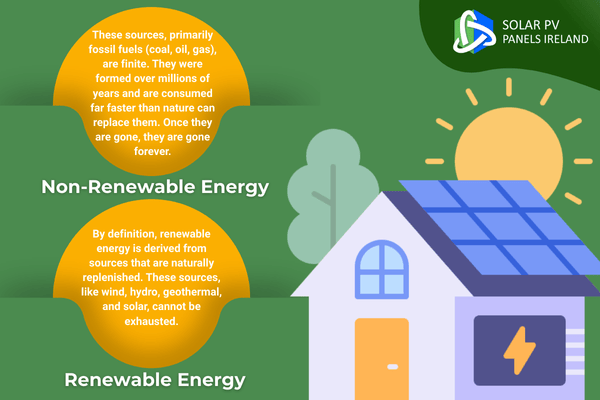
    Renewable Energy: By definition, renewable energy is derived from sources that are naturally replenished. These sources, like wind, hydro, geothermal, and solar, cannot be exhausted.

    Non-Renewable Energy: These sources, primarily fossil fuels (coal, oil, gas), are finite. They were formed over millions of years and are consumed far faster than nature can replace them. Once they are gone, they are gone forever.

    Solar energy, which is the process of capturing light and heat from the Sun, fits perfectly into the former category. The sun’s energy output is essentially continuous and entirely limitless for the duration of human civilisation. It is the ultimate source of power.

    The Sun: The Ultimate Power Source

    The Sun, a massive ball of plasma and hydrogen, generates energy through nuclear fusion. This process is so powerful that the tiny fraction of energy the Earth receives, known as insolation, is enough to power the world many thousands of times over.

    While nothing in the universe is truly infinite, scientists estimate the Sun has approximately 4.5 to 5 billion years left in its main-sequence life cycle. Put simply, the Sun will continue to shine and provide us with free, abundant energy for longer than we can possibly imagine needing it. For all practical purposes, this makes the Sun an inexhaustible, endless, and perfectly renewable energy source.

    Sustainability vs. Renewability

    The question of whether solar is renewable often opens up a more complex, and frankly, more important debate: Is it sustainable?

    The primary criticism directed at solar power doesn’t concern the Sun itself, but rather the technology we use to harness it, the Solar PV Panels. A photovoltaic system, like any manufactured product, requires raw materials and energy to produce. This is the system’s initial carbon footprint.

    If solar panels are manufactured using energy generated by coal or gas power plants, how can they truly be called clean? This is a valid question, and the answer lies in the concept of Energy Payback Time and Carbon Payback Time.

    The Carbon Payback Calculation

    Modern Solar PV Panels are incredibly efficient, durable, and clean. Studies consistently show that the energy and carbon required to manufacture, transport, and install a solar panel system are offset by the clean energy the system generates over a relatively short period.

    • Energy Payback Time: The time it takes for a PV system to generate the same amount of energy that was consumed in its manufacture, installation, and decommissioning. This is typically 1.5 to 3.5 years.
    • Lifespan: Most high-quality solar systems installed today have a warranted operational lifespan of 25 years or more.

    After the initial few years, every kilowatt-hour (kWh) of electricity your system produces is genuinely zero-carbon, pure renewable energy. When you weigh a 25-year-plus period of clean generation against a three-year carbon debt, the positive impact is overwhelming. The net gain for the environment is massive.

    The Circular Economy and Recyclability

    Furthermore, the industry is rapidly transitioning toward full sustainability through recycling. Today, over 80% of a typical solar panel’s materials, including the aluminium frame, glass, and copper wiring, can be recycled. Innovative processes are being developed to efficiently recover the more complex components, like silicon, ensuring that the technology is not only renewable in operation but increasingly sustainable across its entire life cycle.

    The manufacturing carbon footprint is shrinking every year, meaning solar power is quickly moving from being just a renewable source to being one of the most sustainable energy options available.

    Solar PV in Ireland

    For Irish homeowners, the theoretical renewability of the Sun is only useful if the technology works effectively on your rooftop. Given Ireland’s reputation for rain and clouds, people often wonder if Solar PV is a wise investment here. The logical response is a resounding yes.

    Solar panels do not rely on heat; they rely on daylight. Ireland’s solar radiation levels are comparable to major European solar markets like Germany and Belgium. Those countries are leading the continent’s solar revolution, proving that Mediterranean sunshine isn’t necessary.

    Installing Solar PV Panels offers unparalleled benefits rooted in both renewability and financial common sense:

    1. Massive Bill Reductions: By generating your own clean, renewable electricity, you instantly reduce your reliance on expensive grid power, potentially cutting electricity bills by 50% or more.
    2. Increased Home Value and BER Rating: Homes with installed solar systems are significantly more attractive to prospective buyers. Solar contributes directly to improving your Building Energy Rating (BER), a tangible asset in the Irish property market.
    3. Government Support and Incentives: The Irish Government is fully committed to the energy transition, offering generous support. The SEAI grant makes the upfront investment significantly more affordable, drastically shortening your payback period.
    4. Microgeneration and Income: Thanks to the Microgeneration Support Scheme (MSS), homeowners can now sell any surplus, renewable electricity generated by their system back to the national grid via a Feed-in Tariff, turning your roof into a genuine income-generating asset.

    This combination of eternal, clean power from the Sun, technological breakthroughs, and strong governmental backing confirms that solar power is not just a renewable choice for Ireland, it is the financially smart choice.

    The Logical Path Forward

    To cycle back to our core question, Is Solar Energy Renewable? The answer is unequivocally yes.

    Solar power is sourced from the most reliable and abundant energy reservoir in our solar system. It generates electricity without combustion, without harmful emissions, and without depleting the source. While the equipment needed to capture this energy carries a temporary footprint, the overwhelming benefit of zero-carbon operation cements solar PV’s role as the foundation of a secure energy future.

    For Irish homeowners, embracing solar energy is more than an environmental statement; it is a declaration of energy independence, a hedge against fluctuating power prices, and a long-term investment in your property and the planet.

    Are you ready to harness the power of the Sun and start generating your own clean, renewable electricity right here in Ireland?

    Solar PV Panels Ireland specialises in designing and installing high-efficiency solar systems tailored to your home, ensuring maximum savings and environmental impact. We handle everything from the initial consultation and grant applications to final installation and commissioning, making your switch to renewable energy seamless and straightforward.

  • Solar PV vs Traditional Panels

    Solar PV vs Traditional Panels

    Defining the Core Technology: Solar PV vs. Solar Thermal

    To clear up the most common point of confusion, what many people refer to as “traditional” solar panels in an Irish context are often Solar Thermal collectors. These systems were the early pioneers of renewable energy in Ireland, specifically designed to heat domestic hot water. They work by absorbing solar radiation to heat a liquid, usually a mix of water and glycol, which then travels through a heat exchanger to warm the water in your cylinder.

    On the other hand, Solar PV (Photovoltaic) panels represent the modern standard for energy independence. Instead of heating liquid, PV technology uses silicon cells to convert daylight directly into electricity. Learn exactly how solar PV panels work here. This electricity can then be used to power everything from your kettle and TV to your electric vehicle and heat pump. While thermal panels are highly efficient at one specific task, Solar PV offers a level of versatility that has made it the dominant choice for those looking to offset the rising cost of living.

    Why the Irish Climate Favours Modern PV Systems

    A common myth that persists across the country is that Ireland isn’t sunny enough for solar power to be viable. In reality, modern Solar PV panels do not require direct, scorching sunlight to function; they operate on daylight. Even on an overcast day in Longford or Dublin, these panels are capturing “diffuse” light and converting it into power.

    Interestingly, solar panels actually perform more efficiently in cooler temperatures. In sweltering climates, the electrical resistance in the panels can increase, slightly hindering performance. Ireland’s temperate climate and long summer daylight hours provide an ideal environment for PV systems. While a thermal system might struggle to reach high temperatures on a very cold, cloudy winter day, a PV system will still be generating a baseline of electricity that contributes to your home’s daily energy requirements.

    Versatility and the Power of Electricity

    One of the primary reasons homeowners are moving away from traditional thermal setups in favour of Solar PV is the sheer range of applications. When you install a Solar PV system, you aren’t just solving a hot water problem; the electricity generated can be diverted to a variety of sources.

    For instance, if you have a surplus of energy on a bright afternoon, you can use a power diverter to send that excess electricity to your immersion heater, effectively doing the job of a thermal panel. Furthermore, with the rise of electric vehicles in Ireland, many of our clients are now integrating EV chargers with their solar arrays. This allows you to “fuel” your car with the energy captured from your own roof, bypassing the petrol station and the fluctuating prices of the national grid entirely.

    Financial Incentives and the SEAI Grant Landscape

    The financial argument for switching to solar has never been stronger. The Sustainable Energy Authority of Ireland (SEAI) provides substantial support for domestic and commercial installations. For homeowners, grants of up to €2,100 are available, which significantly reduces the initial capital outlay and shortens the payback period.

    At Solar PV Panels Ireland, we take pride in being an SEAI-registered company, ensuring that our customers can easily access these incentives. Our background in domestic and commercial electrical installations means we don’t just fit panels; we design integrated systems that maximise your return on investment. Whether you are looking at a small residential setup or a large-scale agricultural project through the TAMS 3 grant, which offers up to 60% funding for farmers, the goal remains the same: long-term savings and energy security.

    The Role of Battery Storage in Modern Irish Homes

    A major differentiator between “traditional” setups and modern PV systems is the ability to store energy. Traditional solar thermal systems rely on a water tank to hold heat, but once that water is hot, any additional solar energy is essentially lost if not used immediately. Solar PV changes this dynamic through the use of lithium-ion battery storage.

    By adding a battery to your Solar PV installation, you can store the electricity generated during the peak daylight hours of 11 am to 3 pm and use it later in the evening when your family is home, the lights are on, and the dishwasher is running. This significantly increases your self-consumption rate, which is the percentage of solar energy you actually use rather than sending it back to the grid. In an era of high energy prices, every kilowatt-hour you store and use yourself is money kept in your pocket.

    Maintenance and Longevity

    When investing in a home improvement of this scale, durability is a natural concern. Traditional solar thermal systems involve moving parts, pumps, and fluids that can occasionally leak or require servicing to ensure the antifreeze levels are correct. They are robust, but they do require a more hands-on maintenance schedule over their 20-year lifespan.

    Solar PV panels, by contrast, are remarkably low maintenance. Because they have no moving parts, there is very little that can go wrong with the panels themselves. Most high-quality panels come with a 25-year power rating warranty, meaning they are guaranteed to produce a high percentage of their original output for over two decades. Aside from an occasional rinse to remove dust or bird droppings, which Ireland’s frequent rainfall often handles for you, a PV system is largely a fit and forget technology.

    Taking the Next Step with Solar PV Panels Ireland

    Choosing the right system depends entirely on your specific goals. If your only concern is a high volume of hot water for a large family, traditional thermal might still have a place. However, for the vast majority of Irish households and businesses, the flexibility, ease of maintenance, and broad cost-saving potential of Solar PV make it the superior choice.

    At Solar PV Panels Ireland, we offer a comprehensive service that includes a detailed site survey to assess your roof orientation and energy requirements. We understand that every home is different, which is why we provide bespoke designs, whether you have a south-facing roof or need a ground-mounted system in your garden. Our team of fully qualified Safe Electric registered technicians ensures that your transition to green energy is seamless and professional.

    Building a Sustainable Future for the Next Generation

    Beyond the financial savings, there is a profound environmental benefit to choosing Solar PV. By reducing your reliance on fossil-fuel-generated electricity, you are directly lowering your carbon footprint. In Ireland, where we are striving to meet ambitious climate targets, every rooftop contributes to a cleaner, more resilient national grid.

    The transition from “traditional” solar thinking to a modern PV-first approach is about more than just technology; it is about taking control of your own energy future. With utility costs unlikely to return to the lows of the past decade, generating your own power is the most effective way to protect your household budget. If you are ready to explore how solar can transform your home or business, reach out to us at Solar PV Panels Ireland for a free, no-obligation quote. Let us help you harness the Irish daylight and turn it into an asset for your property.

  • Jinko Solar Panels

    Jinko Solar Panels

    At Solar PV Panels Ireland, we source the best materials available for our customer requirements. This ensures that we provide good quality service and a product that delivers reliable performance. 

    Why Jinko Solar Panels Are a Top Choice for Your Home or Business

    When it comes to installing solar panels, you want to choose a brand that offers quality, performance and reliability. Jinko Solar is one of the leading manufacturers in the solar industry. They are known for producing high-efficiency panels that deliver really good results. Whether you’re a homeowner or a business looking to reduce energy costs and carbon footprint, Jinko solar panels are a great option.

    In this blog post, we’ll dive into why Jinko Solar panels are a top choice. We’ll highlight some of the key specifications that make them stand out in the market.

    About Jinko Solar

    Jinko Solar is a global leader in solar technology. They have over 10 years of experience in the industry. The company produces a wide range of solar panels. They are designed to meet the needs of residential, commercial and industrial installations. Jinko’s commitment to quality, innovation, and sustainability has made it one of the most trusted names in the solar market.

    The company is known for its high-efficiency solar modules, reliable performance in various weather conditions and really affordable pricing. This makes them a popular choice for solar installations worldwide.

    Why Choose Jinko Solar Panels?

    jinko solar

    Jinko Solar panels offer several advantages, including:

    High Efficiency: Jinko panels use advanced technology to achieve high energy conversion rates. This ensures you get the most out of every ray of sunlight.

    Durability: Jinko panels are built to withstand harsh weather conditions, including high winds, snow, and rain. This makes them ideal for the variable climate in Ireland.

    Long Lifespan: With a lifespan of 25 years or more, Jinko solar panels offer long-term performance. This gives you excellent value for your investment.

    Warranty: Jinko provides a 10-year product warranty and a 25-year performance warranty. This should give you peace of mind about your investment.

    Global Recognition: As one of the world’s largest solar panel manufacturers, Jinko Solar has earned a strong reputation for providing top-quality, reliable products.

    Jinko Solar Panel Specifications

    Jinko Solar panels come in several models. Each model is designed for different applications. One of the most popular models is the Jinko Eagle 72 HC. It offers impressive efficiency and performance. Here’s an overview of its key specifications:

    Jinko Eagle 72 HC (High Efficiency) Solar Panel

    • Type: Monocrystalline
    • Number of Cells: 72
    • Panel Efficiency: 20.3% (high efficiency for more power generation)
    • Nominal Power Output: 360W – 380W (depends on the specific panel variant)
    • Voltage at Max Power (Vmp): 39.3V
    • Current at Max Power (Imp): 9.2A
    • Open-Circuit Voltage (Voc): 47.5V
    • Short-Circuit Current (Isc): 9.6A
    • Temperature Coefficients:
      • Power: -0.37%/°C
      • Current: +0.05%/°C
      • Voltage: -0.28%/°C
    • Operating Temperature Range: -40°C to +85°C (Jinko Solar panels are designed to operate in a wide range of temperatures)
    • Weight: 21.5 kg per panel
    • Dimensions: 2,002 mm x 992 mm x 40 mm
    • Frame: Anodized aluminum alloy (provides durability and resistance to corrosion)
    • Glass: Anti-reflective, tempered glass (ensures better light absorption and durability)

    Key Features of the Jinko Eagle 72 HC

    High Power Output: With power outputs ranging from 360W to 380W, the Jinko Eagle 72 HC delivers high performance for residential and commercial solar systems. This means you can generate more electricity with fewer panels. This saves space and saves on installation costs.

    High Efficiency: At 20.3% efficiency, the Eagle 72 HC solar panel offers one of the highest efficiency rates in the industry. It ensures maximum energy production even in limited space or less-than-ideal conditions.

    Durability: Jinko’s Eagle panels are designed to withstand harsh weather. This includes heavy snow loads and high wind speeds. The durable aluminium alloy frame and tempered glass protect the panels from physical damage and environmental factors.

    Performance Warranty: Jinko Solar guarantees that their panels will retain at least 80% of their original power output after 25 years. This ensures long-term efficiency and savings.

    Other Jinko Solar Panel Models

    Jinko Solar offers a variety of other models. They include the Jinko Tiger and Jinko Cheetah series. Each series is designed to cater to different needs. Some for ultra-efficient panels or some for cost-effective solutions. Here’s a quick overview:

    Jinko Tiger Panels: Known for their high performance, the Jinko Tiger panels feature PERC (Passivated Emitter and Rear Cell) technology. This increases efficiency and reduces energy loss.

    Jinko Cheetah Panels: These panels are designed for cost-effectiveness while still offering excellent efficiency and durability. The half-cell technology in the Cheetah panels allows them to generate more power and improve shading tolerance.

    Why Jinko Solar Panels Are Ideal for Irish Homes and Businesses

    Ireland’s climate can present unique challenges for solar energy generation. This is often because cloudy weather and rain. However, Jinko Solar panels perform well in a variety of conditions.This includes low-light environments. They are an excellent choice for Irish homeowners and businesses. Their high efficiency ensures you still get maximum power generation even on overcast days.

    Jinko’s strong warranty coverage, robust performance and competitive pricing make it a great option for long-term savings and sustainability. By investing in Jinko Solar panels, you can enjoy reliable, cost-effective, and environmentally friendly energy for years to come.

  • What Happens to Renewables in a Storm?

    What Happens to Renewables in a Storm?

    Ireland is a nation famed for its breathtaking coastline and its rolling green hills. Yet, alongside this picturesque image, we are a nation defined by our elemental weather. Positioned on the eastern edge of the North Atlantic storm track, we are routinely battered by powerful and intense wind and rain.

    As Ireland keeps pursuing its climate targets and transitions away from fossil fuels, renewable energy, primarily wind and solar, has become the backbone of our energy independence. This raises a critical, fundamental question for homeowners and businesses alike: What exactly happens to our renewable energy infrastructure when a major storm hits?

    When the wind is howling and the rain is lashing against the windows, many assume that the very elements designed to generate our power are being destroyed, or at least severely compromised. The reality, however, is a testament to modern engineering, rigorous certification and most importantly, expert installation. Today’s wind turbines and solar photovoltaic (PV) systems are built not just to survive, but to endure the very worst that the Irish climate can throw at them.

    In this guide, we delve into the engineering marvels that protect Ireland’s green power sources, explore the recent extreme weather events that have tested their limits, and explain why choosing a provider like Solar PV Panels Ireland is the vital step in future-proofing your home’s energy supply against the increasing frequency and intensity of Atlantic storms.

    Ireland’s New Reality and the Test of the Atlantic

    Ireland has always been a windy island, but the recent storm seasons have highlighted the increasing power of our weather. Understanding the sheer forces involved is essential to seeing the level of engineering required for renewable energy systems to operate safely.

    The 2025/2026 storm season, which commenced on September 1st, has already made its presence felt, with Storm Amy being named as the first major storm to impact the country in early October. However, the true benchmark for resilience was set in the preceding season. According to Met Éireann, the Irish Meteorological Service, Storm Éowyn brought winds in January 2025 that shattered long-standing records.

    Specifically, Met Éireann recorded a provisional highest gust speed ever observed on land in Ireland during Storm Éowyn, reaching a staggering 184 km/h at Mace Head in Co. Galway on January 24th, 2025. This gust was classified as Hurricane Force and broke a record set 80 years prior, underscoring the extreme environmental conditions our national infrastructure must tolerate.

    These statistics confirm that renewable technology in Ireland is not dealing with an average breeze; it must withstand large forces. This is the challenge that modern solar and wind technologies face.

    Wind Turbines: Built to Rest in the Face of Fury

    The most visible sign of a major storm’s impact on renewable energy is often the sight of static wind turbines. When gusts reach their peak, wind farms are designed to power down, not because they are weak, but because they are exceptionally clever and robust.

    The strategy for wind farms during severe weather can be broken down into three essential protective mechanisms:

    1. Automatic Shut-Down Thresholds

    Modern wind turbines are equipped with sophisticated sensors which continuously monitor wind speed. When wind speeds exceed a predetermined safe threshold, typically around 90 km/h, which falls into the Beaufort Scale’s ‘Strong Gale’ or ‘Storm Force’ categories, the turbine’s control system initiates an immediate shutdown.

    This action is purely preventative. While the structure could technically handle higher winds, generating power under such extreme stress causes undue wear and tear on the gearbox, rotor, and generator. Shutting down ensures the longevity of the valuable machine.

    2. Blade Pitch Control (Feathering)

    When the emergency threshold is reached, the blades are rotated parallel to the incoming wind flow. This action is known as feathering. Instead of presenting a broad, rotating surface to capture the wind, the blade edge cuts through the wind, vastly reducing aerodynamic load. Think of it like turning a sail sideways into the wind; it stops the forward movement and minimises the force exerted on the mast. Feathering reduces the total force on the rotor by up to 90%, preventing the turbine from spinning uncontrollably and safeguarding the structure from destructive forces.

    3. Yawing and Braking

    At the same time, the yaw system rotates the entire nacelle (the housing unit at the top of the tower) to track or, in extreme cases, intentionally angle the blades away from the most damaging wind direction. Mechanical disc brakes are also applied to the main shaft, ensuring the rotor comes to a complete, controlled stop and remains securely locked in place for the duration of the storm.

    Ultimately, a stationary wind turbine during a storm is a sign of success, not failure. It indicates that the system’s protective function is working exactly as it should, ensuring it survives the event and is ready to resume full power generation as soon as wind speeds return to normal.

    Solar PV Resilience: Anchoring the Future on Your Roof

    While wind power captures the drama of extreme weather responses, solar PV panels face a different, often underestimated, set of structural challenges during a storm. Unlike turbines that can shut down and rotate, a solar panel is a fixed structure that must absorb the full, concentrated force of the elements.

    For Irish homeowners considering solar, particularly with the volatile weather witnessed during Storm Éowyn, resilience is paramount. The strength of a PV system lies not just in the panel itself, but in the entire structure, from the glass to the frame to the mounting system connecting it to the roof.

    The Physics of Solar Panel Survival

    A modern solar panel is an incredibly resilient piece of technology, built to rigorous international standards (such as IEC 61215).

    1. Tempered Glass: The front surface of a PV module is typically covered in highly durable, low-iron tempered glass. This glass is engineered to withstand impacts from large hailstones, often tested to resist ice balls travelling up to 80 km/h, and provides a protective shield against flying debris.
    2. Structural Frame: The panels are encased in sturdy aluminium frames, which distribute weight and tension evenly, protecting the delicate internal silicon cells.
    3. Pressure Rating: Standard PV modules are rated to handle significant loads. They are typically certified to withstand a downward (snow) load of up to 5400 Pascals (Pa) and, crucially in Ireland, an uplift (wind suction) load of 2400 Pa. These are not just theoretical numbers; they are tested specifications that translate to survival in gale-force conditions.

    The Critical Role of Installation and Irish Building Standards

    While the panel itself is strong, the most critical point of failure in any severe storm is the connection to the roof. Wind doesn’t just push down (compression); the high-speed air flow over the roof creates a powerful vacuum that tries to pull the entire system up (suction or uplift). This uplift force can be far more destructive than compression, particularly at roof edges and corners.

    To counter this, installation must adhere strictly to Ireland’s national building codes and European standards.

    Solar PV Panels Ireland bases all installations on the principles set out in Eurocode 1: Actions on Structures. This standard requires our experts to perform highly specific calculations for every single installation based on:

    • Location and Topography: Whether the site is coastal, in a city centre, or sheltered in a valley.
    • Building Height: Wind forces increase exponentially with height.
    • Roof Type and Pitch: Different roof geometries experience vastly different wind pressures and suctions.

    For example, a coastal home in Co. Galway that experienced the 184 km/h gusts of Storm Éowyn requires significantly different mounting systems and anchor points than a sheltered urban installation in the midlands. Simply bolting a panel to a roof is insufficient; the mounting system, the rails, clamps, and roof hooks, must be engineered to resist calculated, site-specific uplift forces, often utilising high-tensile steel components secured directly into the roof.

    Direct Expertise Against the Storm

    As leading Irish solar experts, Solar PV Panels Ireland guarantees that our installation methodologies are specifically engineered to withstand Ireland’s extreme winds. We ensure compliance by:

    1. Using Certified Mounting Systems: Employing mounting hardware that has itself been wind-tunnel tested and certified to the highest European standards.
    2. Mechanical or Ballasted Integrity: Depending on the roof type (pitched or flat), we use appropriate mechanical anchor points (securely fixed into rafters or purlins) or weight-engineered ballasted systems (on flat roofs) that are calculated to resist uplift, taking into account safety margins to account for turbulent gusts.

    For a homeowner, this means peace of mind. When Storm Amy or another major storm arrives, your Solar PV Panels Ireland installation is not a weak point; it is a meticulously engineered element of your home, designed with the 184 km/h gust speeds of Storm Éowyn in mind.

    Storm Resilience: A Statistical Advantage for Renewables

    While severe storms cause massive disruption, they highlight the inherent resilience of modern renewable infrastructure compared to older, centralised energy grids. The damage seen in extreme weather events is often concentrated on overhead distribution lines, traditional power lines that are prone to falling due to high winds, ice accumulation, and falling debris.

    Renewable energy offers a protective layer against this vulnerability. When the wider grid goes down due to fallen poles, a home equipped with solar PV and a battery storage system (often installed by Solar PV Panels Ireland) can disconnect from the damaged utility network and continue to operate independently, providing essential power for lights, refrigeration, and communication.

    This capability to continue generating power locally, even when the macro grid is compromised, is a powerful statistic in favour of a wider solar adoption. The transition to a decentralised energy system, where power is generated on millions of rooftops, inherently increases grid resilience, making the system less susceptible to single points of failure caused by storms.

    The Crucial Difference: Why Local Expertise Matters

    The resilience of your solar investment hinges entirely on the quality and integrity of the installation. A panel is only as strong as its weakest attachment point.

    In a country as geologically and meteorologically diverse as Ireland, where wind action varies drastically between the exposed headlands of Donegal and the relatively sheltered inland counties, the generic, one-size-fits-all approach is a recipe for disaster.

    Solar PV Panels Ireland doesn’t rely on general assumptions. We utilise the detailed wind-mapping data provided by Met Éireann and the structural criteria from the Irish National Annex to Eurocode 1 to produce a unique, site-specific structural design for every project. This ensures that every rail, clamp, and fixing is engineered to meet or exceed the maximum possible uplift and shear forces for that precise location on the island.

    Choosing an expert Irish installer means you are getting:

    • Code Compliance Assurance: Guaranteeing that the installation meets the mandatory requirements for handling severe wind loads.
    • Quality Component Selection: Using only certified, high-grade aluminium and steel mounting systems designed to endure corrosive coastal environments and extreme temperatures.
    • Insurance Validation: Ensuring your system is correctly installed, safeguarding your home insurance and warranty in the event of a severe weather claim.

    When facing the kind of weather brought by Storm Éowyn and the latest storms like Storm Amy, this attention to detail is the difference between a system that powers through and one that results in costly damage.

    Storm-Proofing Ireland’s Green Future

    The reality of renewable energy in a storm-prone climate is reassuringly clear: modern solar PV panels and wind turbines are engineered powerhouses. They are designed using scientific principles and tested against forces that exceed the highest recorded wind speeds in Ireland.

    As we move through the 2025/2026 storm season and beyond, the adoption of resilient, expertly installed solar technology is one of the most effective ways for Ireland to achieve energy security. Don’t leave your renewable energy investment to chance. Trust the local knowledge and adherence to the most stringent Irish engineering standards.

    Contact Solar PV Panels Ireland today to ensure your home’s transition to solar is not only sustainable but built to weather any storm the Atlantic sends our way.

  • AIKO Solar Panels

    AIKO Solar Panels

    At Solar PV Panels Ireland, we source the best materials available for our customer requirements. This ensures that we provide good quality service and a product that delivers reliable performance. 

    Why AIKO Solar Panels Are a Great Choice for Your Solar Installation

    Choosing the right solar panels for your home or business is a crucial decision that can impact the efficiency, durability, and long-term savings of your solar investment. AIKO Solar, a respected name in the solar industry, is known for its innovative technology, high-performance solar modules, and commitment to sustainability. Whether you’re looking to reduce your energy costs or reduce your carbon footprint, AIKO Solar panels offer a reliable and effective solution.

    In this blog post, we’ll explore the key features that our team at Solar PV Panels Ireland consider important about  AIKO Solar panels and highlight some of the specifications that make them a standout option for your solar energy system.

    About AIKO Solar

    AIKO Solar is a leading manufacturer of high-efficiency solar panels that combine advanced technology, reliable performance, and affordability. With a commitment to innovation and quality, AIKO Solar has become a popular choice for residential, commercial, and industrial solar installations around the world. The company’s solar panels are built to last and deliver exceptional energy output, ensuring customers get the best value over time.

    AIKO Solar’s commitment to producing clean, renewable energy has made them a trusted brand for those looking to make the switch to solar power.

    Why Choose AIKO Solar Panels?

    AIKO Solar panels stand out in the solar market for several reasons:

    • High Efficiency: AIKO Solar panels are designed to maximise power generation, ensuring you get the most from every unit of sunlight.
    • Durability: These panels are built to withstand harsh weather conditions and have a long lifespan, making them a reliable choice for both residential and commercial installations.
    • Affordable: AIKO Solar offers competitive pricing without compromising on performance, making them a cost-effective solution for homeowners and businesses alike.
    • Innovative Technology: AIKO Solar uses advanced manufacturing techniques, including PERC (Passivated Emitter and Rear Cell) technology, to enhance the performance and efficiency of their panels.
    • Warranty: AIKO Solar offers an excellent warranty, providing peace of mind and ensuring that your investment is protected for the long term.

    AIKO Solar Panel Specifications

    AIKO Solar panels come in several models, each offering different power outputs and efficiency ratings. One of their most popular models is the AIKO 60M-365W, which offers impressive performance, high efficiency, and solid durability. Below are the specifications for the AIKO 60M-365W model:

    AIKO 60M-365W Solar Panel Specifications

    • Type: Monocrystalline
    • Number of Cells: 60
    • Panel Efficiency: 20.1% (high-efficiency design for maximum energy generation)
    • Nominal Power Output: 365W
    • Voltage at Max Power (Vmp): 38.5V
    • Current at Max Power (Imp): 9.48A
    • Open-Circuit Voltage (Voc): 47.5V
    • Short-Circuit Current (Isc): 9.98A
    • Temperature Coefficients:
      • Power: -0.37%/°C
      • Current: +0.05%/°C
      • Voltage: -0.29%/°C
    • Operating Temperature Range: -40°C to +85°C (designed for various climates)
    • Weight: 20.5 kg per panel
    • Dimensions: 1,710 mm x 1,022 mm x 35 mm
    • Frame: Anodised aluminium (providing durability and corrosion resistance)
    • Glass: Anti-reflective, tempered glass for better light absorption and strength

    Key Features of the AIKO 60M-365W Solar Panel

    • High Efficiency: At 20.1% efficiency, the AIKO 60M-365W offers excellent energy conversion, meaning you’ll get more power from every square meter of roof space. This makes it an excellent option for areas with limited space or less than optimal sunlight.
    • Power Output: With a 365W output, this panel delivers a substantial amount of electricity, making it perfect for both residential and commercial use. You can reduce your energy bills significantly by generating more electricity with fewer panels.
    • Durability: Built to last, the AIKO solar panels are weather-resistant, with an anodised aluminium frame and tempered glass that provides superior protection against the elements. They’re designed to perform well in extreme weather conditions, including heavy rain, snow, and high winds.
    • Temperature Performance: AIKO Solar panels are designed to work effectively in a wide range of temperatures, from -40°C to +85°C, making them suitable for both cold and hot climates. This versatility ensures that your system will perform year-round, regardless of weather.
    • Long Lifespan and Warranty: AIKO Solar provides a 25-year performance warranty, ensuring that your panels will continue to generate a high level of electricity for many years to come.

    Other AIKO Solar Panel Models

    In addition to the AIKO 60M-365W, AIKO Solar offers several other models to meet the needs of different types of solar installations. These include:

    • AIKO 72M-400W: A larger panel with 72 cells, designed for commercial installations or large residential properties. It provides a higher power output of 400W per panel.
    • AIKO 60M-330W: A more cost-effective option for homeowners or small businesses who still want the benefits of high-efficiency solar panels but at a lower price point. The 330W model is perfect for average energy needs.
    • AIKO 60M-355W: A mid-range option offering a balanced mix of high efficiency and affordability. This model is suitable for both residential and commercial applications.

    Why AIKO Solar Panels Are Ideal for Irish Homes and Businesses

    In Ireland, where weather can often be cloudy or overcast, efficiency is key to getting the most out of your solar investment. AIKO Solar panels are designed to perform well in less-than-ideal sunlight conditions, making them an excellent option for Irish homes and businesses. With their high efficiency (20.1%) and durability, AIKO panels can generate substantial power even on cloudy days.

    Furthermore, with the rising cost of electricity in Ireland, switching to solar energy is an excellent way to reduce energy bills and take control of your energy consumption. AIKO Solar’s reliable and long-lasting performance ensures that you’ll continue to generate clean, renewable energy for years to come, contributing to a greener future.

    Get in touch today, with Solar PV Panels Ireland.

  • Why Going Solar is Good for the Planet?

    Why Going Solar is Good for the Planet?

    The Environmental Benefits of Solar Panels

    When considering installing solar panels, many people focus on the financial savings and long-term ROI. But one of the most important reasons to make the switch to solar energy is its positive impact on the environment. By harnessing the power of the sun, solar panels help reduce greenhouse gas emissions, conserve natural resources, and pave the way toward a cleaner, more sustainable future.

    In this blog post, we’ll take a closer look at the environmental benefits of solar panels and why switching to solar energy is not only good for your wallet but also great for the planet.

    1. Reducing Greenhouse Gas Emissions

    One of the biggest environmental benefits of solar panels is their ability to reduce greenhouse gas emissions. Solar energy is a clean, renewable source of power that doesn’t release harmful emissions into the atmosphere. Unlike traditional fossil fuels such as coal, natural gas, or oil, which emit carbon dioxide (CO2) and other pollutants when burned for energy, solar panels produce electricity without any emissions.

    By choosing solar energy, you’re helping reduce your carbon footprint and contribute to the fight against climate change. According to estimates, a typical home solar system can reduce its carbon emissions by about 3-4 tons per year, which is equivalent to planting over 100 trees annually!

    2. Reducing Dependence on Fossil Fuels

    The world’s reliance on fossil fuels for electricity generation has led to environmental degradation, air pollution, and rising levels of CO2 in the atmosphere. Solar power provides an alternative to fossil fuels by tapping into a renewable energy source, the sun.

    By installing solar panels, you’re helping reduce our collective dependence on non-renewable energy sources. This, in turn, helps preserve natural resources such as coal, oil, and natural gas, which take millions of years to form. Solar energy, on the other hand, is renewable and inexhaustible.

    3. Lowering Water Usage

    Many traditional power plants, especially those that burn coal or use nuclear energy, require massive amounts of water for cooling purposes. This process can put a strain on local water resources and harm aquatic ecosystems.

    Solar panels, however, use very little water to generate electricity. Unlike fossil fuel-based power plants, they don’t require water for cooling, making them a more water-efficient energy source. This can help conserve water in areas that are facing water scarcity or experiencing drought conditions.

    4. Promoting Biodiversity Conservation

    Traditional energy production methods can have a devastating impact on local ecosystems and biodiversity. Mining for coal, drilling for oil, and extracting natural gas can lead to habitat destruction, soil erosion, and water contamination.

    Solar power, by contrast, has a minimal environmental footprint. The land required for solar farms is relatively small compared to the space needed for fossil fuel extraction, and solar panels can even be installed on rooftops, making them an ideal solution for conserving natural landscapes and protecting wildlife.

    In addition, solar energy can help preserve forests, wetlands, and other sensitive ecosystems by reducing the need for harmful resource extraction.

    5. Decreasing Air Pollution

    Air pollution caused by burning fossil fuels is a major environmental concern, leading to smog, respiratory problems, and other health issues. Solar panels generate clean electricity without producing any harmful air pollutants, such as sulfur dioxide (SO2), nitrogen oxides (NOx), or particulate matter, which are commonly associated with coal and gas power plants.

    By transitioning to solar power, you’re directly contributing to improved air quality in your community and reducing the public health risks associated with fossil fuel use.

    6. Reducing Waste Through Sustainable Technology

    Solar panels are not only clean in operation but also in their production. Unlike fossil fuel-based technologies, solar panels have a relatively low environmental impact during their manufacturing and installation. In fact, as the technology advances, manufacturers are focusing on making solar panels more sustainable by using recyclable materials and reducing the carbon footprint of production.

    Additionally, many solar panels have a lifespan of 25-30 years, and after that, they can be recycled to recover valuable materials like silicon, glass, and metals. This makes solar technology an important part of a circular economy, one where products are reused, recycled, and kept out of landfills

    7. Supporting Global Climate Goals

    Solar energy is a key player in helping countries achieve their climate goals. With more governments committing to reducing carbon emissions and reaching net-zero targets, solar power is becoming an essential part of the global effort to combat climate change.

    By installing solar panels, you’re not only contributing to reducing your own carbon footprint but also supporting global efforts to transition to a low-carbon economy. Solar energy is one of the most scalable and accessible forms of clean energy, and the more people and businesses invest in it, the closer we get to a sustainable future for the planet.