Category: Solar Panels

  • How to Clean Solar Panels in Ireland

    How to Clean Solar Panels in Ireland

    nvesting in solar energy is one of the smartest decisions an Irish homeowner can make. With electricity prices remaining unpredictable and the national push toward a greener future, those black panels on your roof are essentially a personal power plant.

    However, a common question we hear at Solar PV Panels Ireland is: “Do I actually need to clean them?”

    With Ireland’s frequent rain, many people assume the weather takes care of the maintenance for them. While rain does help, it isn’t a magic solution. To get the best return on your investment and ensure your system lasts for decades, a little bit of TLC goes a long way.

    Why Should You Clean Your Solar Panels?

    The science behind solar PV (photovoltaic) panels is simple: they convert sunlight into electricity. Anything that stands between the sun’s rays and the silicon cells inside your panels will reduce the amount of energy produced. This is known in the industry as “soiling.”

    1. Maximising Energy Yield

    Even a thin layer of dust or grime can reduce your system’s efficiency by 5% to 10%. In more extreme cases, such as heavy bird droppings or lichen growth, efficiency can drop by as much as 25%. In Ireland, where we want to squeeze every drop of energy out of our daylight hours, keeping panels clear is vital for your wallet.

    2. Preventing “Hot Spots”

    When a specific part of a panel is covered by a thick clump of dirt, that area can’t produce energy. The surrounding cells continue to work, which can cause the shaded area to overheat. Over time, these “hot spots” can cause permanent damage to the panel, potentially shortening its lifespan.

    3. Protecting Your Warranty

    Some solar panel manufacturers actually stipulate in their warranty terms that the panels must be maintained and kept relatively clean. Regular inspections and cleaning ensure you remain compliant with these terms.

    The Irish Context: Dust, Salt, and Seagulls

    While Ireland doesn’t suffer from the desert sandstorms seen in other parts of the world, we have our own unique environmental factors that affect solar panels:

    • Pollen and Dust: During the spring and summer, pollen from our countryside can create a sticky yellow film on panels.
    • Salt Spray: If you live in a coastal county like Dublin, Cork, Galway, or Kerry, salt crystallisation can build up on your roof, creating a cloudy residue that blocks light.
    • Bird Droppings: Ireland is home to a vast bird population. Bird droppings are acidic and can be particularly stubborn to remove if left to bake in the sun.
    • Algae and Lichen: Because of our damp, humid climate, certain roofs (especially those near trees) can see the growth of moss or lichen on the edges of the panel frames.

    How Often Should You Clean Them?

    In Ireland, a full professional clean is generally recommended once a year.

    A good rule of thumb is to perform a visual inspection every six months. Spring is the ideal time for a clean, as it removes the winter’s grime just before the longest days of the year arrive. An additional check in autumn is wise to clear away fallen leaves or debris.

    Safety First: A Vital Warning

    Before we get into the “how-to,” we must address safety.

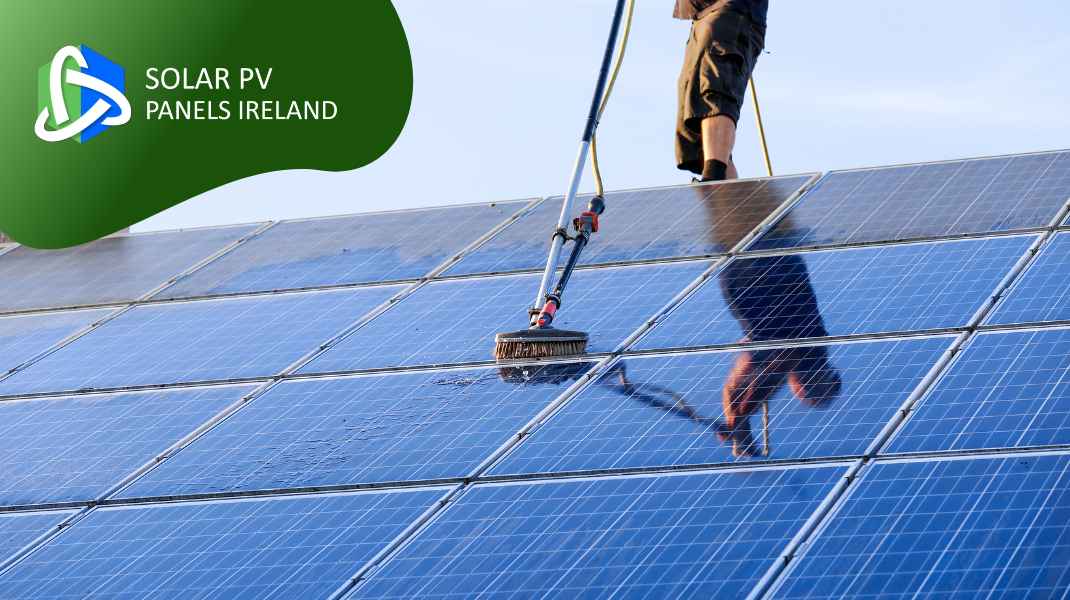
    1. Work from the Ground: Whenever possible, use telescopic poles and long-reach brushes so you can stay on the ground.
    2. Avoid Roof Climbing: Roofs are incredibly slippery when wet. Unless you have professional scaffolding, harnesses, and fall-protection equipment, do not walk on your roof.
    3. Electrical Safety: Never touch the underside of the panels or mess with the wiring. Solar panels carry a live DC current whenever there is light hitting them.
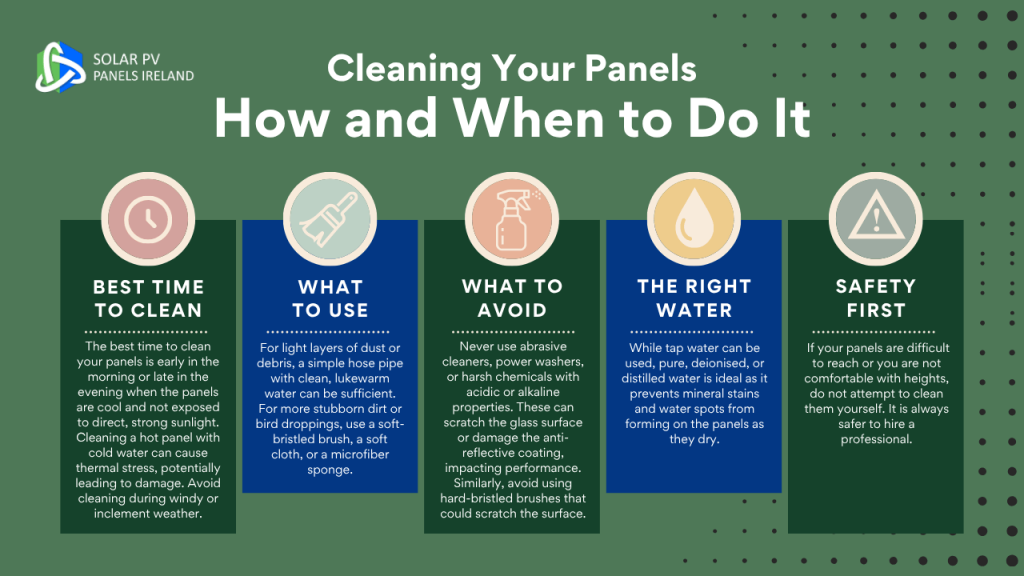
    4. Temperature: Never pour cold water on panels that have been sitting in direct, hot sun. The thermal shock could crack the glass. Clean them early in the morning or late in the evening.

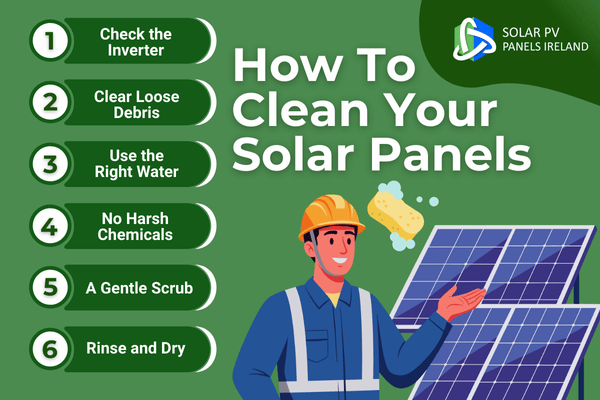
    Step-by-Step Guide: How to Clean Your Solar Panels
    If your panels are accessible and you’ve decided to tackle the job yourself, follow these steps to ensure you don’t damage the equipment.

    Step 1: Check the Inverter

    Before you start, check your solar monitoring app or inverter. If your production looks normal, you might only need a light rinse. If there’s a noticeable dip, you’re looking for specific obstructions.

    Step 2: Clear Loose Debris

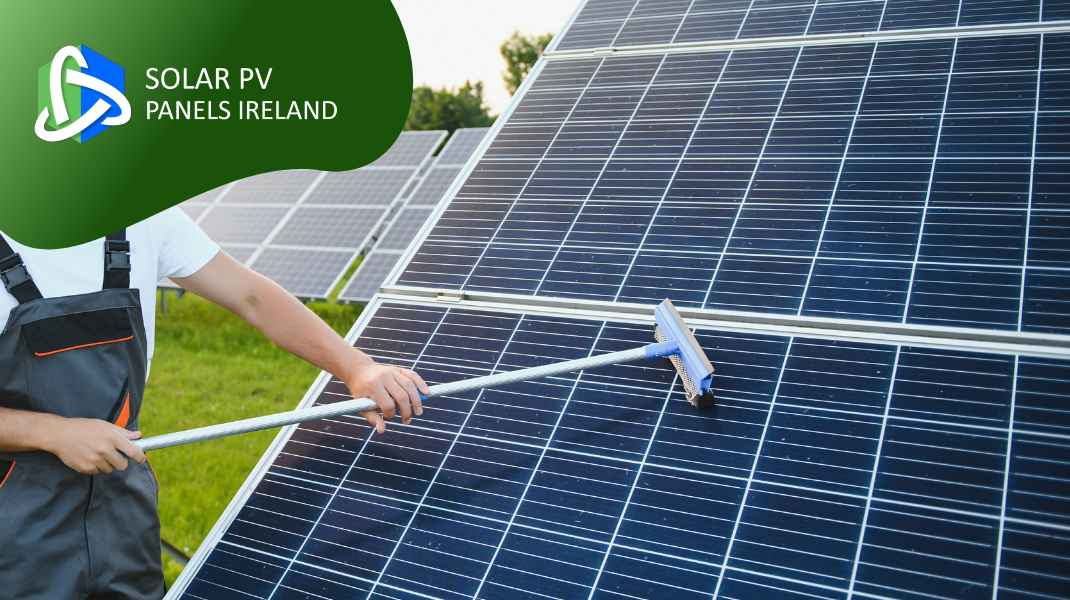
    Using a soft-bristled brush on an extension pole, gently brush away any loose leaves, twigs, or dry dust. Do not use a leaf blower, as it can blast grit into the gaps between panels.

    Step 3: Use the Right Water

    Here is a “pro tip” for Ireland: Avoid using tap water if you have “hard” water. Many parts of Ireland have high lime content in the water. When tap water evaporates on the glass, it leaves behind white calcium deposits (limescale) which can be harder to remove than the original dirt. If possible, use harvested rainwater or deionised water. If you must use a hose, try to wipe the panels dry afterwards to prevent spotting.

    Step 4: No Harsh Chemicals

    Never use abrasive sponges, steel wool, or harsh household detergents like bleach or window cleaners. These can scratch the anti-reflective coating on the glass. A bucket of lukewarm water mixed with a tiny amount of mild, eco-friendly dish soap is all you need.

    Step 5: The Gentle Scrub

    Soak a soft cloth or a dedicated solar cleaning brush (which usually has soft nylon bristles) and gently wipe the surface. For stubborn bird droppings, let the water soak into it for a few minutes to soften it before wiping.

    Step 6: Rinse and Dry

    Rinse the panels thoroughly with a low-pressure hose. Do not use a power washer. The high pressure can damage the seals around the glass or force water into the electrical junction boxes. If you can reach them safely, use a squeegee to prevent streaks.

    When to Call the Professionals

    While DIY cleaning is possible for bungalows or panels mounted on the ground, most Irish homes feature panels on two-storey roofs or steep pitches.

    In these cases, we strongly recommend hiring a professional solar service. Here’s why:

    • Deionised Water Systems: Professionals use “reach and wash” systems that use 100% pure deionised water. This absorbs dirt more effectively and dries completely streak-free without the need for chemicals.
    • Specialised Equipment: They have the correct brushes and ultra-lightweight poles designed specifically for PV glass.
    • Insurance and Safety: They are trained to work at heights and carry the necessary insurance, giving you peace of mind.
    • Lichen Removal: Lichen can “root” into the crevices of a panel. Professionals have the tools to remove this without scratching the glass.

    Common Mistakes to Avoid
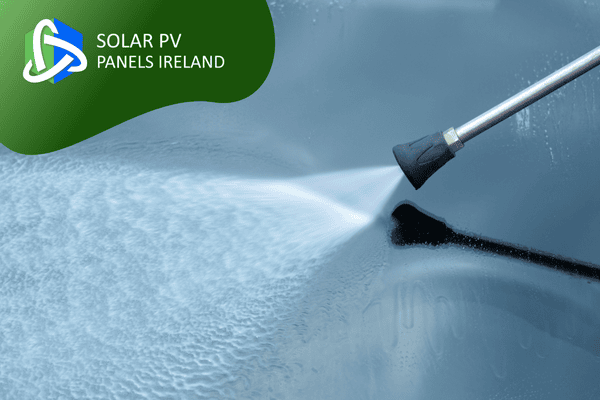
    • Using a Pressure Washer: We cannot stress this enough, the pressure can cause “micro-cracks” in the silicon cells that you can’t see with the naked eye but will kill the panel’s performance.
    • Cleaning in Midday Sun: The water evaporates too quickly, leaving streaks, and the risk of glass breakage due to temperature change is real.
    • Using Metal Tools: Never use a metal scraper or blade to remove bird droppings. One scratch can significantly impact the panel’s ability to capture light.
    • Ignoring the Gutters: While you’re cleaning the panels, dirt and moss will wash down into your gutters. Make sure to clear your gutters afterward to prevent blockages and damp issues.

    Monitoring

    Modern solar systems from Solar PV Panels Ireland come with fantastic monitoring software. This is your best tool for maintenance.

    By checking once a week, you’ll start to recognise your home’s energy production. If you notice that on a perfectly sunny Tuesday, you’re producing 15% less than you did on a similar Tuesday last month, it’s a clear signal that your panels need a wash or there is an obstruction.

    Keep Them Clean

    Cleaning your solar panels in Ireland isn’t a task that needs to be done every week, but it shouldn’t be ignored for years either. By keeping the glass clear of bird droppings, salt spray, and grime, you ensure that your system remains an asset rather than a liability.

    If you can reach your panels safely from the ground, a gentle wash with soft water and a mild soap twice a year is plenty. However, for most homeowners, a professional annual service is the safest and most effective way to protect your investment.

    Are you looking to install solar panels or need advice on your existing system? At Solar PV Panels Ireland, we are dedicated to helping Irish homeowners transition to clean, renewable energy. Contact us today for a free consultation or to learn more about how to get the most out of the Irish sun!
  • Do I Need Planning Permission for Solar Panels in Ireland?

    Do I Need Planning Permission for Solar Panels in Ireland?

    As solar panels become more affordable and popular, many homeowners, businesses, and farmers across Ireland ask: Do I need planning permission to install solar panels? The answer has changed recently, thanks to updates in Irish law. In most cases, you do not need planning permission, but there are exceptions. In this article, we’ll explain what’s allowed, what’s not, and how to check if your specific project needs planning approval.

    What changed in October 2022

    In October 2022, the Irish government introduced updated regulations on solar planning exemptions. These changes significantly reduced the restrictions on installing rooftop solar panels.

    Key updates include:

    • Houses: no longer limited in the area of rooftop solar panels; previous limits like “12 m² or 50% of roof” have been removed.
    • All rooftop solar systems: are largely exempt from planning permission under the new rules.
    • The introduction of Solar Safeguarding Zones (SSZs) where special rules can apply, particularly around airports, helipads, aerodromes etc.

    These changes aim to encourage solar adoption, reduce red tape, and help Ireland meet its renewable energy and climate goals.

    What you can do without planning permission

    Under current rules, many installations qualify for exemption from planning permission. Here are the main cases:

    SituationWhat is exempt / allowed without planning permission
    Rooftop solar on houses/domestic propertiesYou can install unlimited rooftop solar panels on domestic properties without planning permission. The old limits (- e.g. 12 m² or 50% of roof area) are removed.
    Businesses, industrial premises, farms etc. (roofs)Rooftop solar installations are also typically exempt. However, in certain zones (see SSZs) there may be area restrictions.
    Freestanding/ground-mounted solar panelsFor houses, small ground-mounted (freestanding) solar panels are exempt if they meet size, height, and open-space conditions. For other types of buildings, somewhat larger ground-mounted systems may also be exempt depending on location.

    Solar Safeguarding Zones (SSZs)

    Even with the more relaxed rules, Solar Safeguarding Zones remain an important exception. These are areas surrounding – for example – airports, helipads, aerodromes, where glint and glare from large solar installations could interfere with aviation safety. 

    What you should know:

    • If your roof is in an SSZ, rooftop solar panels are still exempt in many cases, but there is a limit of 300 m² for rooftop solar on any building in an SSZ without planning permission.
    • For buildings outside SSZs, roofing installations are generally unrestricted in area under the exemption.

    You can check whether your property is in an SSZ using mapping tools like MyPlan.ie or by contacting your Local Planning Authority.

    Special cases where planning permission is required

    There are situations where planning permission (or other consents) will still be needed. Some key scenarios include:

    1. Protected structures or conservation areas
      If your home or building is a protected structure, or located in an Architectural Conservation Area (ACA), then installing solar panels may need planning permission or special heritage/architectural permission because of visual impact, or statutory protections.
    2. Large / atypical scale installations
      For very large rooftop arrays or ground-mounted systems, particularly in SSZs or on large non-domestic buildings, the exemption may not apply if size or scale exceeds certain thresholds.
    3. Freestanding solar panels that are large or in visible locations
      If free-standing solar panels exceed height or area limits, particularly if they are visible from roads, public spaces, or affect the character of the area, planning permission may be required.
    4. Wind/solar hybrids or special installations near airports
      The SSZ rules were designed for aviation safety, so anything that might produce glare/glint that could impact aircraft may be scrutinised. If you anticipate your installation might do so, you’ll want to check with the relevant planning authority.

    How to check whether you need planning permission

    Before you proceed with installation, here are steps you should take:

    1. Check if your property is a protected structure / in a conservation / heritage area
      Contact your Local Planning Authority, or check the Register of Protected Structures and whether your local area has designated Architectural Conservation Areas.
    2. Check whether you’re in a Solar Safeguarding Zone (SSZ)
      Use tools like MyPlan.ie or local authority maps to see if your building lies in an SSZ around an airport, aerodrome, or helipad. If yes, find the SSZ-map and see whether the 300 m² rooftop limit or other restrictions apply.
    3. Determine what type of installation: rooftop vs ground-mounted / freestanding
      Rooftop installations are more often exempt than ground-mounted ones. If considering ground-mounted, check height, area, visibility, and whether you’re reducing private open space below required minimum.
    4. Check roof installation positioning rules (if any still apply)
      While many of the older spacing rules (from edge of roof, ridge etc.) have been eased or removed in many cases, some local authorities may still have guidelines or conditions around how panels are mounted (for example, distance from roof edges, margins for ridge etc.).
    5. Speak to a professional / installer
      Installers often know local rules, or have done similar work. They can advise whether your particular installation will need planning permission, and may assist with submitting any necessary applications. If in doubt, better to check upfront.

    Benefits of the new exemption rules

    The updated solar planning exemptions offer several advantages:

    • Reduced cost and time: No need to apply for planning permission saves fees, paperwork, and waiting time.
    • Greater flexibility: You can cover more of your roof with panels; roofs may be fully used for solar without worrying about exceeding previous limits.
    • Encourages adoption: Fewer bureaucratic barriers make solar more accessible, helping homeowners, businesses, and farmers to switch to renewable energy more readily.

    Things still to consider even if you don’t need planning permission

    Even where planning permission is not required, other rules matter:

    • Building Regulations: Solar installations must still comply with all relevant building regulations (structural loads, safety, electrical connections).
    • Grid connection / ESB Networks: If you plan to connect back to the grid (exporting excess electricity), you’ll need to ensure compliance with the grid operator’s rules.
    • Grants / SEAI conditions: If applying for grants, ensure that your installation meets the SEAI’s eligibility criteria (certified installers, approved equipment, etc.).
    • Visual / aesthetic concerns: Even where not legally required, local rules or planning-authority preferences may affect your design if your home is very visible, in an architectural area, or neighbours are sensitive.

    FAQs

    Q: Can I install solar panels covering my entire roof now?

    A: Yes, for most residential properties, you can fully cover your roof with solar panels without planning permission, under the 2022 exemption rules.

    Q: What about solar panels on commercial or farm buildings?

    A: Rooftop panels on non-residential buildings are also generally exempt. However, in Solar Safeguarding Zones, or for very large arrays, there may be area limits or special conditions. Ground-mounted panels tend to have stricter conditions.

    Q: Are the rules different for freestanding (ground-mounted) solar panels?

    A: Yes. For houses, small freestanding solar panels are exempt, but only if they stay under certain height, size, and do not reduce private open space below standard minimums. Large freestanding systems or very visible ones may need permission.

    Q: If I live near an airport or aerodrome, do I need planning permission?

    A: Possibly. If your property is in a Solar Safeguarding Zone, rooftop solar panels are still exempt up to 300 m² per building. If your project is larger than that, or you are doing a ground-mounted approach, planning permission may be required.

    Q: My house is in a conservation area or is a protected structure. What now?

    A: You will likely need planning permission or specific heritage consents. The visual impact, architectural character, and statutory protection pave the way for stricter controls. Consult your Local Planning Authority.

    Steps to go ahead (if you’re ready)

    If after reading this you believe your solar panel installation is exempt (or may be), here’s a checklist to follow:

    1. Confirm whether your property is a protected structure / in a conservation area / in SSZ.
    2. Get your roof surveyed for suitability (orientation, shading, structural strength).
    3. Choose a reputable, SEAI-registered or certified solar installer.
    4. Gather documentation: panel specs, structural design, electrical safety plans.
    5. If you’re applying for grants (SEAI etc.), ensure all grant requirements are satisfied.
    6. Arrange grid-connection if needed.
    7. Install, get any inspections or approvals required by building regulations or utility connections.

    Summary

    • No, in most cases in Ireland today, you do not need planning permission to install solar panels on your roof, whether for domestic homes, commercial buildings, or farms.
    • The October 2022 exemptions lifted many of the old limits (e.g. size/area) and simplified the rules significantly.
    • Exceptions still apply: protected structures, conservation areas, SSZs, very large installations, visible ground-mounted systems, etc.
    • It’s always safest to double-check with your Local Planning Authority, especially if doubts remain.

    If you’re considering solar panels, SolarPVPanelsIreland.ie can help you assess whether you’ll need permission, what kind of system fits your needs, and manage all the regulatory or technical steps. Contact us for a free assessment tailored to your property.

  • Are Solar PV Panels Suitable for the Irish Weather?

    Are Solar PV Panels Suitable for the Irish Weather?

    The question is perhaps the single most common one for Irish homeowners considering the switch to renewable energy: “Are solar panels suitable for Irish weather?”

    It’s an understandable concern. When most people imagine solar energy, they picture sun-drenched rooftops in the Mediterranean or California, not the often-grey, damp skies that characterise Ireland. The perception is that our famously changeable and often overcast climate must make the tech ineffective.

    Yet, this idea is a myth that is being debunked across thousands of Irish homes. The short answer is: Yes, solar PV panels are not just suitable for Irish weather, they are highly effective and are revolutionising the way Irish households power their homes.

    Ireland’s commitment to tackling climate change, coupled with the rising cost of electricity, has led to an unprecedented surge in solar installations. Modern Photovoltaic (PV) technology is specifically engineered to thrive in conditions other than direct sunshine. This guide, brought to you by the experts at Solar PV Panels Ireland, will cut through the misconceptions, explain the science and show you exactly why now is the perfect time to invest in solar power for your Irish home.

    Is Sunshine Necessary, or is Daylight Enough?

    The biggest misconception about solar panels stems from a misunderstanding of how they actually generate electricity. Many people assume solar panels require direct, blazing sunlight to work. If this were true, solar wouldn’t be viable in countries like Germany, which has a similar solar resource to Ireland yet is a global leader in solar adoption.

    Differentiating Direct Sun and Diffuse Light

    The key scientific fact to understand is that solar panels generate electricity from irradiance, which is the total amount of solar energy that reaches them. This energy comes in two main forms:

    1. Direct Irradiance: Sunlight that hits the panel straight-on (when it’s a clear, sunny day).
    2. Diffuse Irradiance: Sunlight that is scattered or reflected by clouds, atmospheric particles, or the surrounding environment (i.e., on a cloudy or overcast day).

    A standard solar PV panel is engineered to capture both types of light. Even when heavy clouds blanket the sky, a significant amount of diffuse light still penetrates the atmosphere. While output is naturally higher on a bright, sunny day, modern solar cells are highly efficient at converting this diffuse light into usable electricity.

    Ireland’s Solar Resource – The Surprising Truth

    When measured in terms of annual solar irradiance (specifically, the amount of energy that falls on a square metre, measured in kWh/m²), Ireland’s resource is surprisingly strong.

    • A typical house in the Southeast of Ireland receives around 1,050 kWh per square metre per year on a tilted surface.
    • A house in the Northwest receives approximately 950 kWh per square metre per year.

    For context, this is more than enough to achieve significant, year-round energy savings. Our resource is comparable to major cities in central Europe, which have highly successful and mature solar markets. The high latitude does mean shorter daylight hours in winter, but this is offset by extremely long daylight hours in summer, sometimes lasting up to 17 hours, when the system generates its peak power.

    Crucially, modern solar technology, especially the high-efficiency monocrystalline panels supplied by Solar PV Panels Ireland, is specifically designed to maximise power generation from the lower light levels common on overcast days.

    Understanding Ireland’s Climate and Solar Performance

    Instead of being a hindrance, several characteristics of the Irish climate actually make it an ideal environment for optimal solar panel efficiency.

    Temperature and Efficiency: The Sweet Spot

    Contrary to popular belief, solar panels do not like excessive heat.

    A common industry standard is that the efficiency of a typical silicon PV panel begins to drop by about 0.35% to 0.5% for every degree Celsius the panel surface temperature rises above 25°C. In hot countries, panels can easily reach 60°C or even 70°C, causing a substantial loss of efficiency.

    Ireland’s typically moderate, cool, and temperate climate is a massive advantage. Our average ambient temperatures, even during peak summer, ensure that the panels operate closer to their optimal performance temperature. The cooler air helps keep the panel temperature down, meaning the panels can convert solar energy to electricity much more effectively than those sweating on a scorching roof in Southern Spain. Ireland offers the perfect balance of sufficient light without the detrimental heat.

    The Cloud Factor: Diffuse Light and Optimal Angle

    We’ve established that diffuse light works. The key is understanding how technology has adapted:

    • Modern PERC/Half-Cut Cells: Advanced panels use technologies like Passivated Emitter and Rear Cell (PERC) and half-cut cells. These designs capture a wider spectrum of light and dramatically improve performance under low-light and shaded conditions, meaning even a partially overcast sky is still a productive environment.
    • Optimisation Technology: The use of power optimisers or micro-inverters, which we detail further below, ensures that if one panel is temporarily shaded by a passing cloud or chimney, it does not drag down the performance of the entire system.

    Rainfall and Self-Cleaning

    Ireland’s frequent, though often light, rainfall is another beneficial factor. Rain acts as a natural, free cleaning agent, washing away dust, pollen, and other environmental debris (such as moss spores or bird droppings) that can accumulate on the panel surface.

    Accumulated dirt can significantly reduce a panel’s efficiency, sometimes by as much as 10% or more. The regular rinsing provided by our climate ensures that panels in Ireland typically maintain a higher baseline efficiency throughout the year compared to systems in dry, dusty climates that require manual or robotic cleaning.

    Maximising Solar Panel Efficiency in Ireland: Technology and Design

    For homeowners in Ireland, suitability is not just about the weather, it’s about choosing the right technology and installation design to match the environment. A bespoke, expertly installed system will guarantee peak performance under Irish conditions.

    The Importance of High-Quality Components

    When investing in solar, the choice of equipment is paramount. Solar PV Panels Ireland exclusively recommends high-tier, durable components built to withstand the specific rigours of the Irish climate.

    1. Monocrystalline Panels: These are the industry gold standard. They are more efficient than older polycrystalline panels and perform much better in low-light conditions, a crucial factor for capturing maximum energy from diffuse light on cloudy days.
    2. Weather Resistance: All panels installed in Ireland must meet stringent quality and durability standards, ensuring they are certified to withstand the wind loads, frost, and high moisture levels characteristic of our Atlantic climate. Long-term warranties (often 25 years on performance) reflect the confidence in their ability to endure.

    Inverters, Optimisers, and Micro-Inverters

    The inverter is the “brain” of your solar system, converting the DC power generated by the panels into the AC power usable in your home. For Ireland, sophisticated power electronics are a necessity:

    • Micro-Inverters & Power Optimisers: These devices attach to individual panels. If part of your roof experiences occasional shading (due to a chimney, satellite dish, or cloud cover), these devices isolate the affected panel, ensuring the rest of the array continues to operate at maximum efficiency. Given the variable nature of Irish weather and the potential for shading, we highly recommend this technology to ensure your system performs optimally throughout the year.

    Optimal Panel Tilt and Orientation

    While a south-facing roof is the absolute ideal, generating the most energy per panel, the experts at Solar PV Panels Ireland know that not every roof is perfect.

    • South: Best for maximum annual yield, concentrating generation around the middle of the day.
    • East/West Split: For homes with East and West-facing roofs, installing an East/West split system can be a superior choice. While the overall peak generation might be slightly lower, it spreads the generation across the day, perfectly aligning with a typical household’s energy usage: morning power for breakfast/showers (East) and evening power for cooking/laundry (West). This dramatically increases the percentage of solar electricity you self-consume, which is the fastest way to achieve your return on investment (ROI).
    • Optimal Tilt: For an Irish latitude, the optimal annual tilt angle is typically between 30 and 35 degrees. Our surveyors ensure the mounting system is engineered to maximise the capture of solar energy based on your roof pitch and location.

    The Crucial Role of Battery Storage Solutions

    Solar panels in Ireland generate the most electricity during the long summer days, often at times when the home is unoccupied. The most effective way to turn a solar investment into a financial powerhouse in Ireland is to pair it with a home battery storage system.

    The battery stores the surplus energy generated during the day, allowing you to use it at night or on a very cloudy day. This allows you to maximise your self-consumption, using the energy you generate, which is far more valuable than exporting it to the grid. An integrated PV and battery system is the ultimate solution for energy independence in Ireland, ensuring energy availability regardless of hourly weather fluctuations.

    The Financial Case for Solar PV in Ireland

    The technical suitability of solar panels is only half the story. The other, equally compelling half is the financial viability, which has never been stronger in Ireland.

    Government Support: The SEAI Grant Scheme

    The Government, through the Sustainable Energy Authority of Ireland (SEAI), has provided substantial financial incentives to encourage solar adoption.

    • Solar PV Grants: SEAI offers generous, tax-free grants to homeowners toward the cost of installing solar PV systems. These grants significantly reduce the upfront capital expenditure, making the switch affordable for the majority of homeowners.
    • Grant Management: Navigating the SEAI application process, paperwork, and technical requirements can be complex. As part of our comprehensive service, Solar PV Panels Ireland handles the entire grant application process for you, ensuring your system meets all criteria and that you receive your full entitlement with minimal hassle.

    Exporting Excess Power: The Clean Export Guarantee (CEG)

    Ireland has implemented the Clean Export Guarantee (CEG), requiring electricity suppliers to compensate micro-generators (like homeowners with solar PV) for any surplus electricity they export back to the national grid.

    While the rate you get for exporting is less than the rate you pay for importing, it provides a crucial third pillar of the solar financial model:

    1. Avoided Cost: The primary saving, by using your own power instead of buying it.
    2. Grant Funding: The reduction in upfront cost.
    3. Export Revenue: Getting paid for any unused excess energy.

    This government-mandated payment for surplus energy guarantees a faster Return on Investment (ROI) for Irish solar PV systems.

    Long-Term Savings and ROI

    With Ireland facing consistently high electricity prices, the long-term savings delivered by a solar PV system are immense. A well-designed system can immediately slash a home’s annual electricity bill by 50% to 70% (or more when paired with a battery).

    Factoring in the SEAI grant, the ROI period for a typical Irish installation is now significantly shorter, often achieving full payback in as little as 5 to 8 years. Considering the expected operational lifespan of a high-quality solar system is 25 years or more, the remaining two decades provide pure, tax-free energy savings and protection against future energy price hikes.

    Why Choose Solar PV Panels Ireland?

    Choosing a solar installer in Ireland means choosing a partner who understands the local climate, the specific building regulations, and the intricacies of the SEAI grant scheme. This is where Solar PV Panels Ireland delivers unparalleled value.

    Local Expertise, Tailored Solutions

    We are a 100% Irish company focused specifically on delivering the highest-performing solar PV solutions for Irish homes and businesses. Our core service is not simply selling panels; it is about providing a bespoke energy strategy.

    Our comprehensive service includes:

    • Detailed Site Surveys: We use advanced software to calculate exact irradiance levels for your specific rooftop angle and location, accurately forecasting your annual energy generation under Irish weather conditions.
    • Highest Quality Components: We source only Tier 1, low-light-optimised panels, premium inverters, and reliable battery storage systems, all backed by industry-leading warranties and designed to withstand the Irish climate.
    • End-to-End Installation & Grant Management: From the initial consultation and detailed design to the final, certified installation and full management of your SEAI grant application, we handle every step.

    Our deep understanding of Irish building standards and electrical regulations ensures your installation is not only compliant but built for maximum, year-round efficiency. We are dedicated to ensuring that your investment delivers the quickest possible return while providing maximum energy independence.

    Solar is a Certainty in Irish Weather

    The narrative is clear: Solar panels are not just suitable for Irish weather, they are an exceptional investment because of it.

    The combination of the Irish climate’s cool operating temperatures, which boosts efficiency, and the ample diffuse light available throughout the year, creates a highly productive environment for modern PV technology. When you couple this technical suitability with the robust financial support offered by the SEAI and the certainty of payment through the CEG scheme, the decision becomes a compelling one for every homeowner across the country.

    Forget the misconception that Ireland is too cloudy or too wet. Instead, focus on the reality: your roof is an untapped power station, ready to deliver clean, cheap, and reliable energy for decades.

    If you are ready to secure your home’s energy future, reduce your carbon footprint, and start saving significantly on your electricity bills, trust the local experts.

    Contact Solar PV Panels Ireland today for a free, no-obligation survey and quotation. Let us design a high-performance system perfectly tailored to your home and the unique conditions of the Irish sky. The future of Irish home energy is bright, and it starts on your roof.

  • How Can Solar Panels Improve My BER Rating in Ireland?

    How Can Solar Panels Improve My BER Rating in Ireland?

    Are you an Irish homeowner feeling the chill of rising energy bills? Are you looking for ways to make your home warmer, more affordable to run, and more valuable? If so, you’ve almost certainly heard about the Building Energy Rating, or BER.

    That A-to-G letter on your BER certificate has become one of the most important metrics in Irish property. It’s not just a label; it’s a direct reflection of your home’s efficiency, comfort, and running costs. A low rating (like an F or G) means your home is leaking heat and money. A high rating (like an A or B) means you have an efficient, comfortable, and highly desirable property.

    The big question for many is: how do I improve my rating?

    You can add insulation, upgrade windows, or install a new boiler. These are all valid steps. But one of the most powerful, effective, and future-proof upgrades you can make is installing solar photovoltaic (PV) panels.

    This article will explore exactly what a BER rating is, why it’s so crucial, and how installing Solar PV Panels is perfect for the job of dramatically boosting your home’s score and increasing your property’s value.

    What is a BER Rating and Why Does it Matter?

    Before we dive into the solution, let’s make sure we understand the challenge. What exactly is a BER certificate, and why should you care?

    Decoding Your BER Certificate

    A Building Energy Rating (BER) is an official rating of your home’s energy efficiency. It’s managed by the Sustainable Energy Authority of Ireland (SEAI) and is a legal requirement if you are selling or renting a property.

    Think of it like the energy label on your fridge or washing machine, but for your entire house. The scale runs from A1 (best) down to G (worst).

    • A-rated homes are the most energy-efficient. They are well-insulated, airtight, and often feature advanced heating systems and renewable technology. They have the lowest energy bills.
    • G-rated homes are the least energy-efficient. They are typically poorly insulated, draughty, and have old, inefficient heating systems. They cost a fortune to heat and are uncomfortable to live in.

    A BER certificate is valid for 10 years and must be carried out by a registered SEAI BER Assessor. This assessor inspects your home’s insulation, windows, doors, heating systems, hot water, ventilation and any renewable energy sources to calculate your final score.

    The “Why”: More Than Just a Letter on a Page

    why is your ber important

    A decade ago, a BER rating might have been seen as just another piece of paperwork. Today, it’s a critical factor for any savvy homeowner. Here’s why it matters so much:

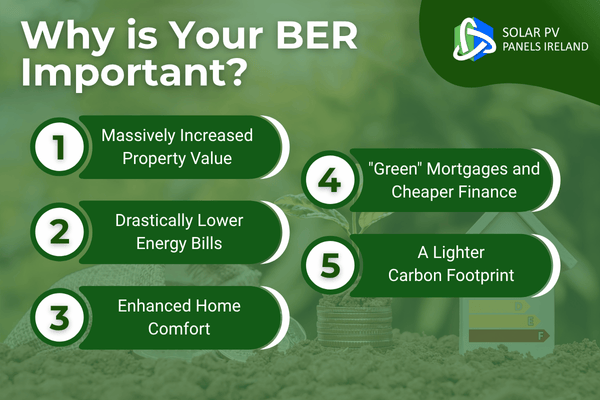
    1. Massively Increased Property Value: This is the big one. Irish buyers are now highly educated about BER ratings. Properties with higher BER ratings, tend to to command higher sale prices. Moving from a G-rating to an A-rating could add tens of thousands of euros to your home’s value. Buyers see an A-rating and know they are buying a high-quality, low-running-cost home.
    2. Drastically Lower Energy Bills: This is the benefit you feel every month. A more energy-efficient home requires less fuel (oil, gas, or electricity) to keep it warm. An A-rated home can cost 80-90% less to heat than an equivalent G-rated home. In an era of volatile energy prices.
    3. Enhanced Home Comfort: A good BER rating isn’t just about money; it’s about comfort. A-rated homes are warmer in winter and cooler in summer. They are free from the cold draughts, damp spots, and condensation that plague inefficient properties.
    4. Access to “Green” Mortgages and Cheaper Finance: Many Irish banks now offer “green mortgages” or better interest rates for customers who are buying or renovating a home to a B-rating or higher. A better BER can literally make your mortgage cheaper.
    5. A Lighter Carbon Footprint: For the environmentally conscious homeowner, improving your BER is one of the single biggest things you can do to reduce your personal carbon footprint. An efficient home uses less fossil fuel, which means fewer CO2 emissions.

    The BER Calculation: A Quick Look Under the Hood

    To understand how solar panels improve your BER, you first need to understand how the rating is calculated.

    Your BER Assessor doesn’t just guess. They input all the data about your home, insulation levels, window types, boiler efficiency, etc., into something called the Dwelling Energy Assessment Procedure (DEAP).

    This calculates your home’s Primary Energy Requirement. This is a measure of the total energy needed to run your home for a year. Crucially, this includes the energy used at the power station to generate your electricity. Because of energy loss during generation and transmission, for every 1 unit of electricity you use from the grid, the DEAP counts it as roughly 2 units of primary energy.

    Your home’s final BER grade is based on this primary energy score. To improve your rating, you must reduce your home’s Primary Energy Requirement.

    You can do this in two ways:

    1. Reduce Demand: Use less energy. This is what insulation, airtightness, and new windows do. They reduce the amount of heat your home needs.
    2. Generate Your Own (Clean) Energy: This is where solar PV comes in.

    Solar PV Panels: The BER-Booster

    This brings us to the hero of the story. While insulation is essential (and you should absolutely have it), installing solar PV panels is one of the most significant single “leaps” you can make to your BER score.

    How Solar PV Directly Impacts the DEAP Calculation

    Remember how the DEAP penalises you for using grid electricity? Well, it massively rewards you for generating your own.

    When you install a solar PV system from Solar PV Panels Ireland, you are placing a mini power-plant on your own roof. Every single kilowatt-hour (kWh) of clean electricity your panels generate is a kWh you don’t have to import from the grid.

    The DEAP sees this on-site generation and subtracts it from your home’s total energy demand. This has a dramatic and immediate impact on your Primary Energy Requirement, slashing the final number and propelling your home up the BER scale.

    It’s not uncommon for a solar PV installation to improve a home’s rating by a full grade or more (e.g., from a C to a B, or a B to an A) all on its own. It directly addresses the “Primary Energy” part of the calculation in a way few other technologies can.

    Solar PV vs. Other Upgrades

    Think of your BER improvement journey like this:

    • Insulation & Windows (The Fabric): These are reductive upgrades. They stop heat from leaving. This is your home’s defensive line. It’s vital, but you can only insulate a wall once.
    • Solar PV (The Generator): This is an additive upgrade. It adds clean energy into your home’s energy equation. It’s your home’s offensive line, actively winning you points on the BER scorecard.

    For many homes sitting on a C or D rating, the “fabric” might already be quite good. It could cost thousands to gain a few extra points from specialist insulation. A solar PV system, by contrast, can be a more cost-effective upgrade that tips you over the line into a coveted B or A rating.

    The Ripple Effect: Beyond the BER Score

    The impact of a solar PV system goes far beyond the letter on your certificate. It creates a positive ripple effect that transforms your home and your finances.

    • Slash Your Bills: This is the most immediate win. By using the free electricity you generate, your daytime energy costs can drop to zero.
    • Get Paid for Your Power: Thanks to the Clean Export Guarantee (CEG) scheme, any surplus electricity you generate and don’t use is automatically sold back to the grid. You get paid for your contribution!
    • Future-Proof Your Home: Solar PV is the foundation of a modern, smart home. It’s the perfect partner for:
      • Electric Vehicles (EVs): Imagine charging your car with free sunshine from your roof.
      • Battery Storage: Add a battery to your solar system to store your daytime energy and use it at night, becoming almost fully independent from the grid.
      • Heat Pumps: Air-source heat pumps are incredibly efficient, but they run on electricity. Powering your heat pump with your own solar panels is the ultimate combination for a low-cost, A-rated home.

    The Process: From Consultation to A-Rating

    So, how do you get started? A proper BER improvement plan is a journey, but it’s a straightforward one.

    Step 1: Get Your Baseline – The Initial BER Assessment

    First, you need to know where you stand. Before starting any work, we strongly recommend getting a professional, independent assessment from a registered SEAI assessor.

    For a thorough and reliable report, we recommend Greenwise Energy. Their team of expert assessors will give you a detailed report showing exactly where you stand and what your home’s potential is. This baseline report is your starting map.

    Step 2: The Solar PV Panels Ireland Consultation

    This is where we come in. Once you have your BER report, Solar PV Panels Ireland will analyse your report, discuss your goals (Are you aiming for an A2? A B1?), and assess your roof’s orientation and size.

    We will then design a bespoke solar PV system, complete with optional battery storage, that is perfectly sized to meet your ambitions and your budget. We’ll show you the projected energy savings and the expected impact on your BER.

    Step 3: Flawless, Professional Installation Our teams of SEAI-registered installers will handle the entire installation. It’s a clean, fast and safe process, usually completed in just a day or two. We only use the highest-quality Tier 1 panels and components, ensuring your system performs flawlessly for decades.

    Step 4: The Final BER Assessment (The Reward!) After our installation is complete, you’ll have your BER assessor return. They will conduct a new assessment, factoring in your brand-new solar PV system. This is the exciting part, witnessing your BER rating jump, often by several grades and receiving that coveted A or B certificate.

    Don’t Forget the SEAI Grants

    The good news gets even better. The SEAI offers significant grants to help homeowners invest in their home’s energy future. There are grants available for solar PV, insulation, heat pumps and more.

    As an approved SEAI installer, Solar PV Panels Ireland can guide you through the entire grant application process. We’ll help you understand what you’re eligible for and ensure all the paperwork is handled correctly, making your journey to an A-rating even more affordable.

    Your Journey to an A-Rated Home Starts Today

    Improving your home’s BER rating is no longer a luxury, it’s one of the wisest financial and environmental decisions an Irish homeowner can make. It’s a direct investment in your property’s value, your personal comfort and your financial security.

    While many upgrades offer small, incremental gains, installing a solar PV system is a game-changer. It fundamentally changes your home’s relationship with energy, turning it from a passive consumer into a smart, active producer.

    Ready to transform your home’s energy future?

    Contact Solar PV Panels Ireland today for a free, no-obligation consultation. Let’s analyse your home and design the perfect solar system to get you on the path to an A-rating.

    And don’t forget to book your initial assessment with the experts at Greenwise Energy to find out exactly where your journey begins. A warmer, cheaper and more valuable home is closer than you think.

  • How Solar PV Contributes to Ireland’s 2030 Climate Action Plan Goals

    How Solar PV Contributes to Ireland’s 2030 Climate Action Plan Goals

    The clock is ticking. By the year 2030, Ireland has committed to one of the most ambitious climate transformations in Europe: cutting our national greenhouse gas emissions by a legally binding 51%. This isn’t just a political goal; it’s a national mission that will fundamentally change how we live, travel, and, most importantly, how we power our homes and businesses.

    The engine room of this entire plan is our electricity grid. To slash national emissions, we must almost entirely decarbonise the way we generate power. That’s where Solar PV steps in.

    Once considered a niche or ‘future’ technology, solar photovoltaic (PV) panels have become a central pillar of the Government’s 2030 Climate Action Plan Goals. Far from being a luxury, installing solar panels is now a direct and essential contribution to national energy independence and environmental security.

    The Non-Negotiable Targets – 80% Renewable, 8 GW Solar

    Ireland’s ultimate climate challenge lies in transitioning our electricity system from one heavily reliant on imported fossil fuels to one dominated by clean, domestic power.

    The headline goal is clear: to generate up to 80% of our electricity from renewable sources by 2030.

    This target is a big leap. Today, we stand at around 40% renewable electricity. To bridge that gap, we need monumental investment across all clean energy sectors, but the most striking ambition belongs to solar.

    The Climate Action Plan dictates a massive ramp-up in Solar PV capacity to 8 Gigawatts (8 GW) by 2030. For context, just a few years ago, this figure was viewed as unachievable. It requires us to build the energy equivalent of a large conventional power station, purely from the sun, every single year between now and the deadline.

    This 8 GW is split between two main types of installation:

    1. Utility-Scale Solar Farms: Large ground-mounted arrays connected directly to the high-voltage national grid.
    2. Non-Utility (Distributed) Solar: Rooftop installations on homes, farms, schools, and commercial buildings. Crucially, the plan calls for 2.5 GW of this capacity to come from these distributed, small-scale sources.

    If you have a roof, you can have a role in hitting this target, which is roughly equivalent to installing half a million domestic solar panels Ireland-wide.

    Solar PV – The Swift Solution for Decarbonising the Grid

    While wind power is the backbone of Ireland’s renewable energy system, solar PV offers unique benefits that are vital for achieving the 2030 targets quickly and efficiently:

    Solar panels are most efficient at converting sunlight to electricity when they are cool. As their temperature rises, their efficiency slightly decreases. The relatively mild, temperate climate of Ireland, with average temperatures rarely soaring above 20°C, is a significant advantage. It allows the solar panels to operate at or near their optimal efficiency throughout the year, preventing the power losses associated with extreme heat.

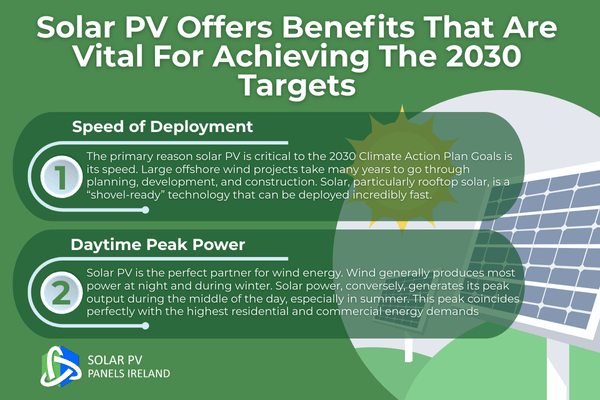
    1. Speed of Deployment (The Race Against Time)

    The primary reason solar PV is critical to the 2030 Climate Action Plan Goals is its speed. Large offshore wind projects take many years to go through planning, development, and construction. Solar, particularly rooftop solar, is a “shovel-ready” technology that can be deployed incredibly fast.

    A single home installation takes a day or two. A commercial rooftop can be completed in weeks. This ability to deploy megawatts of clean power today, without years of planning battles, makes it the fastest way to add new, zero-carbon capacity to the grid and reduce reliance on fossil fuels.

    2. Daytime Peak Power

    Solar PV is the perfect partner for wind energy. Wind generally produces the most power at night and during winter. Solar power, conversely, generates its peak output during the middle of the day, especially in summer. This peak coincides perfectly with the highest residential and commercial energy demands (when kettles, washing machines, and office air conditioning units are running).

    By flooding the grid with clean solar electricity during the day, we reduce the need to fire up expensive, polluting gas power plants, which is the single most effective step we can take to achieve substantial emissions reduction in the electricity sector.

    Empowering the People – The Microgeneration Revolution

    The push for solar is about more than just numbers on a grid; it’s about empowering every citizen and business to become a local power producer, creating a system known as distributed generation.

    For homeowners and businesses, the government has put forward powerful incentives to make this happen, turning a climate responsibility into a sound financial investment:

    • SEAI Grants and Zero VAT: Generous SEAI grants significantly reduce the upfront cost of residential solar PV systems. Furthermore, the removal of VAT on domestic installations makes the decision even more attractive, ensuring that climate action is affordable for more families.
    • The Clean Export Guarantee (CEG) Tariff: This is the game-changer. For the first time, homeowners are guaranteed a payment for any excess electricity they export back into the national grid. This turns your solar system from a simple cost-saver into a revenue generator, effectively making every home with panels a small, independent power station supporting the national grid.
    • Energy Security and Independence: Global events have highlighted the risk of relying on imported fossil fuels. Every home that installs Solar PV systems in Ireland is helping the country achieve greater energy independence, insulating us from volatile international energy prices while simultaneously strengthening our national grid.

    This movement has already resulted in significant progress, with Ireland recently hitting the major 1 GW rooftop solar milestone. This achievement, driven by individual action, proves that the public is ready to embrace its role in the transition.

    The Economic and Environmental Co-Benefits

    Meeting the 8 GW target delivers far more than just reduced emissions. The massive investment required in this sector creates significant positive ripple effects across the Irish economy, leading to both financial and environmental rewards.

    Economic Benefits

    If Ireland meets its 2030 targets, the solar industry could contribute over €2.3 billion in Gross Value Added (GVA) to the Irish economy between now and 2030. More importantly for local communities, the sector is projected to create jobs nationwide in manufacturing, installation, maintenance, and related services. This means that embracing solar PV is a powerful engine for green job creation and regional economic growth, securing a sustainable future for Irish workers.

    Environmental and Societal Impact

    • Air Quality: By displacing fossil fuel generation, solar power reduces the pollutants that lead to smog and respiratory illnesses, directly improving public health.
    • Decentralisation: Distributed generation (rooftop solar) reduces the burden on the national transmission infrastructure. Power is generated right where it is consumed, leading to fewer network losses and greater local grid resilience.
    • Future-Proofing: Solar PV systems are often installed alongside battery storage, turning intermittent sunlight into reliable, dispatch-able power. This technology is vital for preparing the grid for the higher demands of electric vehicles and heat pumps, two other key pillars of the Climate Action Plan.

    Your Part in the 2030 Vision

    Ireland’s 2030 climate challenge is formidable, but achieving it is possible. The goal of cutting emissions by 51% and achieving 80% renewable electricity hinges on a massive deployment of solar technology.

    Solar PV is not just an energy solution; it’s a national delivery mechanism for climate action. It offers the speed, the capacity, and the community involvement necessary to meet the ambitious 8 GW solar target.

    Every single solar panel installed in Ireland, whether on a large solar farm or your own roof, is a tangible step toward a cleaner, more secure future. By investing in solar panels now, you are not only taking control of your household or business energy costs, but you are also actively participating in one of the most important national infrastructure projects of the decade. The future of Irish energy is bright, and it’s powered by the sun. Get in touch with Solar PV Panels Ireland today!

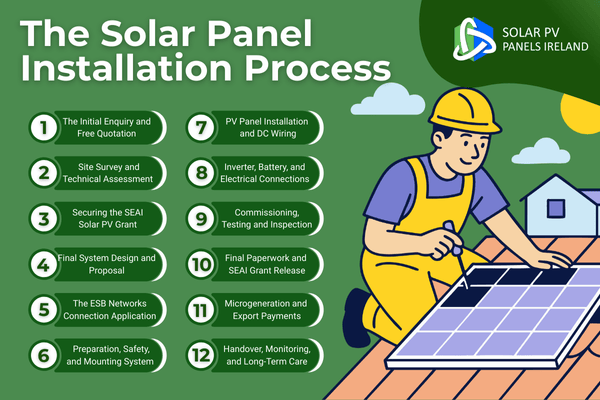
  • The Solar Panel Installation Process: Step By Step Guide

    The Solar Panel Installation Process: Step By Step Guide

    Ready to Ditch the High Bills? Your Journey to Solar Starts Here!

    Despite the occasional gloomy day, solar energy is proving to be one of the smartest investments Irish homeowners can make. It’s a game-changer, slashing those eye-watering electricity bills and dramatically shrinking your carbon footprint.

    If you’re reading this, you’ve probably already made the decision to go green and save money, which is brilliant. However, you might also be feeling a bit overwhelmed by what happens next. The thought of scaffolding, paperwork, and technical jargon can put anyone off. Trust us, it’s far simpler than you think!

    The solar panel installation process, when managed by professionals, is remarkably smooth and efficient. It’s a structured journey from initial chat to flicking the switch on your own clean, renewable power source.

    Here at Solar PV Panels Ireland, we’ve perfected the process to make it as hassle-free as possible for you. By the end of this guide, you’ll know exactly what to expect when you take the leap into solar PV.

    The Solar Panel Installation Process

    Phase 1: Getting the Ball Rolling – Initial Assessment and Design

    The first phase is all about gathering information, understanding your needs, and ensuring your property is perfectly suited for a solar PV system. This foundational stage ensures the final installation is as efficient and cost-effective as possible.

    Step 1: The Initial Enquiry and Free Quotation

    It usually begins with a simple phone call or a submission on our company’s website. You’ll provide some basic details about your home, such as your electricity usage (often found on your bill), the size and type of your roof, and whether you’re interested in a battery storage system.

    Step 2: The Detailed Site Survey and Technical Assessment

    Once you’re happy with the estimate, the next step is a deep dive, the site survey. This is essential for turning a theoretical design into a practical one. One of our engineers will visit your home, usually taking no more than an hour or two, to perform a meticulous check of your roof and electrical setup.

    What they look for:

    • Roof Integrity and Pitch: They confirm the structural suitability of your roof, checking the material (slate, tile, metal, etc.) and the angle (pitch).
    • Orientation and Shading: This is crucial. While south-facing roofs are ideal, panels facing east and west can also be highly efficient, generating power earlier and later in the day. The engineer will meticulously check for anything that casts a shadow, such as chimneys, neighbouring trees, or adjacent buildings, as even a small shadow can significantly impact a panel’s output.
    • Electrical Setup: They examine your existing consumer unit (fuse box) to determine the best place to install the inverter and how to connect the new PV system safely.

    This survey finalises the perfect layout and system size, guaranteeing that your solar panel installation is tailored specifically for your home and lifestyle. It’s the difference between a decent system and a top-performing one.

    Phase 2: The Paper Trail – Securing Funding and Grid Approval

    The second phase is often the one that scares people the most, but this is where an experienced installer truly earns their stripes. In Ireland, there are specific hoops you need to jump through to secure grants and legally connect to the grid, but your chosen installer handles most of the work.

    Step 3: Securing the SEAI Solar PV Grant

    The Sustainable Energy Authority of Ireland (SEAI) offers a fantastic grant to help reduce the cost of your solar PV system. Currently, homeowners can receive up to €1,800 (or more, depending on the most recent scheme updates) towards their installation, which makes going solar more affordable than ever.

    Crucial Point: You must apply for and receive your Letter of Offer for the SEAI grant before any physical work starts on your property. This is non-negotiable!

    Your solar PV installer will guide you through this application, ensuring all the necessary technical details are included. Once the SEAI approves your application, you receive the grant offer, and only then can we officially schedule the installation.

    Step 4: Final System Design and Proposal

    With the site survey complete and the grant confirmed, we present the final, fully engineered design. This isn’t just a layout; it’s a technical blueprint detailing:

    • The exact number and type of solar panels.
    • The model and specification of the inverter.
    • The inclusion of a diverter (which sends excess energy to heat your water tank) and/or a battery storage unit.
    • The expected increase in your Building Energy Rating (BER) after installation.

    This is the contract stage, and once signed, it gives us the go-ahead to order the components and book a date for the physical installation, which is arguably the most exciting part!

    Step 5: The ESB Networks Connection Application (The NC6)

    Because your solar PV panels will not only power your home but also send any excess power back into the national grid (a process known as microgeneration), you need permission from the Distribution System Operator, which is ESB Networks.

    For most domestic installations (which fall under the Micro-Generation category, typically up to 6kVA for single-phase systems), your installer handles this by submitting the NC6 Notification Form. This step is vital for ensuring grid safety and, crucially, for getting paid for the energy you export. The ESB needs to approve the connection before commissioning. 

    Phase 3: Installation Day – The Physical Transformation

    This is the day the real change happens! A well-organised installation team will usually complete a standard residential solar panel installation in just one or two days, depending on the system complexity (e.g., adding a battery or working on a particularly challenging roof).

    Step 6: Preparation, Safety, and Mounting System Installation

    Safety comes first. The day begins with the safe erection of scaffolding or the use of appropriate safety access equipment. The team will then start work on the roof itself.

    • Marking and Measuring: The installation team marks out the precise location of the array according to the approved design.
    • Fixing the Brackets: Specialist brackets, designed specifically for your roof type (tile, slate, etc.), are securely fixed to the roof rafters. This is where quality materials matter, these brackets need to stand up to the Irish weather for decades.
    • Installing the Rails: Long aluminium rails are then attached to the brackets. These rails are the framework upon which your new panels will sit.

    Step 7: The PV Panel Installation and DC Wiring

    With the mounting frame securely in place, the team cracks on with installing the solar PV panels. Each panel is carefully lifted onto the roof, positioned, and clamped securely to the rails. They are then linked together in strings using weather-proof DC (Direct Current) cables.

    The wires are neatly run down through the roof space, usually through a strategically placed access point, and routed towards the planned location of the inverter, which is often in an attic, garage, or utility room. Minimal disruption inside the house is the goal here!

    Step 8: Inverter, Battery, and Electrical Connections

    While the roof team is busy installing the panels, a certified electrician on the ground is working on the internal components:

    1. Inverter Installation: The heart of the system, the inverter, is mounted in its permanent spot. The DC cables from the panels are connected to it.
    2. AC Connection: The inverter is then connected to your home’s main consumer unit (fuse box) via a new AC (Alternating Current) circuit breaker, ensuring the power generated is safe and compatible with your appliances.
    3. Battery Storage (If Applicable): If you opted for a solar battery, it is installed, often near the inverter. This system manages when to store excess power and when to release it.
    4. Immersion Diverter (If Applicable): A clever little device that detects surplus energy and redirects it to your immersion heater, effectively giving you ‘free’ hot water, a brilliant feature for any Irish home!

    Step 9: Commissioning, Testing, and Inspection

    Before the team packs up, rigorous testing must take place. The entire system is commissioned, which involves:

    • Checking all electrical connections and continuity.
    • Testing the system to ensure the inverter is operating correctly and safely converting power.
    • Verifying that the anti-islanding protection (a safety feature required by ESB Networks) is fully operational.
    • Measuring the actual output of the system to ensure it matches the design specifications.

    Only once these tests are passed and the Safe Electric Ireland standards are met is the system ready to go.

    Phase 4: Flipping the Switch – Post-Installation Life and Maintenance

    The installation is physically complete, but there are a few final, administrative steps that turn your solar panels from a rooftop fixture into a functioning, income-generating asset.

    Step 10: Final Paperwork and SEAI Grant Release

    With the installation signed off, your installer has to prove to the authorities that the work was done correctly. This involves submitting several crucial documents:

    • Declaration of Works: A formal statement confirming the installation was completed to the highest standards and grant specifications.
    • Completion of NC6: The installer sends the final completion certificate to ESB Networks.
    • Post-Works BER Assessment: You must have a new Building Energy Rating (BER) assessment completed. This assessment confirms your home’s energy efficiency improvement, which is a requirement for the SEAI grant.

    Once these documents (including the new BER) are submitted to the SEAI, the grant payment is typically processed and sent directly to you, the homeowner.

    Step 11: Activating Microgeneration and Export Payments

    After ESB Networks accepts the final paperwork, they officially register your Microgenerator on the grid. Crucially, they may also need to install or activate a smart meter if you don’t already have one that can measure exported power.

    Once the ESB connection is finalised, you can then set up an arrangement with your electricity supplier to avail of the Clean Export Guarantee (CEG) tariff. This is where you get paid for every unit of surplus electricity your panels send back to the grid, money straight back into your pocket! This is a pivotal step that transforms your PV system from just a cost-saver into a revenue generator.

    Step 12: Handover, Monitoring, and Long-Term Care

    The final step is the comprehensive handover. Your installer will walk you through your brand-new system, showing you how to monitor its performance. Most modern systems come with an app that allows you to track generation, consumption, battery levels, and exports in real-time. This is essential for maximising your usage and ensuring everything is running smoothly.

    A quality system requires very little maintenance, often just a yearly visual check, but it’s comforting to know who to call if you ever have a question.

    The Future is Bright

    From the first assessment of your roof’s orientation to the final sign-off with ESB Networks, an approved, reliable installer manages the entire process for you. Your job is simply to enjoy the incredible benefits, watching your electricity meter spin backwards, knowing you’re protected from rising energy prices and contributing to Ireland’s collective commitment to renewable energy.

    This installation is more than just a home improvement; it’s an investment in a cleaner planet and a green future. The typical process, including the grant and connection approvals, usually takes a few weeks from the initial deposit to final commissioning, but the installation itself is quick, clean, and highly professional.

    If you’re ready to join the thousands of Irish homeowners already benefiting from solar energy, don’t delay. Start your journey today!

  • Can You Sell Electricity Back to the Grid in Ireland?

    Can You Sell Electricity Back to the Grid in Ireland?

    Yes, you can sell electricity back to the grid in Ireland. This practice, known as microgeneration, is a key part of the country’s strategy to increase renewable energy. It is officially supported by the government through the Microgeneration Support Scheme (MSS) and the Clean Export Guarantee (CEG).

    The Rise of Microgeneration in Ireland

    Microgeneration

    Ireland is committed to a greener future. We have a goal of having 70% of our electricity come from renewable sources by 2030. Microgeneration is the process of homes and businesses generating their own electricity from renewable sources like solar PV panels and selling the excess back to the national grid. It is a vital part of this plan.

    For homeowners, this means that your solar panels don’t just power your home during the day but they can also earn you money. Any electricity you generate but don’t use can be exported back to the grid. This helps to power other homes and businesses while providing you with a financial return. This has made solar PV a more attractive and financially viable option for many Irish homes.

    The Clean Export Guarantee (CEG)

    The Clean Export Guarantee (CEG) is a specific payment mechanism that ensures homeowners receive a good and fair price for the electricity they export to the grid. It mandates that electricity suppliers must pay a minimum rate for this exported energy. This provides a stable and predictable revenue stream for microgenerators.

    Different energy suppliers in Ireland offer varying buyback rates. Some offer competitive rates. For example, some rates can be as high as €0.25 per kilowatt-hour (kWh). Others may offer a lower rate. It is crucial for homeowners to shop around and choose an energy supplier that provides the best terms and rates for their exported electricity. This can make a significant difference in the total annual savings and earnings from a solar PV system.

    How to Sell Electricity Back to the Grid

    Sell Electricity Back to the Grid

    Selling electricity back to the grid is a straightforward process. But it does require a few key steps to ensure you are compliant and properly set up to receive payments.

    1. Install a Suitable System: You must have a renewable energy system like solar PV panels. They must meet safety and size standards. Your installer must be a registered professional, like those listed on the Sustainable Energy Authority of Ireland (SEAI) register.
    2. Get a Smart Meter: A smart meter is essential for microgeneration. It accurately measures the electricity you import from the grid and the excess electricity you export to it. This info is used by your energy supplier to calculate your payments. The ESB Networks which operates the national grid, is responsible for installing these meters.
    3. Register with the ESB Network: Your installer will typically handle the process of registering your solar PV system with the ESB Network. This is a crucial step that ensures your system is properly connected to the grid and ready for export.
    4. Choose an Energy Supplier: Select an electricity supplier that offers a competitive Clean Export Guarantee (CEG) tariff. Your supplier will manage the payments for your exported electricity.

    The Financial Benefits of Solar PV and Microgeneration

    The financial case for installing solar PV panels in Ireland is really strong now. The benefits come from two main sources:

    Direct Savings on Your Electricity Bill: By generating your own electricity, you lower the amount of power you need to purchase from the grid. A well-sized solar PV system can reduce a household’s electricity bill by up to 60% annually.

    Earnings from Exported Electricity: The revenue from selling your excess electricity back to the grid provides an additional financial incentive. A typical household with a solar panel system generating 5,500 kWh annually and using half of it could earn around €550 per year from exporting the remaining 2,750 kWh. Combined with the savings on your bill, the total annual financial benefit could exceed €1,150.

    The typical payback period for a solar PV system in Ireland is estimated to be between 5 to 7 years, making it a sound long-term investment.

    The Installation Process and Grant Support

    Installation Process

    The journey to microgeneration begins with the installation of a solar PV system. The process involves several key stages:

    1. Site Assessment and System Design: A qualified installer will assess your home’s roof orientation and energy needs. This will help them design a solar PV system tailored to your specific requirements. They will also provide a detailed quote.
    2. Grant Application: As an SEAI-registered installer, Solar PV Panels Ireland can help you with the grant application process. The Solar Electricity Grant from the SEAI can provide up to €1,800 for eligible homeowners. This significantly reduces the upfront cost of installation.
    3. Installation: The installation itself is typically completed within a few days. Sometimes in one day. It involves mounting the panels on the roof, installing the inverter to convert the solar energy into usable electricity and connecting the system to your home’s electrical supply.
    4. Grid Connection and Commissioning: Your installer will register the system with the ESB Network. They will ensure all necessary paperwork is completed. Once approved, your system can begin generating and exporting electricity.

    Additional Benefits of Going Solar

    Beyond the financial savings, installing solar PV panels in Ireland offers several other advantages:

    • Environmental Impact: By using clean, renewable energy, you significantly reduce your carbon footprint. You contribute to Ireland’s climate action goals.
    • Increased Home Value: Homes with solar PV systems are increasingly attractive to buyers. This can add to your property’s value.
    • Energy Independence: Generating your own power reduces your reliance on external energy suppliers. This protects you from future electricity price increases.
    • Integration with EV Chargers: For homeowners with electric vehicles, a solar PV system can be combined with an EV charger to power your car with clean, free energy. This further maximises your savings and environmental benefits.

    Navigating the Market: Choosing a Supplier and Installer

    joe reilly

    With the growing popularity of solar PV, the market has seen an increase in both installers and energy suppliers offering microgeneration tariffs.

    When choosing an installer, it is crucial to select an SEAI-registered company to ensure you are eligible for the grants. You also want to make sure that the installation meets the highest quality and safety standards. An experienced installer will guide you through the entire process. fThis starts with the grant application all the way to final commissioning.

    When choosing an energy supplier, compare the Clean Export Guarantee (CEG) rates they offer. Some suppliers might provide a higher rate for a fixed period. Some others might offer a more stable, long-term rate. Read the terms and conditions carefully to understand how and when you will be paid for your exported electricity.

    Common Questions About Selling Electricity Back to the Grid

    What is the difference between a feed-in tariff and the Clean Export Guarantee? The Clean Export Guarantee (CEG) is a specific payment under the Microgeneration Support Scheme (MSS) that replaced the older, less formalised feed-in tariffs. While the term “feed-in tariff” is sometimes still used, the CEG is the official and regulated mechanism for paying for exported electricity in Ireland.

    How is the amount of exported electricity measured? Your smart meter accurately measures both the electricity you import from the grid and the electricity you export to it. The readings from the smart meter are sent to your energy supplier. They then use this data to calculate your payments for exported energy and your bill for imported energy.

    Can I still get a solar grant if I plan to sell electricity back to the grid? Yes. The SEAI Solar Electricity Grant is designed to encourage solar PV installation. It is fully compatible with the Microgeneration Support Scheme. In fact, most systems installed with the grant are intended to be eligible for the CEG.

    Is it worth it to sell electricity back to the grid? Absolutely. The ability to earn money from your excess electricity and the significant savings on your energy bills, makes solar PV a really rewarding financial and environmental investment. It speeds up the payback period of your system and gives a long-term return.

    A Bright Future for Solar in Ireland

    The introduction of the Microgeneration Support Scheme and the Clean Export Guarantee has transformed the solar energy landscape in Ireland. It has made going solar a viable and financially attractive option for homeowners. It is paving the way for a more decentralised, sustainable,and renewable energy system.

    By installing solar PV panels, you are not only taking control of your energy costs and reducing your carbon footprint but also actively contributing to Ireland’s clean energy goals. With good grants, competitive buyback rates and experienced installers, there has never been a better time to invest in solar PV.

    For more information on solar PV panels and to get a quote for your home, contact Solar PV Panels Ireland today.

  • Tips For Solar Panel Maintenance in Ireland

    Tips For Solar Panel Maintenance in Ireland

    In the ever-evolving landscape of renewable energy, solar PV panels have emerged as a practical solution for homeowners and businesses across Ireland. As a nation increasingly committed to a sustainable future, more people are embracing solar technology to reduce their carbon footprint and save on energy bills. But like any valuable asset, a solar PV system requires proper care and attention. To ensure it operates at peak efficiency for its full lifespan. This guide by Solar PV Panels Ireland, provides essential tips for solar panel maintenance. We want to help you protect your investment and maximise your energy savings.

    Why Solar Panel Maintenance is Crucial in the Irish Climate

    solar panels

    Ireland’s climate, with its unique blend of rain, wind, and varying sunlight, presents specific challenges and considerations for solar panels. Even though solar panels are incredibly durable and designed to withstand harsh weather, they are not entirely maintenance-free. Dirt, dust, pollen, bird droppings and even salt from coastal air can accumulate on the panels. This creates a film that reduces their ability to absorb sunlight. This can lead to a significant drop in energy output. And can directly impacting your return on investment.

    A proactive approach to maintenance is not just about cleaning. It’s about a holistic strategy that ensures every component of your system is functioning as good as it can. Regular upkeep can prevent small issues from becoming costly repairs. Most importantly, it guarantees that you are generating the maximum amount of energy.

    The DIY Approach: Simple Maintenance You Can Do Yourself

    cleaning your panels

    While professional servicing is recommended, there are several simple maintenance tasks you can perform yourself to keep your solar panels in decent condition. These visual checks and cleaning routines are key to year-round care.

    1. Visual Inspections: The First Line of Defence

    Before you even think about cleaning, a thorough visual inspection is a must. It is advised to inspect your panels at least twice a year. Maybe  in the spring and autumn. From a safe distance on the ground, look for any visible signs of damage, such as:

    • Cracks or chips in the glass panels.
    • Discolouration or “snail trails” on the surface.
    • Loose or damaged mounting frames and connections.
    • Signs of pest infestation. Such as birds or squirrels nesting under the panels.

    If you spot any significant damage you should contact a professional immediately. Attempting to fix damaged panels yourself can be dangerous and may void your warranty.

    2. Cleaning Your Panels: How and When to Do It

    Cleaning your panels is perhaps the most important DIY maintenance task. The goal is to remove any debris that could be blocking sunlight. Here’s how to do it safely and effectively:

    Best Time to Clean: The best time to clean your panels is early in the morning or late in the evening. This is when the panels are cool and not exposed to direct, strong sunlight. Cleaning a hot panel with cold water can cause thermal stress. This potentially leading to damage. Avoid cleaning during windy or dodgey weather.

    What to Use: For light layers of dust or debris, a simple hose pipe with clean, lukewarm water can be good enough. For more stubborn dirt or bird droppings, use a soft-bristled brush. Or a soft cloth/ microfiber sponge.

    What to Avoid: Never use abrasive cleaners, power washers, or harsh chemicals with acidic or alkaline properties. These can scratch the glass surface or damage the anti-reflective coating. this would severely impact performance. Similarly, don’t use hard-bristled brushes that could scratch the surface.

    The Right Water: Tap water can be used. But pure, deionised, or distilled water is ideal as it prevents mineral stains and water spots from forming on the panels when they dry.

    Safety First: If your panels are difficult to reach or you are not comfortable with heights, don’t attempt to clean them yourself. It is always safer to hire a professional.

    3. Monitoring Your System’s Performance

    Most modern solar PV systems come with a monitoring app or a display that allows you to track their energy output. Make it a habit to check this system regularly. A sudden or gradual drop in performance could indicate an underlying issue. This could be a faulty connection, a problem with the inverter, or a build-up of dirt. Early detection of such issues can save you significant time and money.

    The Role of Professional Servicing

    Professional Servicing

    While DIY maintenance is helpful, it is no substitute for a professional service. A certified solar technician has the tools and expertise to perform a deep-dive inspection of your entire system.

    1. Why You Need Professional Servicing

    • In-Depth Diagnostics: A professional service goes beyond a visual check. Technicians use special equipment to test the performance of individual panels. Also the inverter and all the electrical components.
    • Electrical Connections: They will check all wiring and connections for any signs of corrosion, loose fittings, or damage. Loose connections can lead to power loss. In rare cases, they can even pose a fire risk.
    • Inverter Health: The inverter is the heart of your solar PV system. It converts DC power from the panels into usable AC power for your home. Professionals can assess the health of the inverter and ensure it is working efficiently. Inverters typically have a lifespan of 10-15 years. They will eventually need to be replaced.
    • Mounting and Structural Integrity: A professional will inspect the integrity of the mounting system and the racking. This will ensure the panels are securely fastened to your roof and can withstand strong winds.

    2. How Often Should You Get a Professional Service?

    It is generally recommended to schedule a professional service every 3 to 5 years. This can vary based on the specific recommendations of your installer and the condition of your system. If you notice a significant drop in performance or suspect an issue, don’t wait for your scheduled service. Contact a professional immediately.

    The Solar PV Panels Ireland Maintenance and Service Offering

    joe reilly

    At Solar PV Panels Ireland, we believe that our relationship with our customers doesn’t end with the installation. We are committed to ensuring your solar PV system delivers maximum performance and savings for its entire lifespan. 

    That’s why we also provide comprehensive solar panel servicing. Our team of certified and experienced technicians can perform all the necessary checks and maintenance tasks. From good cleaning to detailed system diagnostics. We offer tailored service plans to suit your needs. This gives you peace of mind that your investment is in safe hands.

    We understand the unique challenges of the Irish climate and have the expertise to address them. Solar PV Panels Ireland is your trusted partner for all your solar needs. Whether you need a one-off service or a regular maintenance plan.

    Contact us today to learn more about our servicing options. Or book your professional maintenance check. By combining your proactive DIY care with our expert professional service, you can ensure your solar panels continues to save you money for a long time to come. 

  • Are Solar Batteries Worth the Investment for Your Home?

    Are Solar Batteries Worth the Investment for Your Home?

    The Ultimate Guide to Solar Batteries

    In an era of rising energy costs and growing environmental consciousness, more and more Irish homeowners are turning to solar photovoltaic (PV) panels to power their homes. Solar panels are a fantastic investment, converting Ireland’s daylight into clean, renewable electricity. But what happens to all that energy when the sun goes down or when your panels are generating more power than your home can use? This is where a solar battery becomes a game-changer.

    A solar battery storage system is a sophisticated piece of technology designed to capture and store excess solar energy. Instead of exporting your surplus electricity back to the grid for a minimal credit, you can save it for later use. For an Irish household, where energy consumption often peaks in the evening when we’re cooking, watching TV, and running appliances, a solar battery can significantly increase your self-sufficiency and reduce your reliance on the grid.

    This comprehensive guide will walk you through everything you need to know about solar batteries in Ireland, from how they work and their key benefits to the specific models available from Solar PV Panels Ireland and a detailed breakdown of whether the investment is truly worth it for you.

    How Solar Batteries Work and Why They are Essential for Irish Homes

    Solar panels generate direct current (DC) electricity from sunlight. This DC electricity is then fed into a solar inverter, which converts it into alternating current (AC) electricity that your home’s appliances can use.

    When you have a solar battery, the system becomes more intelligent. During the day, if your panels are producing more electricity than your home is consuming, the excess DC power is automatically diverted to your battery for storage. When the sun sets or on a particularly cloudy day, your home will then draw power from the battery instead of importing expensive electricity from the national grid.

    This seamless process allows you to maximise your self-consumption of the clean energy you generate. Without a battery, a typical Irish home might only use 30-40% of the solar energy it produces, with the rest being exported. By adding a battery, you can increase this self-consumption rate to 70-80% or even higher.

    The benefits of a solar battery for an Irish home are numerous and highly relevant to our climate and energy habits:

    • Maximise Your Savings: The primary financial benefit of a solar battery is the significant reduction in your electricity bills. By using your own free, stored solar power during peak evening hours, you avoid buying expensive electricity from the grid. While you can earn a Clean Export Guarantee (CEG) tariff for exporting power, the rate you receive is often lower than what you pay for grid electricity, making self-consumption the most cost-effective option.
    • Energy Independence and Grid Resilience: Having a solar battery gives you greater control over your energy supply. You become less vulnerable to fluctuations in grid electricity prices and potential power outages. In the event of a blackout, a well-designed solar battery system can provide backup power to keep essential appliances, such as your fridge, lights, and Wi-Fi, running.
    • Harnessing Low-Cost Energy: With a smart meter and a time-of-use tariff, you can program your battery to charge from the grid during off-peak, low-cost periods (like overnight) and then use that stored energy during the more expensive daytime or evening peak hours. This clever feature allows you to buy electricity when it’s cheapest and use it when it’s most expensive, further enhancing your savings.

    A Closer Look at the Solar Batteries from Solar PV Panels Ireland

    At Solar PV Panels Ireland, we understand that every home is unique. That’s why we offer a range of high-quality solar batteries designed to meet the diverse needs of Irish homeowners. Our selection includes industry-leading brands known for their reliability, performance, and advanced technology.

    1. Huawei LUNA Smart String Battery

    The Huawei LUNA is a modular, high-voltage battery system that offers exceptional flexibility and performance. It consists of a Power Module and can be expanded with 1 to 3 Battery Modules, allowing you to tailor the capacity to your specific energy needs. This scalability means you can start with a smaller system and add more storage later as your energy requirements evolve. The Huawei LUNA is widely regarded as one of the best on the market, built to withstand the harsh Irish climate. It has an impressive IP66 rating, meaning it is protected against powerful jets of water and dust, and can operate and even charge in temperatures as low as -25°C.

    1. Sigenergy Solar Battery System

    Sigenergy offers state-of-the-art battery systems that are packed with intelligence and safety features. The Sigenergy system is also IP66 rated, ensuring it is robust enough for outdoor installation. A standout feature is the inclusion of heating pads, which ensure optimal performance in low temperatures. Sigenergy also integrates advanced AI features that learn your household’s energy usage patterns. This allows the system to intelligently manage charging and discharging cycles to maximise efficiency and savings. For added peace of mind, it comes with a self-extinguishing fire suppression system.

    1. Duracell Dura 5+ Solar Battery

    For those looking for a reliable, low-voltage solution, the Duracell Dura 5+ is an excellent choice. It’s a popular option for pairing with Solis inverters and is known for its dependable performance. Like the other models we sell, it holds an IP66 rating, making it a safe and durable choice for your home. The Duracell Dura 5+ is offered in 5kWh modules, providing a solid foundation for most household energy storage needs.

    Are Solar Batteries Worth the Investment? A Financial Breakdown

    This is the big question for many homeowners. While the benefits are clear, the initial investment can be a consideration. As of now, there is no specific SEAI grant for solar batteries alone. However, the government’s removal of VAT on solar PV installations (as of May 2023) has made the entire system, including the battery, a more affordable proposition.

    The cost of a solar battery system typically ranges from €1,700 to €3,000 for a 5kWh battery, with larger systems costing more. This is an additional cost on top of the solar panel installation, which can range from €6,000 to €8,700 for a typical home after the SEAI grant.

    So, how do you determine if the investment is worth it for you?

    Factors to Consider:

    • Your Energy Usage Patterns: A battery is most beneficial for homeowners who are not at home during the day and consume most of their electricity in the evening. If you are home during the day and can shift your electricity usage to align with solar production (e.g., running the washing machine, dishwasher, or tumble dryer while the sun is shining), a battery may be less critical. However, a battery provides maximum flexibility.
    • Payback Period and ROI: The payback period for a solar system with a battery is generally slightly longer than a system without one, but the long-term savings are often greater. While a solar PV system alone might have a payback period of 5-7 years, adding a battery can extend this. However, it significantly increases your annual savings by reducing your reliance on expensive evening grid power. A well-sized system can save you hundreds of euros per year on your electricity bills, making the battery a sound long-term investment.
    • Energy Independence and Environmental Goals: For many, the decision goes beyond a simple financial calculation. The desire for energy independence, peace of mind during power outages, and a commitment to reducing their carbon footprint are significant drivers. Solar batteries are a key part of creating a truly sustainable and self-sufficient home.

    Sizing Your Solar Battery System

    Choosing the right size battery is crucial for maximising its value. The capacity is measured in kilowatt-hours (kWh). A typical Irish household uses around 11.5 kWh per day.

    • For most homes: A 5-7 kWh battery is a great starting point, as it can usually cover a significant portion of your evening and overnight energy usage.
    • For larger homes or high-energy users: If you have an electric vehicle, a heat pump, or a particularly high electricity demand, a 10 kWh battery or a modular system like the Huawei LUNA that can be expanded is likely a better fit.

    It’s important to consult with a professional installer like Solar PV Panels Ireland to assess your specific energy habits and recommend the right size and type of battery for your home.

    A Smart Step Towards a Smarter Home

    The question “Are solar batteries worth the investment for your Irish home?” has a resounding answer for most: Yes. While it represents an additional upfront cost, a solar battery system is a strategic investment in your home’s long-term energy security and financial well-being. It transforms your solar PV system from a daytime-only asset into a powerful, round-the-clock energy solution.

    By storing your own free, clean electricity, you gain freedom from volatile energy prices, a reliable source of backup power, and the satisfaction of knowing you’re making a significant contribution to a greener future. With the right system, such as the advanced options from Huawei, Sigenergy, and Duracell, you can take control of your energy, significantly reduce your bills, and future-proof your home for decades to come.